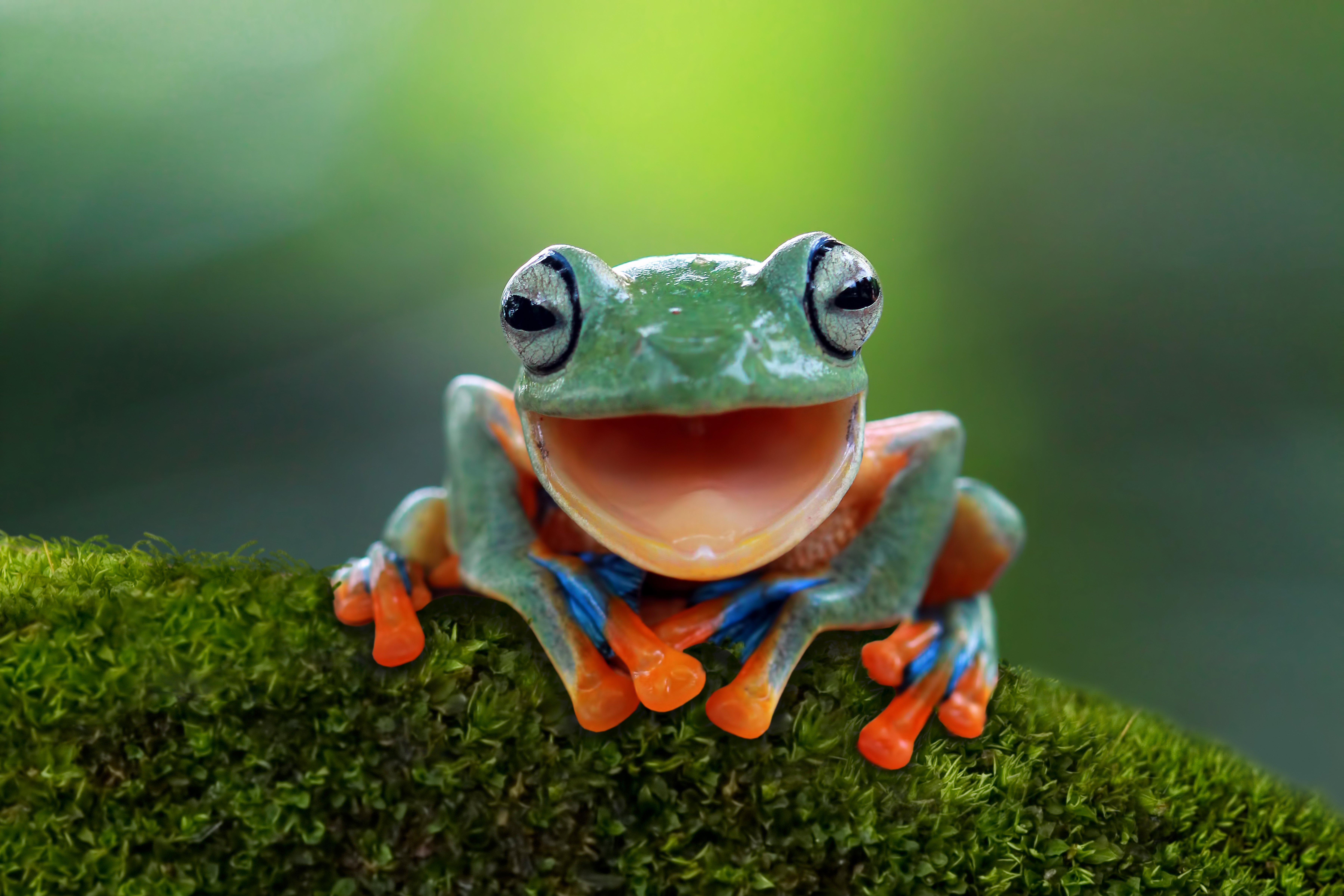
Most frogs have a visible ear drum on each side of their head. It sends sound waves to the frog's inner ear and protects it from dirt and water. It's also one way of telling male frogs apart from female ones. Girl frogs have an ear drum that is smaller than their eye.
You can identify frog species by listening to their call. These calls can differ from one region to another, just like human accents. From high-pitched whistles, to a "ca-ha-ha" cackle, or a rattling snore, male frogs sing to warn others of predators, and defend their territory.
Most frogs only have teeth on their upper jaw, which they use to hold onto their prey until they decide to eat it.
And they literally eat in the blink of an eye. When a frog swallows its prey, it blinks and pushes its eyeballs down into its sockets. This presses down on the top of the frog's mouth, and helps push the food into its throat!
Frogs don't need to drink water because they absorb it through an area on their skin called the "drinking patch". It is on their belly.
Keeping diseases away
Some frogs, like the poison dart frog, give off poisons so strong that even one touch can be deadly.
These cold-blooded animals hibernate in the winter as they cannot make their own body heat, and you can tell the number of times a frog has done this. Frog bones form a new ring every year, just like trees do. Scientists can count the rings to find out how old a frog was.
Finally, frogs play an important role in the ecosystem. Tadpoles eat algae and keep our rivers clean. Adult frogs eat insects, such as grasshoppers, flies and mosquitoes, and help to keep diseases such as malaria and dengue fever away.
Here are some amphibians you can find in Hong Kong:
Asian common toad
This is the most common amphibian in Hong Kong. Its call sounds like an old-fashioned telephone. This chubby fellow has a hidden talent – it's really good at climbing trees. It makes a milky poison that kills predators.
Green cascade frog Photo: SCMP
Commonly seen in Tai Po Kau, Tai Mo Shan, and parts of Hong Kong Island, this little frog is not one to mess with. Just like its brown cousin, the green cascade frog produces a milky poison to protect itself. It's also known to kill other frogs.
Asiatic painted frog
You can recognise it by the orange markings on its back. This medium-sized frog mostly lives in forests and near ponds. When disturbed, it will blow up its body and release a sticky white substance from its skin.
Giant spiny frog
The largest frog in Hong Kong, the male giant spiny frog has short spines on its chest and fingers. Often found resting on rocks in streams, it enjoys snacking on freshwater crabs and insects.
Hong Kong newt
The only amphibian in Hong Kong with a tail, the Hong Kong newt can be found at Tai Mo Shan and Shing Mun the New Territories, Tai Tam on Hong Kong Island, and Lantau Island.
Fun facts
Frogs lay their eggs in water. The eggs hatch into tadpoles, which live in water until they change into adult frogs. Frogs use their long, sticky tongues to catch and swallow food.
Quick questions
- How does the Asian common toad defend itself?
- Are frogs cold-blooded or warm-blooded?
- Which places in the New Territories are mentioned in the story?