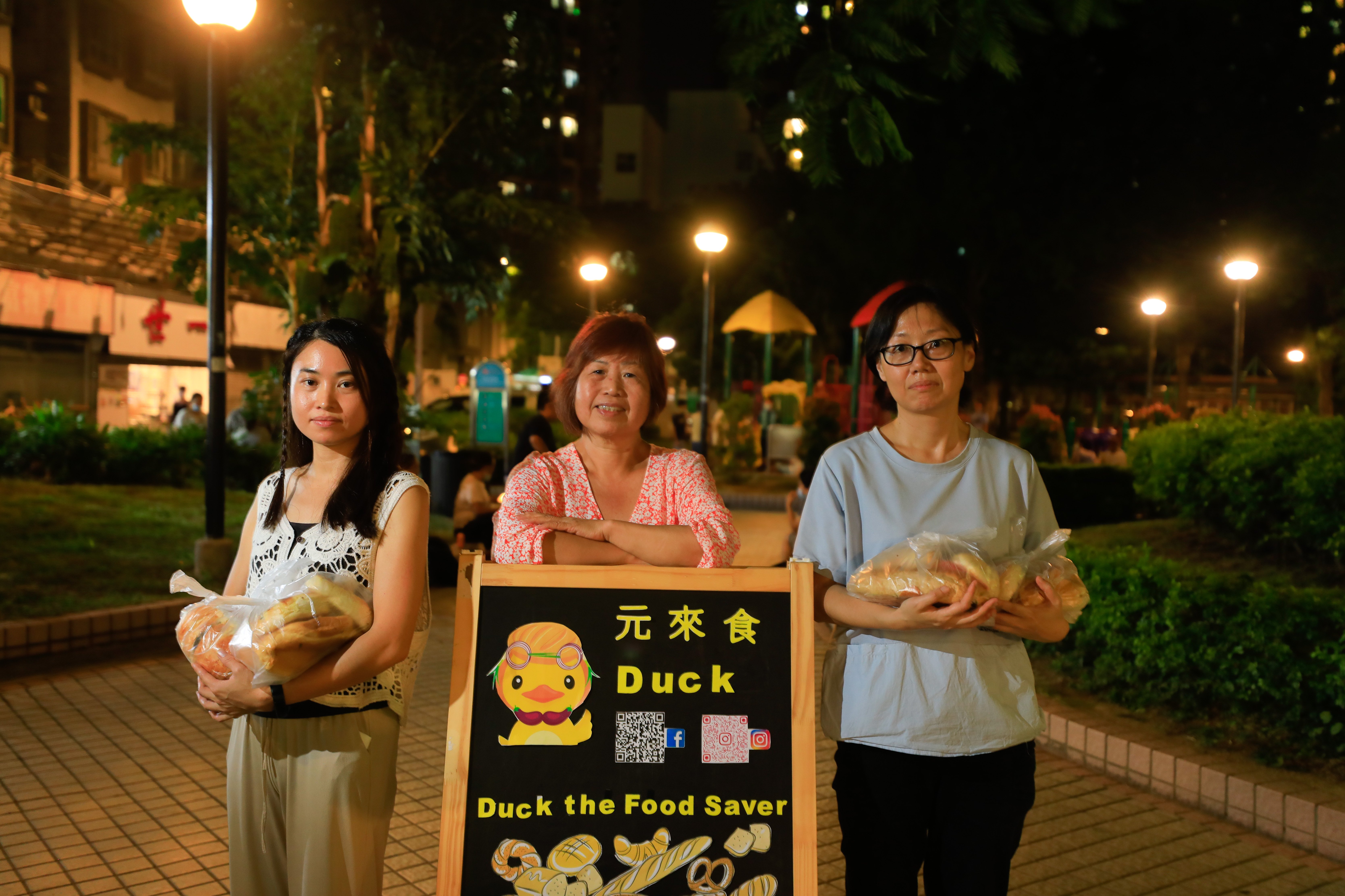
In a busy park in Yuen Long, volunteers take baked goods from bags on their shoulders and hand them to street cleaners, homeless people and elderly cardboard collectors.
"Some grannies told me the bread serves as breakfast for them and their grandchildren, which helps relieve their family's burden," says Shadow Cheung, one of the volunteers.
The group, called 'Duck the Food Saver', meets three times a week to collect surplus bread from bakeries and take it to those in need. On a usual night, they collect up to 450 surplus baked goods.
Each bag contains different items, such as pineapple buns, garlic bread, cocktail buns and egg tarts.
At 7.30pm every Monday, Thursday and Saturday, a gazebo in Chun Yin Square is the meeting place for the bread group and the community. Children, domestic workers and street cleaners line up to collect bread.
Afterwards, the group goes to deliver food to people who could not collect it at the park. As they receive the bread, the elderly have big smiles.

Tonnes of waste
Every day in Hong Kong, more than 3,000 tonnes of food waste is sent to landfills – the same weight as 226 double-decker buses. To tackle this issue, four citizens from Yuen Long and Ap Lei Chau started Duck the Food Saver last September. Because bread lasts longer than fruit or vegetables, they decided to ask bakeries for help.
"The bakeries said they would throw away the surplus bread if no one collected it," says Amy Lai, the Thursday organiser. One bakery that agreed to help was Hi-Ten Cake Shop, owned by Chak Kin-fat.
"You can see bakeries dumping bread every night. It is a disgrace," says Chak. "I appreciate the volunteers who come to pick up the surplus bread for the community."
He also likes to bake cakes for the elderly on their birthdays. "When it comes to the elderly and the volunteers, there's no talk about profits," he says.

Lots of supporters
The group now has about 40 volunteers. On the Mid-Autumn Festival, they collected mooncakes and took them to elderly people in the district. Among the volunteers that day was Boo Wu, a Primary One pupil who joined the 'bread run' with her mother.
Another young volunteer, Jessica Cheung, says the bread run opened her eyes to vulnerable people in the area. "Usually, you do not see these people who need help during the day. Now, I realise they only appear late at night," she says.
The bread run helps not just people, but also the environment. The group uses donated supplies, such as bags and tongs, which they clean and reuse.
Showing the power of community, the group has also given out bento boxes, medicine, sanitiser and other supplies donated by citizens. "We hope this idea can be taken to more districts," says Amy.
"We are happy to share our experience with anyone who wants to start something similar. Since the food items wasted every day can be useful for others, why shouldn't we give them out?"

Fun facts
Bread is made from dough, which is made from flour and water. Usually, salt and yeast are also added to the dough. The dough is then baked in a hot oven, which makes it rise.
Quick questions
- What sort of baked goods are given out by the volunteers?
- Why does the group give out bread but not fruit?
- Are children allowed to join the group?