Difficulty: Challenger (Level 2)
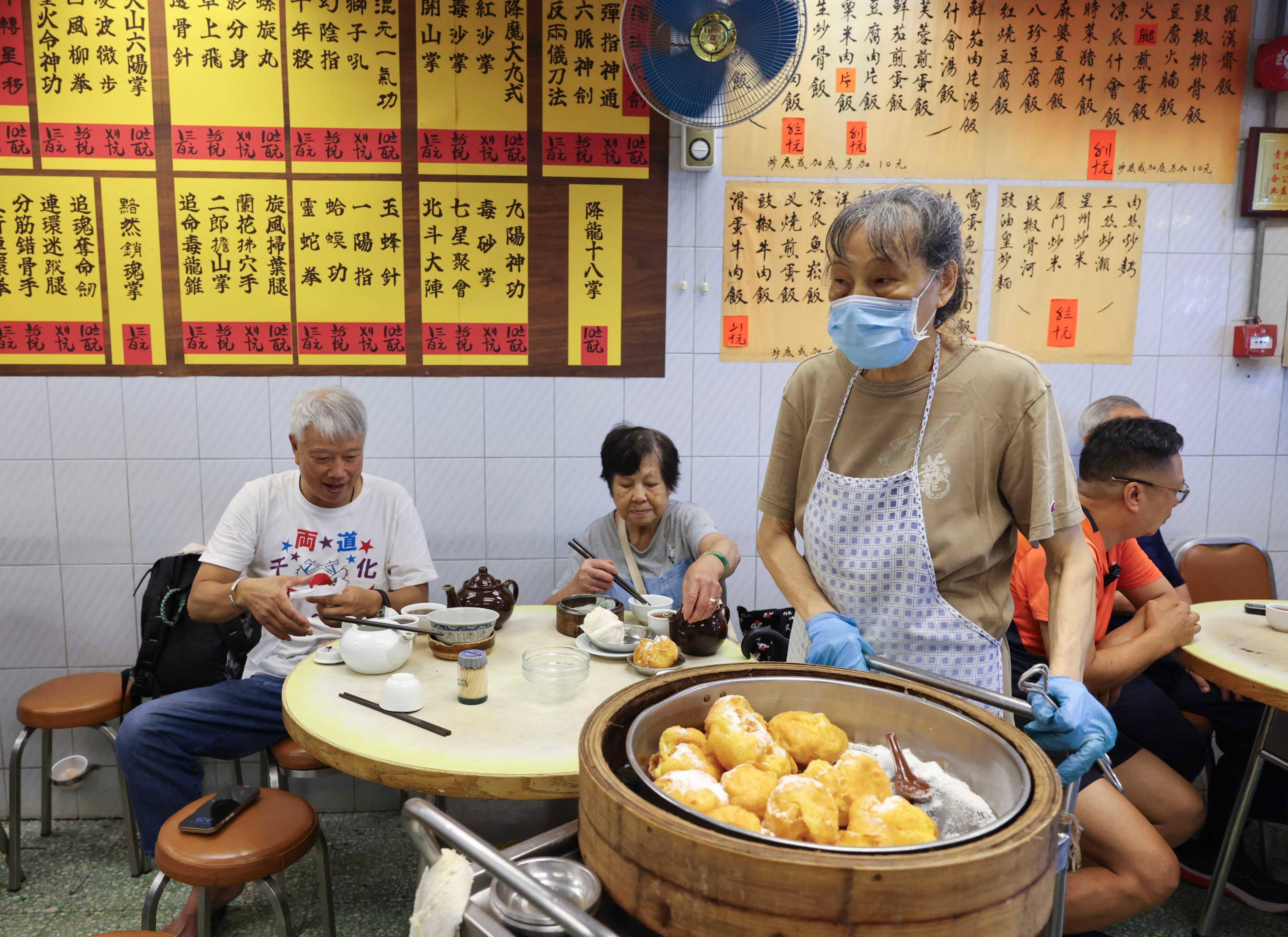
If you visit Hoi Lin Restaurant in Tsuen Wan, you aren’t just going for lunch – you are stepping into a time machine.
As steam billows from silver trolleys stacked with bamboo baskets, this noisy restaurant tells the story of how Hong Kong has changed over the last 60 years.
The restaurant was opened in 1959 by Choi Sai-kwai, who is now in his 90s. Back then, it started as a humble shop on the outskirts of the legendary Kowloon Walled City.
The Walled City was a famous and busy place with many buildings, but it no longer exists. In 1992, the restaurant moved to Fuk Loi Estate, one of Hong Kong’s oldest public housing areas, and it remains there today.
The evolution of the trolley
Did you know that dim sum restaurants didn’t always use trolleys?
“In the past, dim sum was served by staff holding up one or two bamboo steamers at a time,” Choi remembered. It was incredibly heavy work. Later, restaurants invented special trays with straps that waiters wore over their shoulders to carry more food.
Finally, the dim sum trolley was invented. It made life easier for the waiters and allowed customers to see the food before buying.
Today, Hoi Lin is one of the few places left that make dim sum the old-fashioned way – by hand, starting at 2am every morning.
Because they don’t use factory machines, they can serve rare dishes that have disappeared from other menus, like the sugar egg puff and sticky rice bun. Machines can’t make these items because the dough changes depending on the weather – only a human chef knows how to adjust it.
A living museum
Sadly, these trolleys are becoming a rare sight. They are hard to fix, and modern restaurants prefer having customers use QR codes to order.
But for many customers, the trolley represents the memory of a generation. It allows grandmothers and grandchildren to share a meal exactly the way it was eaten decades ago.
Steve Tang, who moved to Fuk Loi Estate in 1963, said he visited the restaurant once or twice a week as he enjoyed the high quality of its dim sum, especially the buns.
“I really hope that the Chinese traditions of dim sum and drinking tea can be handed down,” the clerk said. “When you use an order form to tick dim sum items, you lose the sense of personal interaction with staff.”