Deep Dive delves into hot issues in Hong Kong and mainland China. Our easy-to-read articles provide context to grasp what’s happening, while our questions help you craft informed responses. Check sample answers at the end of the page.
News: Life expectancy for women in Hong Kong hits record high
-
The city already has some of the world’s longest average life expectancies, and now women are outdoing men at another record high
-
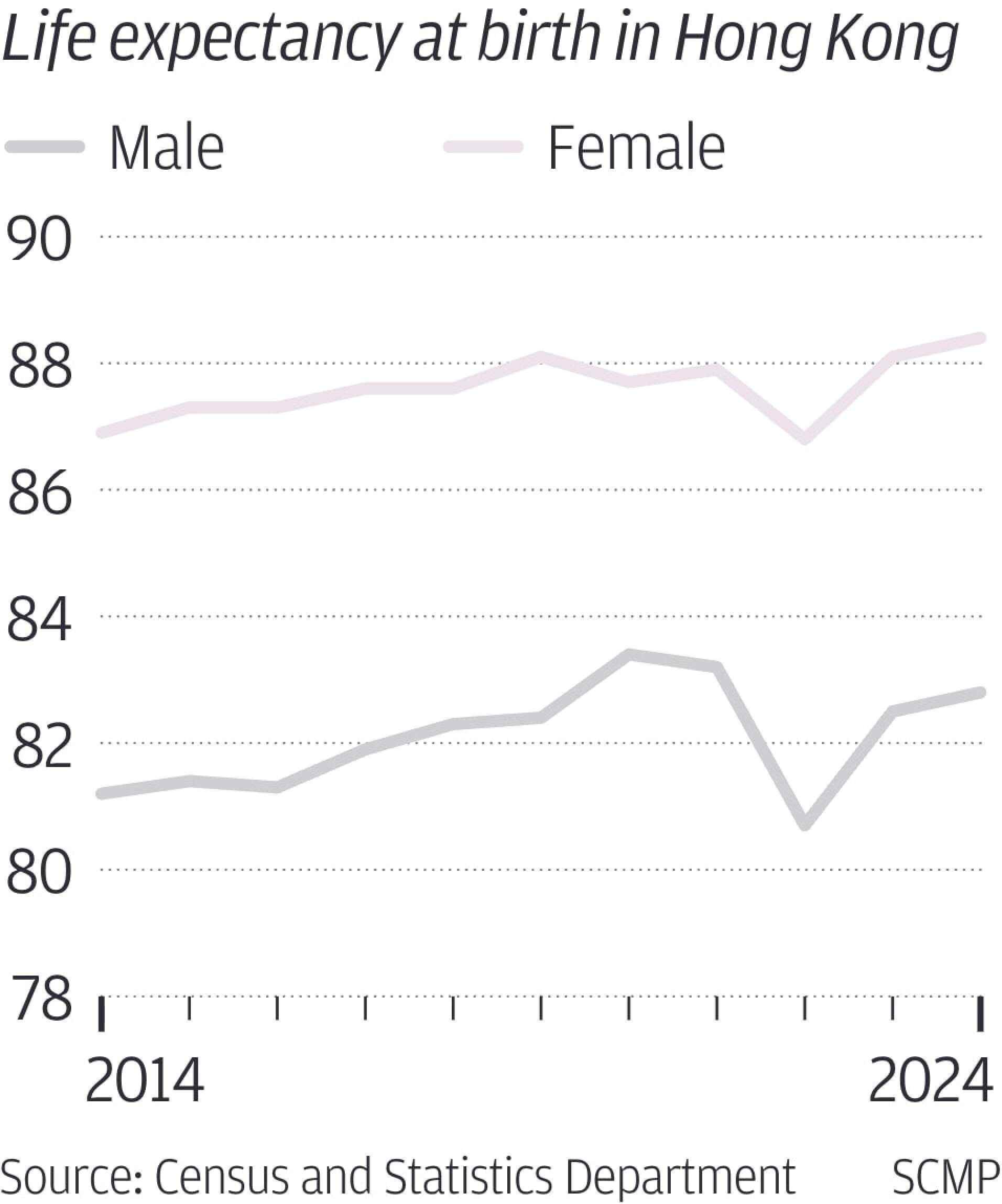
Life expectancy at birth for women in 2024 was 88.4 years, but only 82.8 years for men
Hongkongers’ impressive life expectancies rose even further last year, despite falling momentarily during the pandemic. Now, women in the city are expected to live for 88.4 years on average, a record high, and men for 82.8 years.
Hong Kong citizens have some of the longest life expectancies in the world, followed by Japan and South Korea, according to statistics provider Worldometer.
A recently released report from the Census and Statistics Department highlighted the new life expectancy at birth in Hong Kong, which increased from 88.1 years for women and 82.5 years for men in 2023. The report also emphasised the increasing strain on the city’s public healthcare system as the population ages.
Hong Kong’s population stood at 7.5 million at the end of 2024. The number of residents aged 65 and over grew to 1.76 million, a 4.3 per cent increase in 2024 after growing by 5.9 per cent in 2023 and by 6.7 per cent in 2022.
Meanwhile, the city’s young people are disappearing. The number of children aged under 15 shrank by 4.7 per cent last year. That is a shocking decline compared to the 1.7 per cent fall in 2023 and 2.6 per cent drop in 2022.
Paul Yip Siu-fai is the chair professor of population health at the University of Hong Kong. He warned that the city’s ageing population meant we should expect challenges to intensify dramatically in the next five years. “Our economy is not in very good shape”, he said.
According to the latest census statistics, the number of residents receiving a social security allowance grew to more than 1.32 million in 2024. The figure climbed steadily from 1.19 million in 2022. Around 54.2 per cent are women.
The scheme includes the Old Age Living Allowance and is now serving a rapidly expanding elderly population.
Women in Hong Kong looked for psychiatric help far more often than men, according to a chapter on medical and health issues in the report. Hospital Authority psychiatric outpatient clinics recorded 616,085 attendances by women in 2024. In contrast, men accounted for only 401,865 visits.
Clinic visits for women, outnumbering men, also increased within a year, from 588,317 in 2023. Men’s attendances have also risen, climbing by 4.4 per cent from 384,917 over the same period. The figures perhaps point to broader mental health challenges across the city.
Staff writer
Question prompts
1. Which of the following statements are true, according to the information in the news?
(1) Hong Kong women tend to live longer than Hong Kong men.
(2) The longest life expectancy for women in the world is 86.4 years.
(3) The number of residents aged 65 and over grew by another 5.9 per cent in 2024.
(4) About 1.32 million Hongkongers received a social security allowance in 2024.
A. (1), (2) only
B. (2), (3) only
C. (2), (4) only
D. (1), (4) only
2. List ONE way men and women differ in Hong Kong, aside from life expectancy rates, based on the information in the news.
3. How is Hong Kong’s population changing? Explain using the news, glossary and your own knowledge.
Graph
Question prompts
1. What is being shown in the graph? How does it support the information provided in the news?
2. Why is there a dip in the graph from 2021 to 2022? Explain using the news and your own knowledge.
Glossary
life expectancy: an estimate of the average number of years a person is expected to live based on statistics. Life expectancies can differ by region, ethnicity and gender, as well as factors such as socioeconomic status and health conditions.
ageing population: a population trend where the percentage of older people in a demographic increases, usually due to longer life expectancies, immigration and a declining birth rate
census: a system or procedure that acquires, records and calculates information about the people that make up a given population. Census data can include family size, age, gender, ethnicity, education level and more. Findings can help inform policy, research and social services.
social security: a government programme that provides financial help or a source of income to those in need, for example, due to ageing or a disability.
Sample answers
News
-
D
-
Women get psychiatric help more often than men do in Hong Kong. Women attended health clinics more than 200,000 times more than men.
-
Women and men are living longer in Hong Kong. That means the already large elderly population will continue to grow and soon take up a larger percentage of the city’s overall population. There will also be fewer infants and young people, as Hong Kong has a low birth rate. According to the news, the number of children aged under 15 has dropped by nearly 5 per cent in one year. This means the population will lean heavily towards the elderly.
Graph
-
The graph shows the average life expectancy for men and women by birth year in Hong Kong across a decade. Women have consistently had a longer life expectancy than men. The general life expectancy for both men and women in 2024 has increased slightly since 2014.
-
Both men and women saw a drop in life expectancy from 2021 to 2022 during the pandemic, but bounced back at a similar rate. The sudden and sharp decline in life expectancy is because Covid-19 hit vulnerable populations particularly hard. There was a higher mortality rate due to the virus, which decreased as the city developed protocols and medical help to combat the illness.