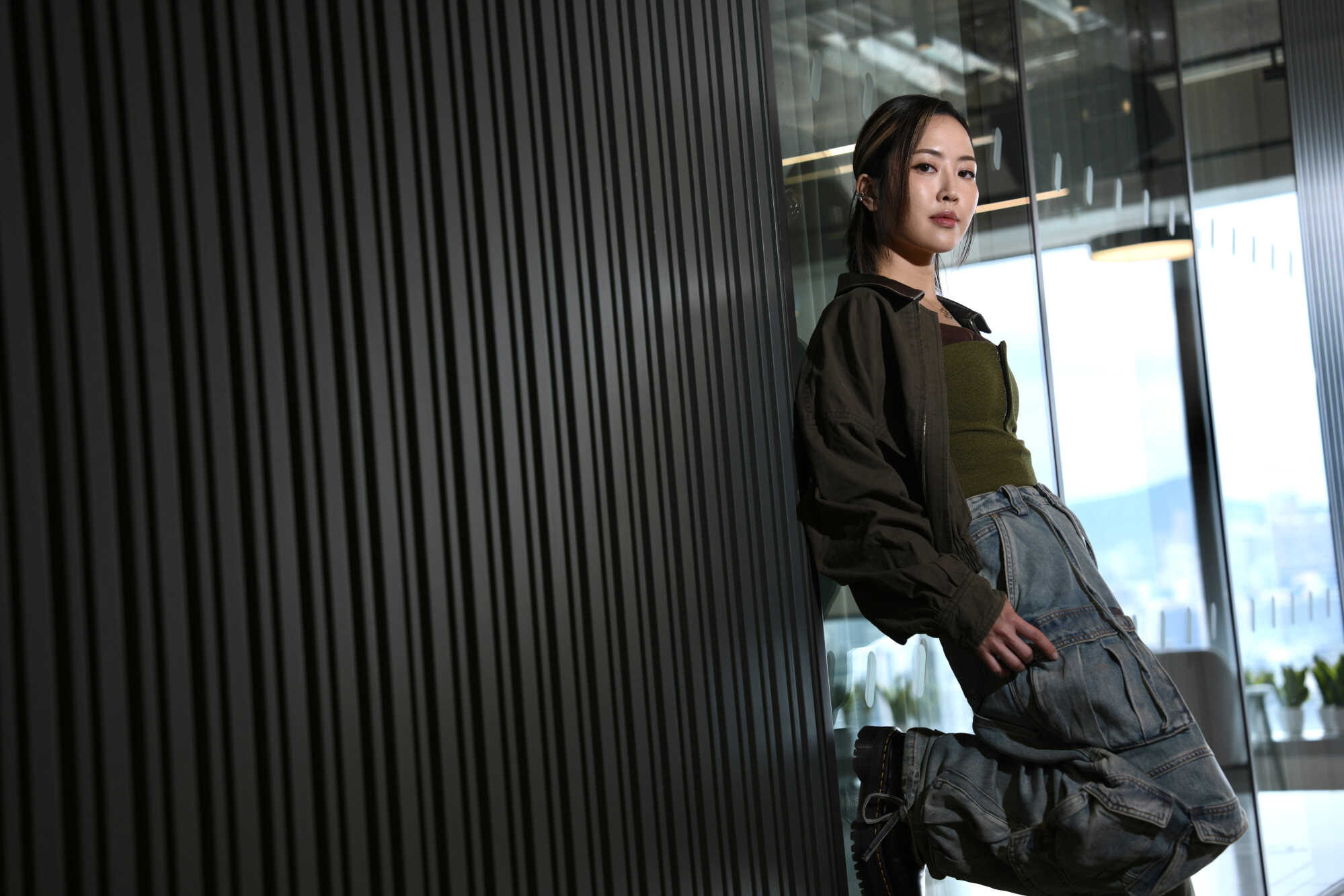
Whether you have seen her dressed in a spacesuit helmet playing a battered piano on a truck or riding a bright red toy Mercedes-Benz through Causeway Bay, there is no denying that singer-songwriter Kiri Tse Hiu-ying is ready to lean into drama and have some fun.
The Hong Kong artist, better known by her stage name Kiri T, likes to take on heavier topics with lighthearted lyrics.
She is self-made, experimental and delightfully offbeat. She is also among a wave of musical artists ushering in a new era of Cantopop.

Take her pop-rock ballad “中暑傷風加失戀x2 (Arctic Summer)” as an example. In the song, Tse compares breaking up to catching a chill in a Hong Kong summer, contrasting sweltering heat with cold feelings of loss.
Other painful moments are also transformed into tongue-in-cheek punchlines. These songs are relatable to many Hongkongers.
“Sometimes when I’m sad, I laugh,” Tse said. “Even when I hear bad news, I might smile just to cope. So when I write about break-ups or failure, I try to laugh it off.”
Left on ‘Read’
Kiri Tse’s latest single “藍剔未必是壞習慣 (Read)” tackles a modern relationship dilemma that many may resonate with: messaging someone you are secretly crushing on – only for them to leave you on read.
“I actually kind of appreciate the space of not having to jump into a relationship,” she said. “It’s not just about romance. It’s about embracing the unknown.”
Instead of focusing on speedy replies, the singer wanted the song to capture feelings that take time to unfold and develop. In a way, Tse said she was nostalgic for an older way of life when love was not instant.
“I was so shy that I’d go an entire year liking someone without ever speaking to them,” the singer recalled with a grin. “I’d just … observe from afar. So this song is about bringing back that slow, awkward magic of admiring someone in silence.”

Sharing secrets
The music video for her breakout pop track “至少做一件離譜的事 (You Gotta Screw Up At Least Once)” has racked up more than 9.6 million views on YouTube since its release last year.
The song resonated with young Hongkongers navigating the chaos of growing up. Listeners are encouraged to embrace mistakes as a part of life and are told that failing is better than never trying at all.
Fans have said the song speaks to the feeling of being lost as a young person and have found it therapeutic.
Music has become a space to share the things Tse has struggled to say aloud: “I feel like my fans and I share secrets through music.”
Hong Kong’s Cantopop scene
If she had not become a singer-songwriter, Tse said she imagined she might have taken a very different path.
“Maybe a social worker. If I were good at studying, maybe I’d be a psychologist,” she said, laughing. “Or a music therapist.”
Like many Cantonese-speaking singers today, Tse spoke lovingly of the golden years of Cantopop. Female artists in particular, she said, wore unconventional fashion and made boundary-pushing music.
While the genre had seen something of a decline since the 1990s, Tse said she felt the Cantopop scene today is blooming with new artists and diverse styles.
“I see a lot of people stepping outside the Cantopop formula but still getting so much love and attention,” she said. “It’s cool to see the public being so receptive to new stuff.”
She highlighted singers Jace Chan and Marf as examples of Cantopop’s current experimental turn.
“I think this era is pretty cool,” she explained. “I feel like anything is possible now.”