





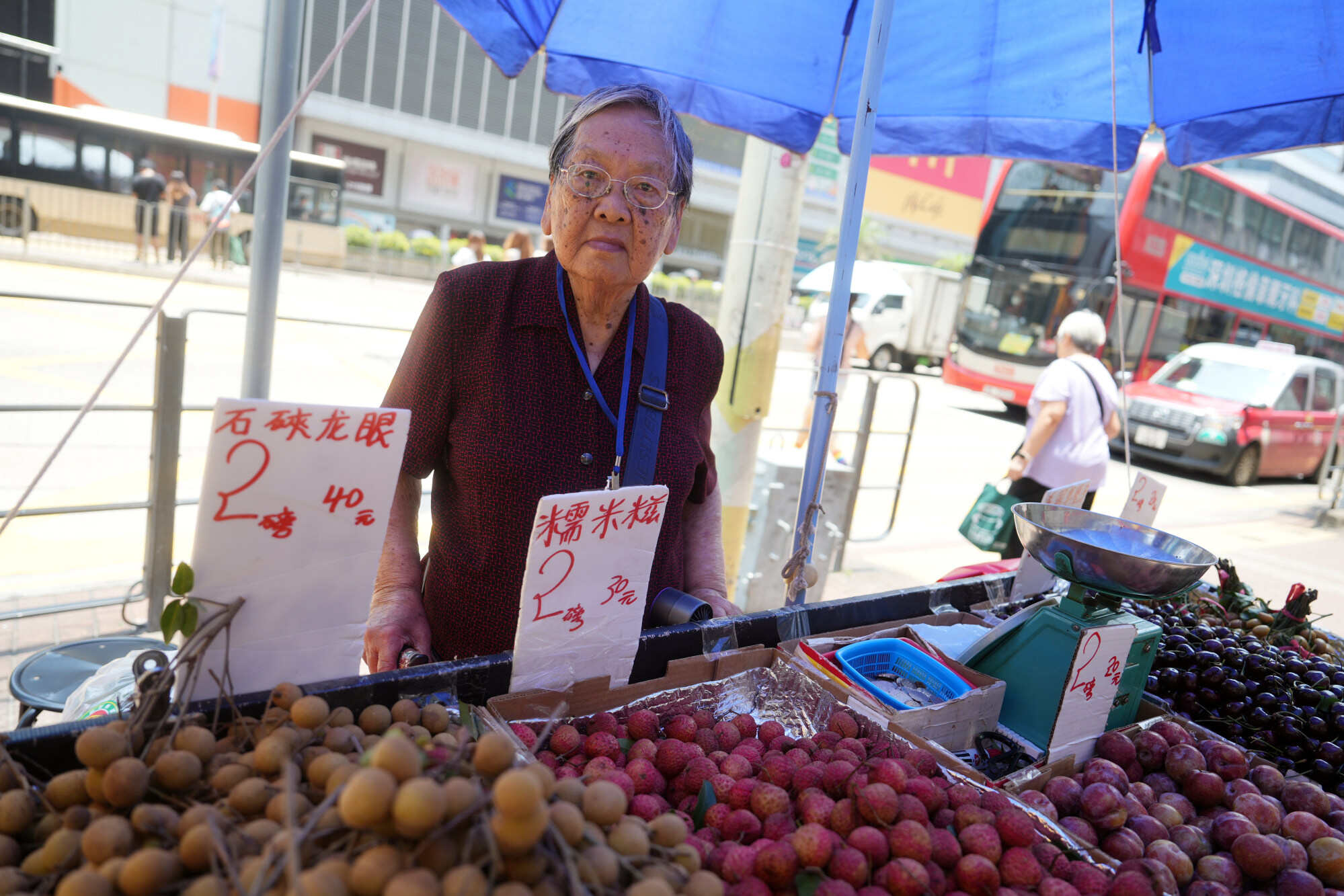
Chan Tak-ching, 92, spends her day at a stall set up next to a Hong Kong railway station as her colleagues manage operations under a sweltering 33 degrees Celsius (91.4 degrees Fahrenheit) heat.
She is not concerned about the earnings – about HK$500 (US$63.70) to HK$600 a day – but about being physically present at the stall. Chan, along with other hawkers in the city, must comply with what some have called an “outdated” policy to ensure her colleagues have the opportunity to earn a living amid the sluggish economy.
“I am over 90 and supposed to be retired; my family is against me working, but if I don’t work, my partners can’t. They all have a family to support,” she said.
Under the government’s decades-old regulations, itinerant licence holders such as Chan cannot pass on their hawking permits to anyone. They are also banned from having helpers, meaning that they have to be present at the stall at all times and be the only ones handling the transactions and everything else.
Fixed-pitch hawkers, meanwhile, are only allowed to pass down their licence to direct family members once.
Chan, who started running her street stall more than six decades ago, offers roasted chestnuts in winter while selling seasonal fruits in summer. She said she wished to pass on her licence to partners who had been working with her for decades.
“They know the ins and outs of running the stall as well as I do. I trust them, and I want to pass my licence to them,” she said. “But I cannot do it, unfortunately.”
Hawking has been one of the city’s sunset industries after the government stopped issuing all related licences in 1972 as part of efforts to remove these vendors from the streets through “natural loss”.
The latest research by the legislature, which found that the number of itinerant hawkers has dropped by 80 per cent to only 233 in 2024 since 2000, has reignited debate on whether the government should update its hawking policies, especially when tourists are now also opting for a more authentic experience.
Cheung Men-wah, 67, has more than 30 years of experience in roasting chestnuts at street stalls and has been one of Chan’s right-hand men since 2010.
But he still has to depend on Chan’s licence to make a living.
“We can only work when she is here. I think I deserve a licence or at least the right to operate a stall, with my years of experience,” he said.
“If she dies, I have to retire and live on a government pension.”
He warned that traditional snacks such as roasted chestnuts were bound to disappear from Hong Kong streets as licence holders die.
Cheung also lamented the hostile environment they faced, saying they had received four tickets from food hygiene officers in three weeks, even with Chan’s presence as a licence holder.
How Hong Kong’s rules for hawkers are affecting the dying trade
“We get penalty tickets even when she has a licence; I can’t imagine trying to survive without one,” he said.
Under the rules, hawkers are barred from setting up their stalls at 177 black spots across the city, which are defined as major thoroughfares and areas of high pedestrian flow.
Sometimes, they have also been charged with hawking illegally because Chan was not the one “getting the money from customers”, he said.
Dr Leung Chi-yuen, a lecturer at Polytechnic University’s Department of Applied Social Sciences who specialises in hawking policy, said the current legislation and the top-down approach were outdated.
He said sometimes hawkers’ sons and daughters were not willing to inherit the trade, warning that the number of street vendors would decline drastically if the government insisted on restricting licences from being passed down to others, not even to skilled helpers.

“Throughout the city’s more than 120 years of hawking history, the government has never developed policies for this symbol of local culture,” he said, citing how street snacks such as charcoaled egg waffles have won over people’s hearts and the potential for these stalls to be popular among tourists.
“Look at Japan; their government thinks conversely. They focus on where the street hawkers should go, not where they shouldn’t go.”
Lawmaker Doreen Kong Yuk-foon said the city’s “outdated” policies lagged behind other regions, such as mainland China and South Korea.
“We are in big trouble when only the Environmental and Ecology Bureau is involved in hawker policies because we see it as a hygiene issue without considering its cultural significance,” she said.
Kong said cross-bureau efforts were needed in rethinking the future of hawking in Hong Kong.
August 2020: Hong Kong’s dai pai dong serving up the city’s ultimate comfort food, risk extinction
“The Food and Environmental Hygiene Department is concerned about hygiene, and it’s not part of their job to preserve local culture. When street hawkers are on the edge of extinction, why can’t we have the Culture, Sports, and Tourism Bureau lead hawker policies and rethink them as a cultural issue?”
The department had earlier stressed that it was essential to balance the expectations of different stakeholders in terms of hawking policies.
The bureau did not respond to the South China Morning Post’s inquiry, saying the issue was beyond its purview.
For now, Chan plans to stay on just to back her long-time colleagues, saying hawking is also a means for people who have no access to education to sustain themselves without depending on the government.
“I can only continue as long as my body is able to; I have been hawking for years, and so have my assistants. We are not educated, and our options are very limited,” she said.
