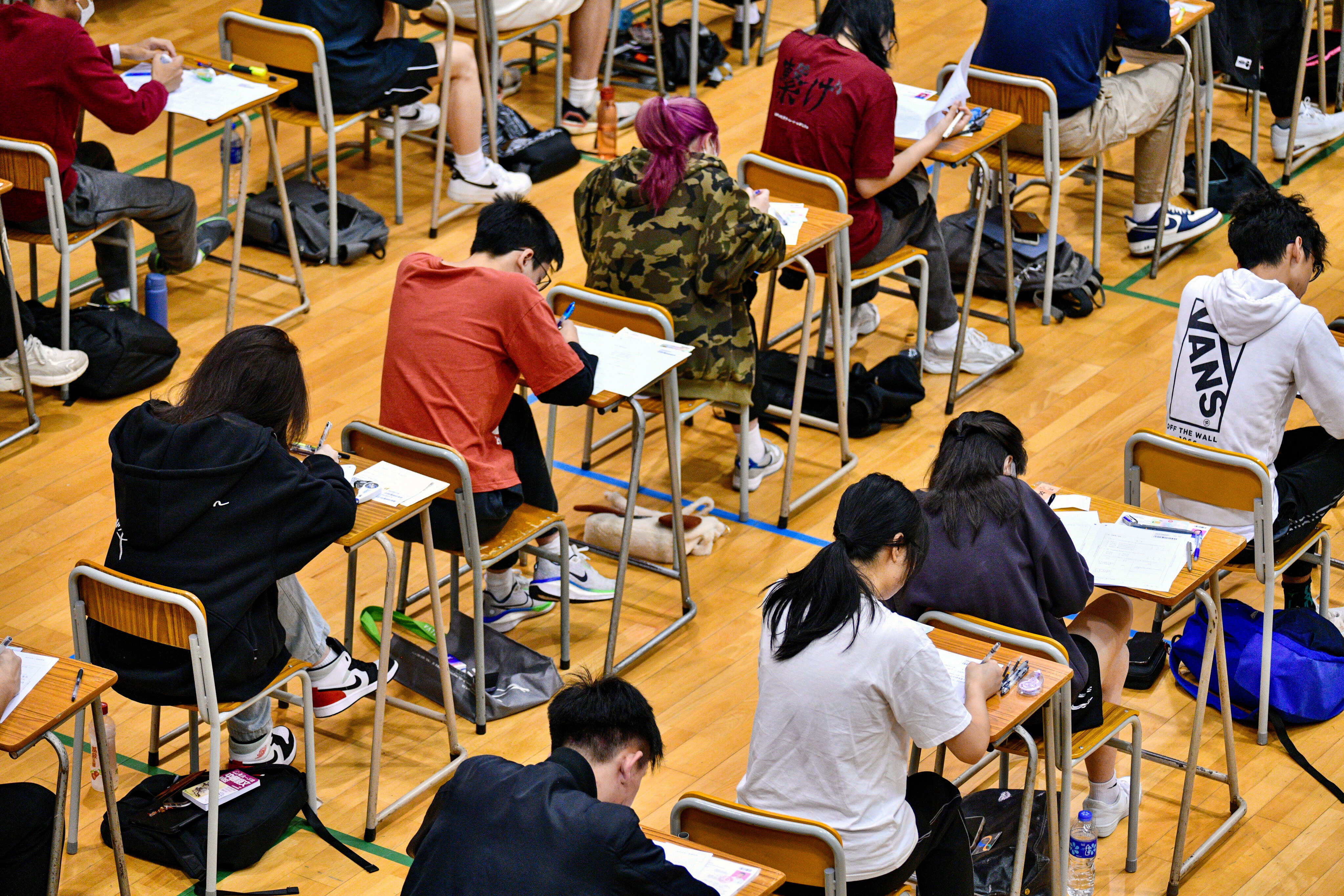
Hong Kong’s Diploma of Secondary Education (DSE) English exams can cause a lot of anxiety among students, who often begin studying months – or even years – before the exams take place.
Alan Chan, a top tutor at King’s Glory Education Centre, offered his revision tips for the exam’s reading, writing and listening papers.
Paper 1: Reading
Focus on the requirements
Chan pointed out that many candidates repeat the same mistake every year – not answering a question according to its specifications.
For example, they answer a “do/does” question without giving a clear “yes” or “no”. They also often list examples from the passage instead of identifying the core argument required by the question.
The tutor also warned against falling into the “copy-paste trap”.
“Don’t just copy chunks of text without adjusting the grammar and context. Remember to change the pronouns to ensure the answer is logically sound,” he said.
Multiple-choice options that look alike
When faced with multiple-choice options that seem similar, Chan recommended checking if the word form matches the question’s sentence structure.
For instance, the correct choice might depend on whether the question requires a present participle or a past participle to complete the sentence logically and grammatically.
Candidates can also look at the tone and connotation of each option, the tutor said.
“While the words ‘surprised’ and ‘shocked’ both describe an unexpected event, the former is usually positive or neutral, whereas the latter leans towards negative. Match this tone to the overall sentiment of the passage,” Chan explained.
If two options have the same meaning and grammar, then neither can be the correct answer. Students can use this as a hint to eliminate both and focus instead on the remaining two choices.
Irony vs sarcasm
DSE questions are increasingly asking students to identify the author’s tone and attitude. Candidates often lose marks here because they struggle to distinguish between irony and sarcasm, leading them to misinterpret the writer’s intention.
Chan explained that irony is when there is a contrast between expectation and reality.
It often uses positive language to describe a negative situation, but the goal is usually to highlight a contradiction or add a touch of humour.
“For instance, if you look outside during a violent typhoon and say, ‘What a beautiful day for a walk,’ you are using irony,” the tutor explained.
Sarcasm, however, is driven by a specific attitude. Its purpose is to mock, insult or embarrass someone.
Time management and tips
Chan suggested that candidates set aside ample time for questions that require concise and thoughtful answers. He recommended allocating one minute per mark. You should also factor in six minutes at the end of Paper 1 for a final check.
“Recent exam questions actually require less writing ... compared with pre-2020 papers,” he pointed out.
Save time by identifying easy-to-score questions like vocabulary replacement, where you just need to find and copy a specific word or phrase from the passage.
Near the start of the exam, candidates can check the last page of the booklet to see which format is used in the mandatory matching question: speech bubbles or paragraph main ideas. If it is the latter, complete the matching task for each paragraph immediately after finishing a section’s specific questions.
“This saves time and ensures accuracy, as the details will be fresh in your mind,” the tutor said.
Chan explained that using artificial intelligence (AI) would not offer much help with DSE revision and that you should stick to the traditional method of practising with past papers.

Paper 2: Writing
Hot topics
Popular issues include eco-friendliness and sustainable living practices. Prepare for topics related to city development and the preservation of natural and cultural heritage.
Other issues include the development of sports and sports facilities, initiatives to improve the physical health and fitness levels of the general population, cyber safety, social media anxiety, AI and the future of work.
Another stand-out issue could be the generational gap in public etiquette.
“Read up on different standards of public conduct, such as [how] some older people may use loudspeakers to watch videos on public transport, but the younger generation often thinks this is rude,” Chan said.
Solid stances, transitions and conclusions
When writing an argumentative essay, Chan suggested stating your stance in the last sentence of the introductory paragraph as well as the first sentence of your conclusion.
“Placing your position at these two specific points ensures it stands out and that the examiner knows exactly where you stand,” he said.
“Express your stance differently, either by paraphrasing it or changing the sentence structure to avoid repetition. For example, one statement could be a general overview of your position, while the other could be more specific.”
Candidates can use transitional sentences to bridge different parts of their writing instead of relying solely on simple connectives like “furthermore” and “however”.
Chan gave an example of this type of transition: “While the benefits are significant, it is equally crucial to acknowledge the drawbacks.”
Transitional sentences tend to send a clearer signal to the marker about the direction and flow of the essay.
In general, students should prepare for three different types of shifts in writing: advantages to disadvantages, reasons to suggestions, and problems to solutions.
Also, avoid simply repeating your stance or briefly recapping the points at the end. Instead, aim for a conclusion with reflection. Examples include predicting the future, giving a warning or suggesting a solution.
“Many students rush through their conclusions, especially in Part B, probably because of exam fatigue.
It’s understandable, but try and stick [it out until] the end,” Chan said. He added that one way around this is to draft the final paragraph on your rough-work sheet at the start.
Time management and tips
Chan advised going through Part B as soon as you can check the question paper: “This gives you extra time to think about which elective question you want to choose.”
Once the writing exam begins, allocate 30 to 50 minutes for Part A and 70 to 90 minutes for Part B. Stronger students can aim for about 300 words in Part A to show their ability to elaborate and develop ideas. But weaker students should keep to 200 words so they have more time for Part B.
For both sections, spend about five to 10 minutes checking and tidying up the final work. This includes looking for overused words and replacing them with synonyms or phrases, as well as ensuring that all ideas are well developed.
“Most importantly, never start writing immediately. Use your rough-work sheet to list your ideas first and organise them logically,” Chan said.