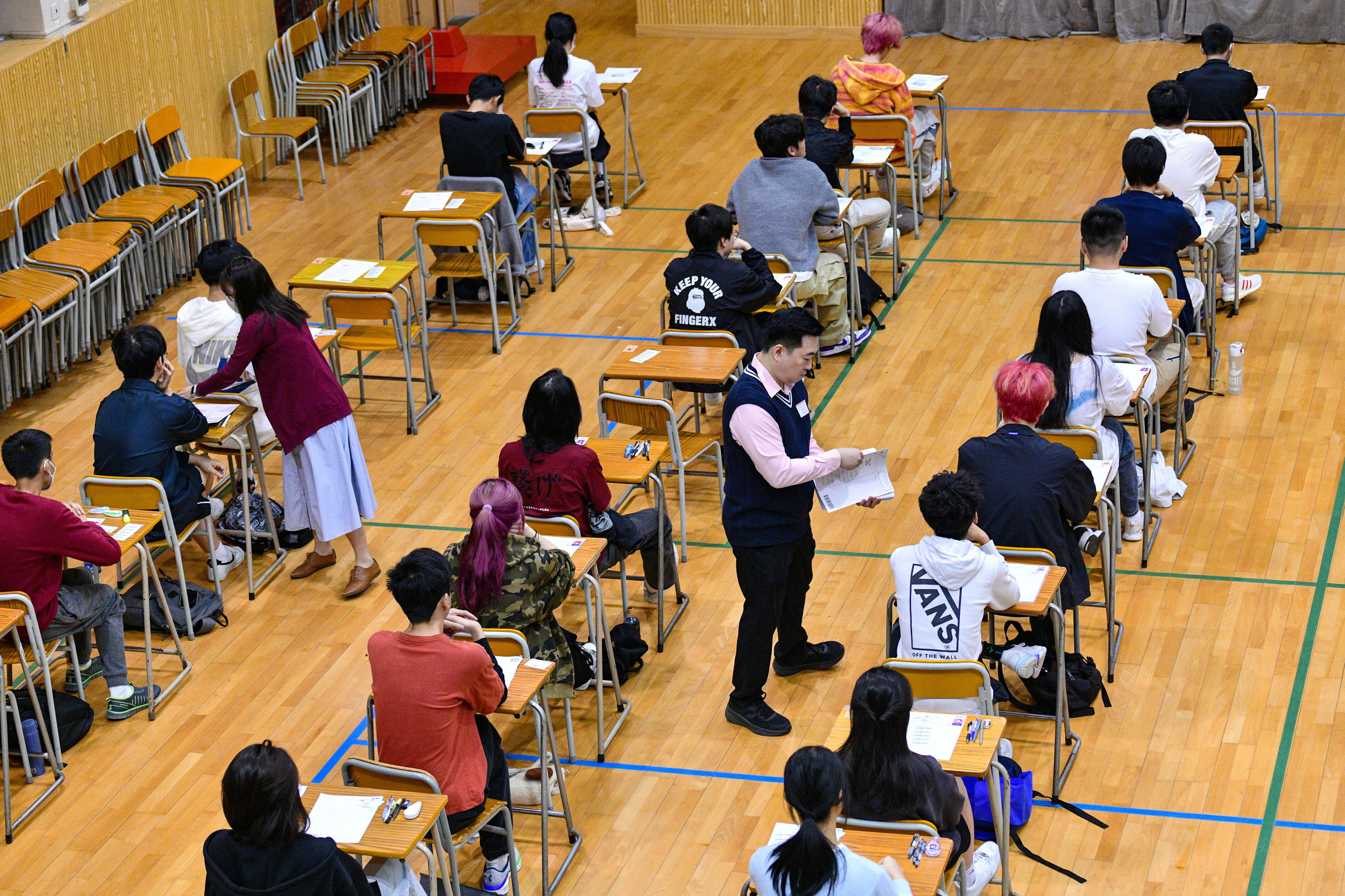
This year marks the third Diploma of Secondary Education (DSE) examination testing citizenship and social development (CSD), a curriculum that replaced liberal studies in 2021.
The CSD exam takes place on April 14.
To help students prepare, Liu Tin-yan – a secondary school teacher and exam marker for the Hong Kong Examinations and Assessment Authority – shared her insights on key topics to study, common mistakes students make and effective preparation strategies.
The teacher urged Hong Kong students to “play it safe” in this year’s exam, while noting that the difficulty level is likely to be the same as the previous two years.
“However, there’s a chance we’ll see some changes around the fourth, fifth or sixth year. Usually, the questions remain quite stable and steady during the first three years,” Liu said.
“Later on – once topics start to overlap – it’ll get tougher. They won’t wait until every single topic has been tested before they start repeating them; they’ll likely start cycling topics back in by the fourth year. That’s when revision might become ‘unpleasant’.”
Key topics to focus on
Looking at the past two years, Liu noted that the exam topics had no overlap because the subject was still new.
For Hong Kong, she stressed that the “Participation in National Affairs” section – specifically national affairs, the Greater Bay Area (GBA) and the five-year plans – would probably come up in this year’s exam.
“We’ve talked about these a lot ourselves over the past two years, but the questions haven’t actually appeared [on the exam] yet. We should pay attention to this part, especially since we’ve just entered the 15th five-year plan,” she explained.
“You can see the trend is leaning more toward these areas – for example, how Hong Kong helps the country within the GBA, or how the country gives back to Hong Kong. I think that part is worth more revision.”
Liu suggested students focus on the topic of “Rule of Law and the Constitution”, as it had not been tested yet and would rely on knowledge.
“The rule of law has barely been touched upon ... even though it’s a standard part of the curriculum,” she said.
“As for the constitution and the Basic Law, there were some multiple-choice questions previously.”
The teacher also suggested memorising how the Basic Law applies to the present.
Liu advised studying this topic alongside the section on titled “Implementation of ‘One Country, Two Systems’”.
“Textbook publishers and we [teachers] expected full questions on the ‘Implementation of One Country, Two Systems’, but we haven’t seen them yet,” she said.
For the China section, the teacher said the exam would probably have questions about the country’s development.
“A topic that clearly hasn’t been touched is the achievements of ‘reform and opening up’. Specifically, the section on poverty alleviation has been highlighted significantly [in the curriculum] but hasn’t appeared in exams yet. The core concept there should be quality of life,” she said.
“Last year, the questions focused more on international relations and less on internal affairs. Of course, there’s a chance they might merge the Belt and Road Initiative with the Greater Bay Area [and Hong Kong’s role]. That’s a likely scenario.”
Regarding global issues, Liu said that the topics of sustainable development and economic globalisation had not been tested yet.

Exam strategies
The teacher noted a clear pattern for question types: a prompt might provide three perspectives or aspects and ask candidates to pick one or two to elaborate on.
The exam also tends to ask about “advantages”, “challenges” and “impacts”.
Don’t just pick the one you like, Liu said. Pick the one that has the most supporting data in the sources.
Liu observed that many students struggled to use the provided data.
“The problem is that once they find it [the information], they tend to copy massive chunks of text directly,” she said. “They might see a keyword, like ‘national security education’, which might appear in all three provided sources, and then they just dump everything related to it.”
But Liu said this way of answering would be “insufficient” and could lead to heavy point deductions.
She reminded students to try their best to rephrase the key points.
When it comes to explaining data, Liu said it would not be necessary to write out every statistic provided.
“You can just state whether it’s an ‘increase’ or ‘decrease’ as a simple reference,” she said. “Students seem afraid; they feel they must include every single reference before they can answer.”
For example, a question on a previous exam asked about “comprehensive national power”. If students understand the concept and pick the right source, those marks are easy to get.
Another old exam question asked about cultural characteristics. Since it was worth only three marks, students don’t need a long set-up in their answers – they should just use the source, elaborate briefly and move on.
Liu also suggested reviewing “Role” and “Suggestion” questions, as they might appear on the exam this year.
Time management
According to Liu, candidates should not do the paper in chronological order.
She advised starting with the questions you are most confident in. This helps you stay calm. If you start with a hard one and use up your time, panic sets in, and you’ll start rushing and making careless mistakes.
The teacher’s biggest piece of advice for students is to play it safe.
“The passing mark is roughly 40 per cent. Sixty per cent is a very comfortable, very safe pass,” she said. “I’m more worried about the top-tier students. They sometimes ‘go down a rabbit hole’ and lose focus.”
Liu added: “To pass [with the Attained level], you just need to get about half of the marks on each question. The first half of the marks is always easy to get by referencing the data.”
For more revision tips, check out last year’s exam tips.