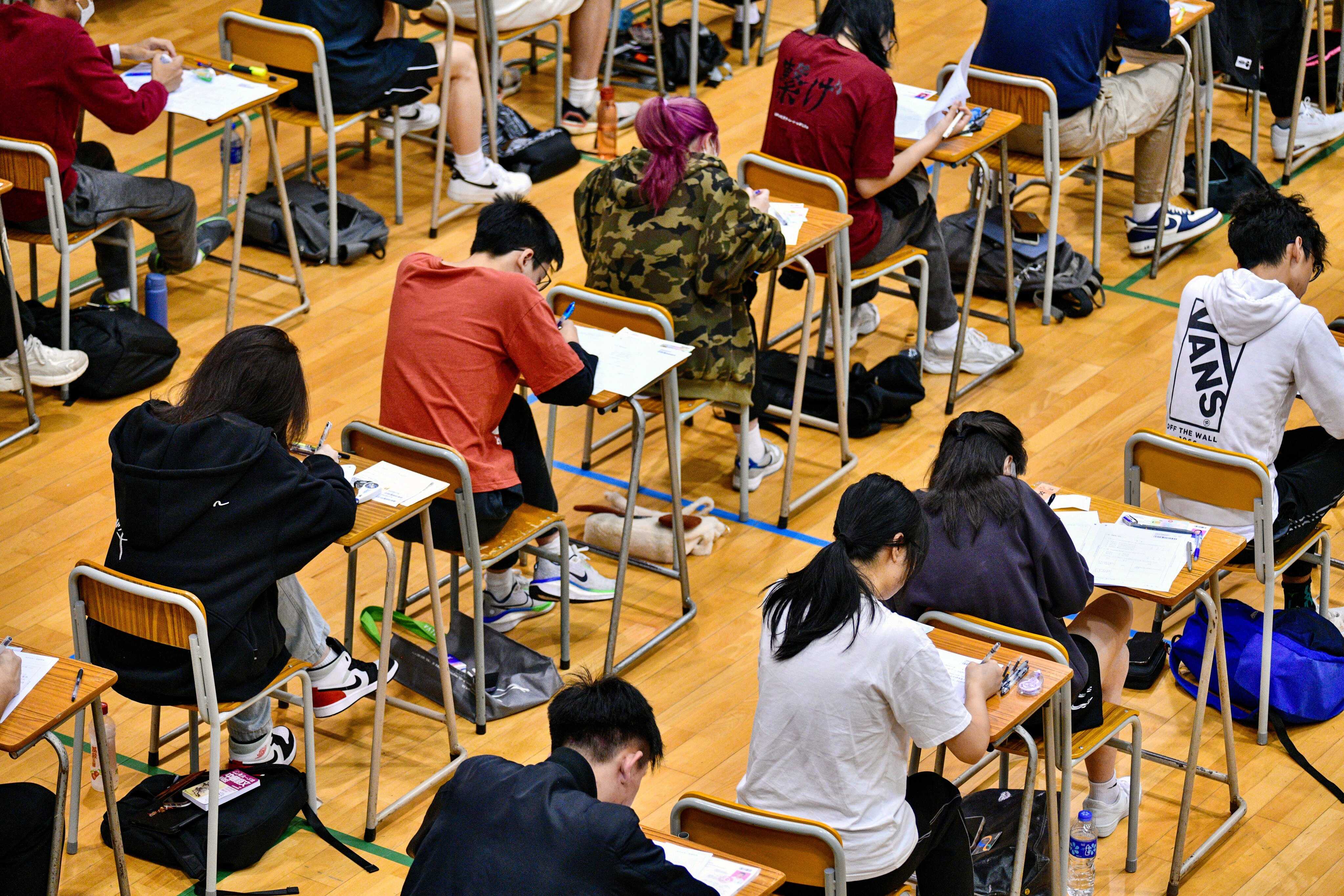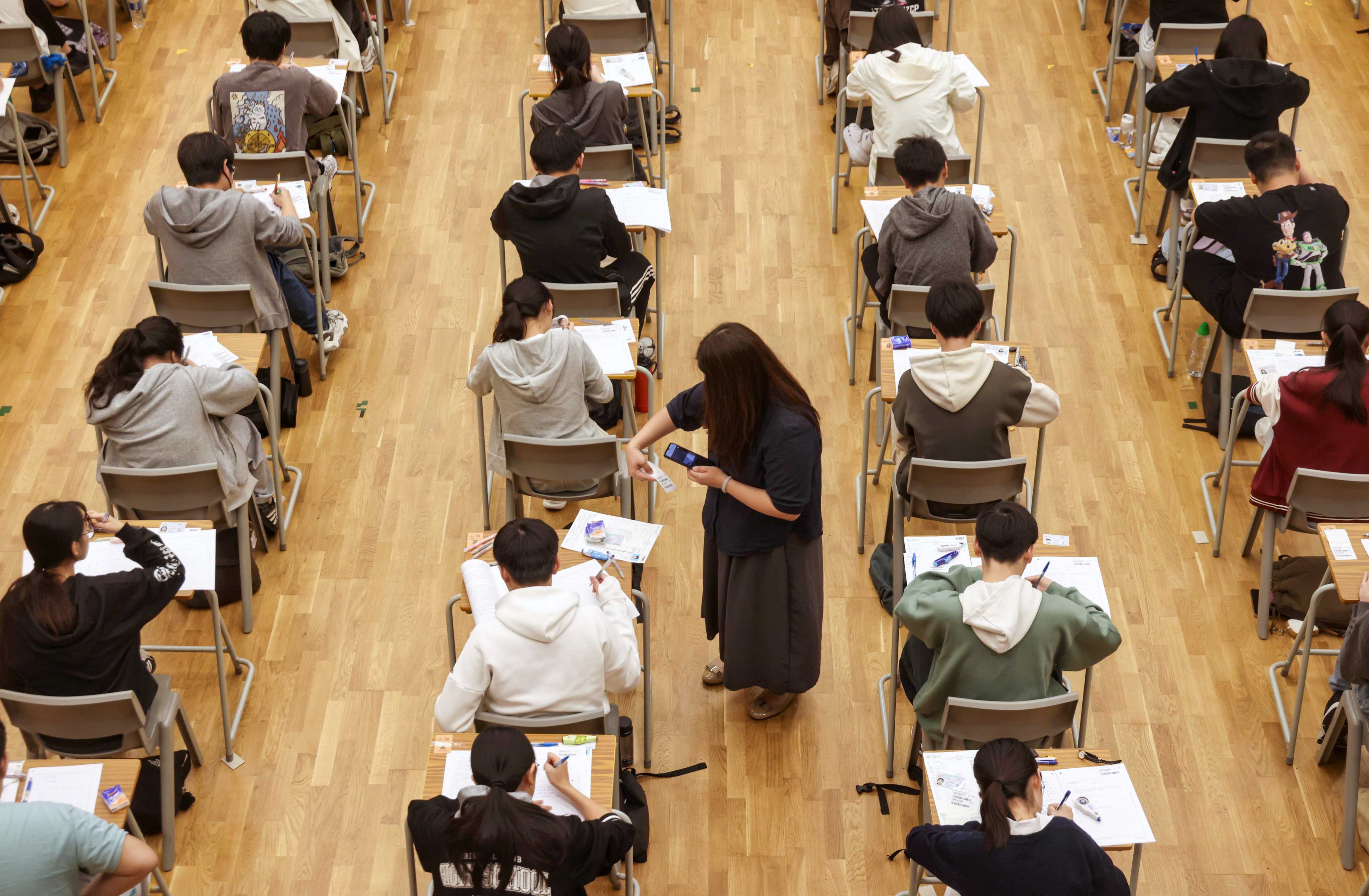
This year’s Hong Kong Diploma of Secondary Education (DSE) mathematics exam was overall easier than last year’s, despite a few tricky questions, according to a tutor and a student who sat the exam.
A total of 41,388 pupils sat the mathematics exam on Monday. The DSE examinations will conclude on May 5, with results scheduled for release on July 15.
Eleni Mak, a 17-year-old candidate from Good Hope School, said she found both papers of the mathematics exam easier than those from previous years.
“I am confident I can get a level 5, but I am aiming for a 5* at this stage,” she added, noting her plans to study business at university.
Dick Hui, a mathematics tutor at Defining Education and King’s Glory Education, believed that this year’s level 5 cut-off point would be slightly higher, as the overall difficulty of last year’s exam was higher than this year’s.
Hui added that this year’s Paper 1 was more difficult than past assessments, while Paper 2 was generally easier.
He also noted that this year’s questions were manageable within the time limit, remaining consistent with previous years.
Student responses to the maths exam
On Paper 1, Eleni said she heard from her peers that they struggled with a few tricky questions.
For example, she said some candidates solved Question 12 in Section A(2) incorrectly because they mistook the rhombus for a rectangle.
Roniya Law, a student at CCC Kei Yuen College, said that Paper 1 was difficult for her, while Paper 2 was at a similar level of difficulty compared with previous years.
The 18-year-old struggled with Paper 1’s Section B, especially on questions involving 3D applications and four centres.
“The 3D question was especially hard as it was a type I’ve never seen before. I was completely stuck,” Law said.
Law had a predicted score of level 5 at school, but after her performance today, she thought her result would be a level 3 or 4.
Tricky questions on Paper 1
In Section A(2) of Paper 1, Question 14, which was about polynomials, asked students to explain if there was only one value of k that allowed the equation to have at least two equal roots.
“Because the equation is cubic, it is already factorised into two factors. So we know one root is ‘x = 3’ and the other factor is a quadratic equation,” Hui explained.
“Since ‘x = 3’ is already a root, plugging ‘x = 3’ into the quadratic part shows that the quadratic can also have a root of ‘x = 3’. This results in another value for k.”
The question should result in two values of k that can produce two equal roots.
In Section B, Question 15 involved a probability concept that was not tested before, Hui said.
“They introduced a concept where the two events overlap, so besides [adding] A plus B, you have to subtract the situation of A and B overlapping,” he explained.
According to Hui, the most difficult questions in Section B were 16 and 19, both concerning coordinate geometry and requiring students to find the fastest method to solve them.
Question 16 asked students to prove if a triangle is right-angled.
“Often, candidates try to find an intersection point to calculate, but actually, the intersection point is not necessary,” Hui said.
In Question 19, he said candidates might get stuck while finding the distance between the incentre and circumcentre.
“This distance can be found by directly locating these two centres and calculating, but this is not feasible within the time limit,” the tutor said.
“So instead, they need to try using a property related to the isosceles triangle to calculate the difference in distance and also use the radius to calculate the distance.”
Common mistakes on Paper 2
Although Paper 2 was generally easier this year, Hui said there were many “error-prone” questions.
For Question 13, which was about sequences, candidates needed to solve simultaneous equations. They had to solve for the unknown terms first in order to find the answer. The answer was C.
Hui noted that Question 21 was trickier as it required students to draw and then calculate a quadrilateral’s perimeter.
“After drawing, it is easy to mistakenly think two triangles are congruent, but they are only similar, not congruent,” he said, adding that the answer was C.
The permutation and combination problem in Question 43 was challenging because candidates had to split it into two steps.
“You need to first select 7 people out of 8 [and] then arrange those 7 people in a specific order,” Hui said. The answer was also C.