Content provided by British Council
[1] Around 1,400 years ago, a young girl was laid to rest in a palace-like stone coffin. Celebrated as China’s “most pampered child”, she was surrounded by her grandmother’s affection and a wealth of treasures. Li Jingxun was an aristocrat from the Sui dynasty (581-618), also known as “Little Girl”. She hailed from Longxi, located in what is now northwest China’s Gansu province. In April, the National Museum of China in Beijing opened an exhibition of Li’s artefacts to the public.
[2] Her story unfolded during a rough period in Chinese history. It was marked by the transition from the fractured Northern dynasties (386-581) to the brief yet unifying Sui dynasty, which paved the way for the Tang era (618-907). Her family wielded significant power: her great-grandfather was the renowned general Li Xian. Her grandmother, Yang Lihua, was the empress of the Northern Zhou and the eldest daughter of the Sui founder.
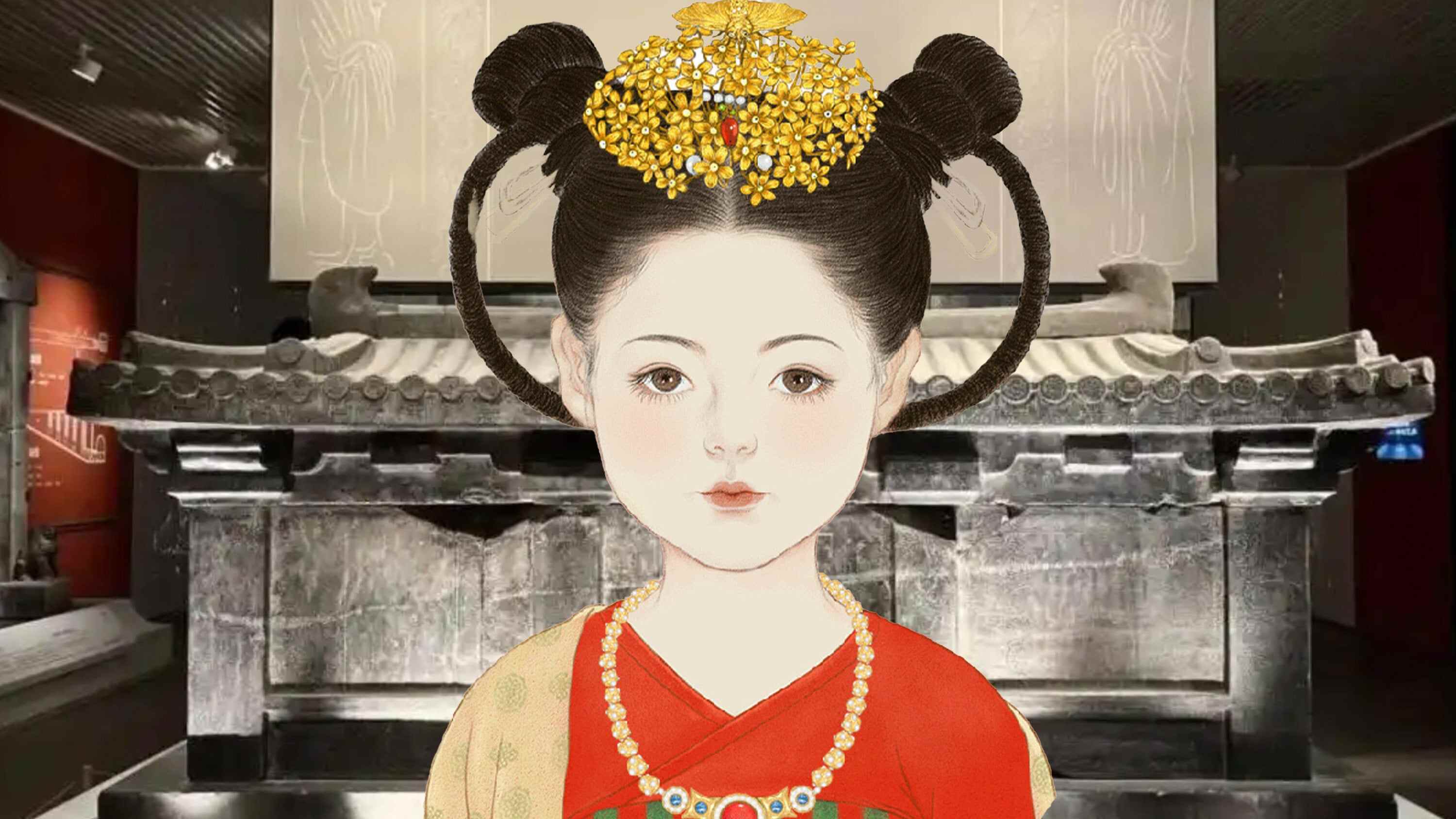
[3] Although no portraits of her exist, modern reconstructions depict her as a noble girl adorned with twin circular hair buns and a delicate, porcelain-like complexion. In 608, Li fell ill during a summer retreat and tragically died at the tender age of nine in a palace in Shanxi.
[4] Her granduncle was the emperor at the time. He ordered her return to the capital with the highest ceremonial honours, removing the palace’s ceremonial instruments and observing a fast in mourning. Her devastated grandmother reportedly buried Li in a temple along with hundreds of treasures and commissioned a grand multi-storey pagoda above her tomb.
[5] In traditional Chinese belief, a temple was deemed essential to soothe the soul of a child who had died young. In 1957, Chinese archaeologists unearthed Li’s tomb in Xian, located in north-central China’s Shaanxi province. It was hailed as the most complete and highest-ranking Sui dynasty tomb still preserved.
[6] Li was interred in a stone coffin inscribed with a warning: “Whoever opens this coffin shall die.” The coffin was adorned with carved attendants and male guardians. Lotus flowers, dragons and vermilion birds decorated the doors, windows and columns. The tombstone detailed Li’s identity, birth and death dates, family lineage and funeral rites, along with her grandmother’s heartfelt words: “Like an orchid cut too soon, her beauty and promise withered before reaching its peak.”
[7] Excavations of her tomb revealed more than 240 burial items, including glassware and gold and silver jewellery. Exquisite figurines of humans and animals were likely placed by her grandmother to keep her cherished granddaughter company in the afterlife. Among the most remarkable artefacts was a gold crown, crafted from wire, sheets, pearls and gemstones to resemble a cluster of flowers with a moth.
[8] Official records suggest that the crown embodied her grandmother’s wish for Li to enjoy “many children and lasting prosperity”. The tomb also contained gold bracelets from Persia and perfume bottles.
Source: South China Morning Post, April 25