Read the following text and answer the quiz below.
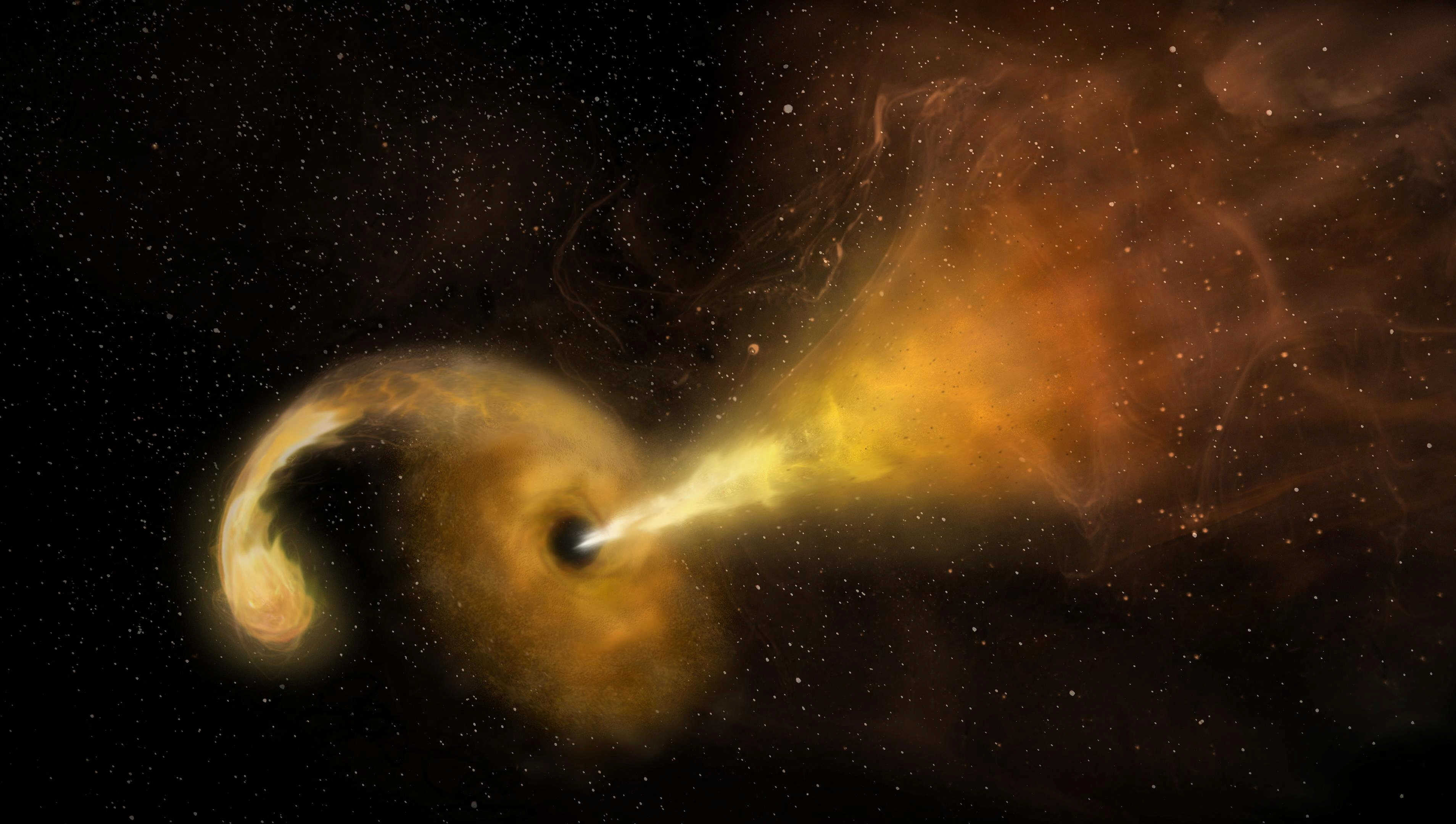
[1] Scientists are observing the behaviour of a supermassive black hole that is displaying exceptionally messy eating habits. Using mainly radio telescopes in New Mexico and South Africa, they are watching the black hole, residing at the centre of a galaxy far beyond our Milky Way, as it continues to belch out a fast-moving jet of material after ripping apart and eating a star that made the mistake of wandering too close.
[2] What makes this stellar fatal encounter unusual is the intensity and duration of the black hole’s post-meal indigestion. The jet – made of material left over from the star – did not begin shooting into space until two years after it was shredded into its component gases by the black hole’s gravitational forces. But this jet has now been shooting into space for six years – longer than has ever been observed before – and continues to intensify, becoming one of the most powerful single events ever detected in the universe.
[3] “The exponential rise in the luminosity of this source is unprecedented. It’s now about 50 times brighter than when it was first discovered and is now incredibly bright for an object in radio waves. This has been going on for years and [shows] no sign of stopping,” said University of Oregon astrophysicist Yvette Cendes, the lead author of a study about the black hole published in the Astrophysical Journal.
[4] Black holes are exceptionally dense objects with gravity so strong that not even light can escape. This black hole is located about 665 million light-years from Earth. A light-year is the distance light travels in a year, which is 9.5 trillion km. The black hole is about five million times more massive than the sun. That makes it roughly comparable to the supermassive black hole at the centre of our own galaxy, which has a mass about four million times that of the sun.
[5] The doomed star was a type called a red dwarf, about a 10th as big as the sun. An event horizon is the point of no return for material drawn by a black hole’s gravitational strength. When a star is pulled apart by a black hole, it is called a tidal disruption event because it results from the same gravitational dynamics that cause ocean tides on Earth.
[6] “Any object that approaches too close to the event horizon of a black hole risks being torn apart by tidal forces and stretched into a long stream of debris, a process called ‘spaghettification’,” said University of Arizona astrophysicist and study co-author Kate Alexander.
[7] Researchers are not exactly sure why this tidal disruption event and its jet, formally called a relativistic jet, have been so spectacular. The question now is how long this jet will continue to intensify. The researchers suspect it may peak later this year or next year. “After the emission peaks, it should fade slowly, so we will probably still be able to see it for a decade or more,” Alexander said.
Source: Reuters, February 5
Content provided by British Council