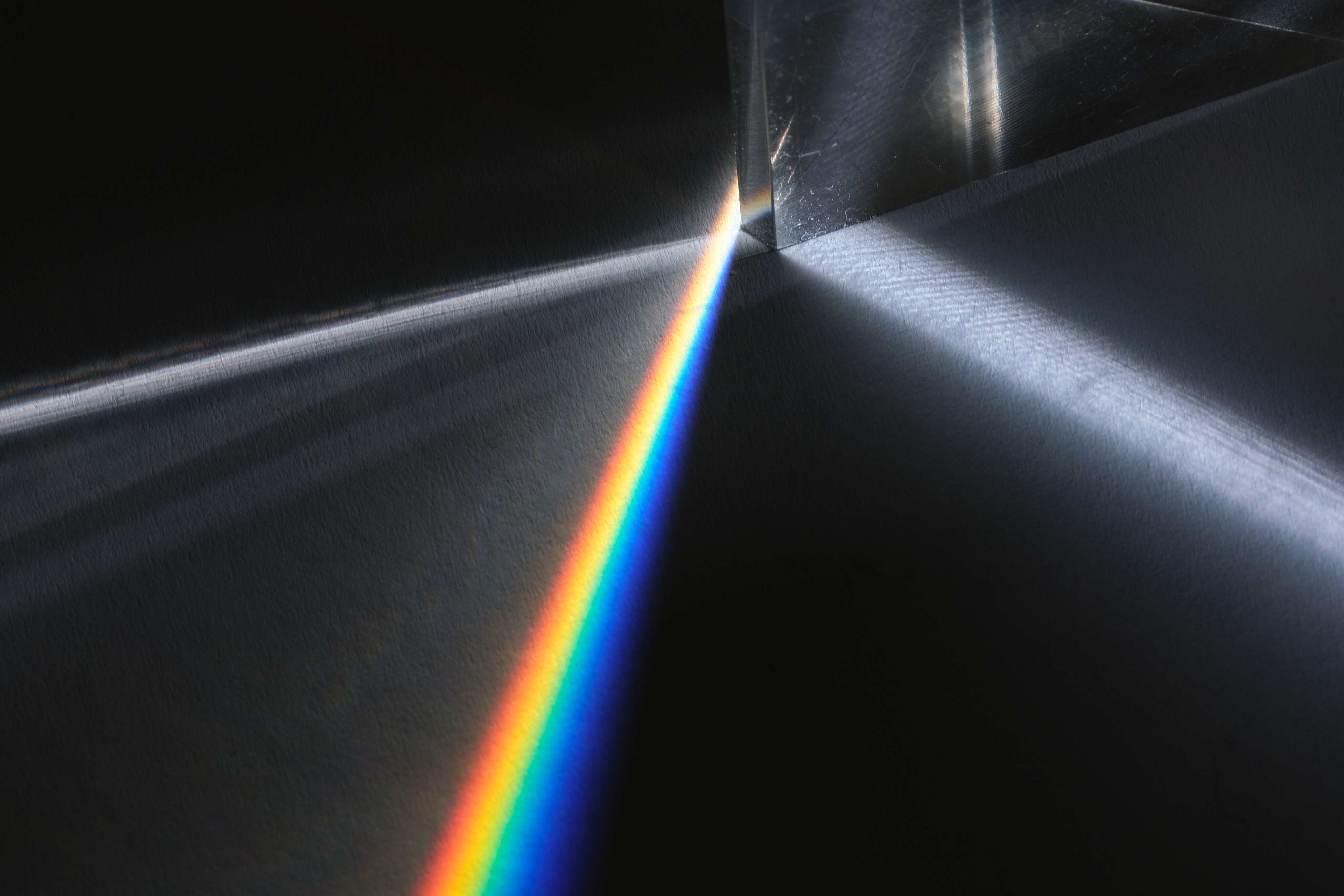
Why are apples red? The fruit’s surface absorbs all colours except for red light, which it reflects to our eyes.
But for an object that absorbs all light and reflects none, what colour will it be?
What is an object that absorbs light and reflects none?
A blackbody takes in all of the light that hits it. You might think that since a blackbody does not reflect any light, it should appear black. But that is not true. In fact, blackbodies emit light and can be any colour.
This is because reflection and emission are different. Reflection happens when radiation – for example, visible light – bounces off a surface without being absorbed. But emission is when something releases its own energy in the form of radiation.
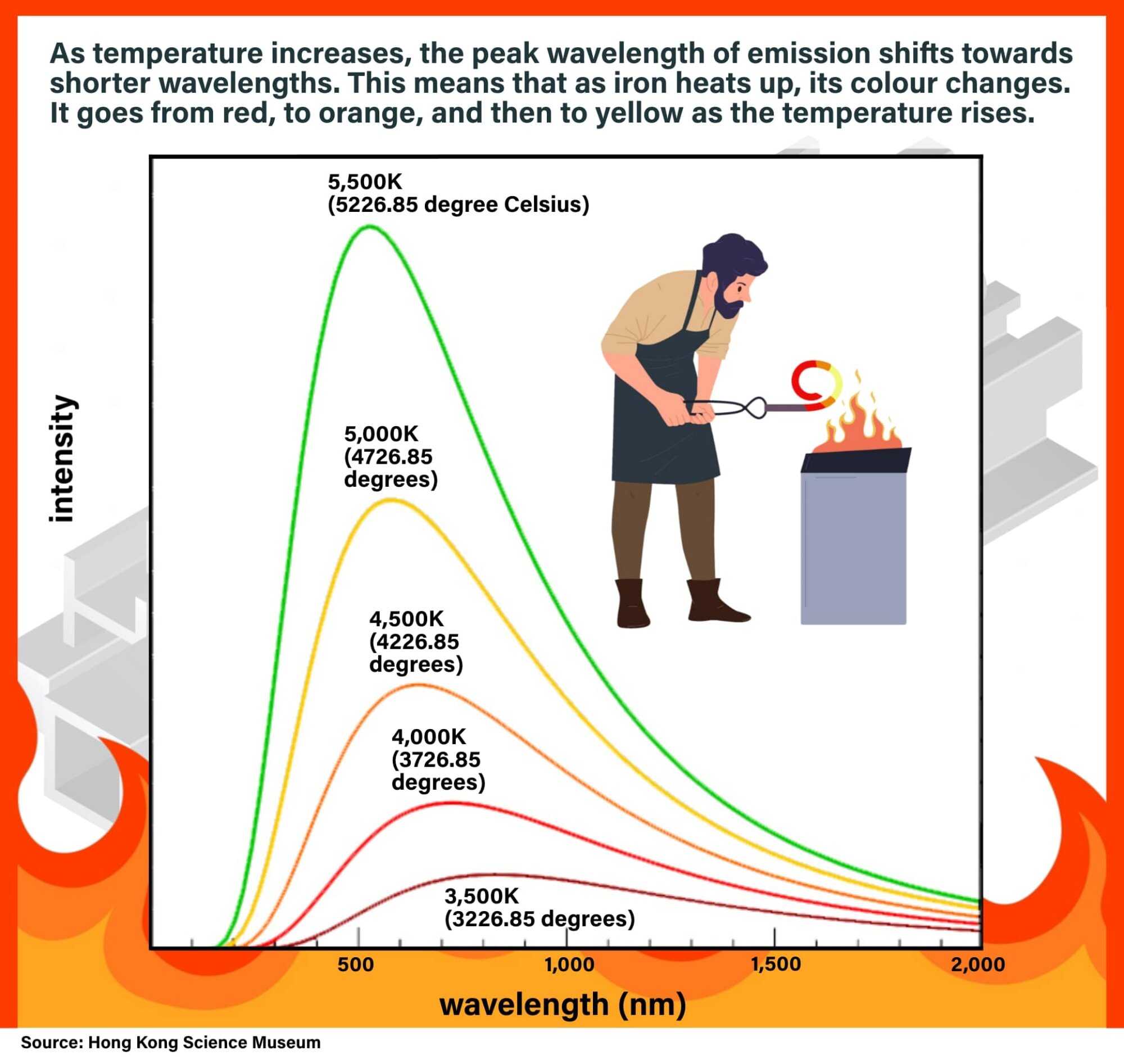
In 1893, German physicist Wilhelm Wien discovered that blackbodies at different temperatures emit energy at different wavelengths. This results in a range of colours (see graph).
Keep in mind that a perfect blackbody does not exist in nature. But there are some objects that come close to it.
Stars like the sun are considered near-perfect blackbodies. They absorb almost all electromagnetic radiation without reflection. The light we see emitted from the sun is a result of how hot it is. Our sun emits most of its radiation at the yellow part of the spectrum. On the other hand, cooler stars will emit most of their radiation in the red part.
You can also see this type of radiation when iron is heated. The metal’s colour changes from red to orange to yellow as it gets hotter.
What is the science behind blackbodies?
For many years, people were confused about the science behind blackbodies.
But in 1900, a German physicist named Max Planck solved the puzzle. He suggested that energy is not radiated continuously, but in separate parts. We now call this “quanta”. Light quanta are called photons.
He explained that the energy of photons follows the formula (E=nhν). In this formula, “h” is a constant, “ν” is the light’s frequency, and “n” is an integer (1, 2, 3 and so on). Light’s frequency is the number of waves that pass a certain point in a second.
Planck’s equation showed that the energy of a photon is directly related to its frequency. Higher energy photons are more likely to be radiated at higher frequencies as the temperature gets hotter.
Why does quantum physics matter?
Planck’s discovery is what led to the study of quantum physics – the science that describes how matter behaves at the smallest levels. Quantum physics has created many new technologies, such as smartphones, computers and medicine.
This year is the International Year of Quantum Science and Technology. It celebrates the 100th anniversary since quantum mechanics was created.
Young Post has partnered with Hong Kong Science Museum and Hong Kong Space Museum to encourage your pursuit of science. Every month, the museums answer questions about the world around us, the cosmos and beyond.