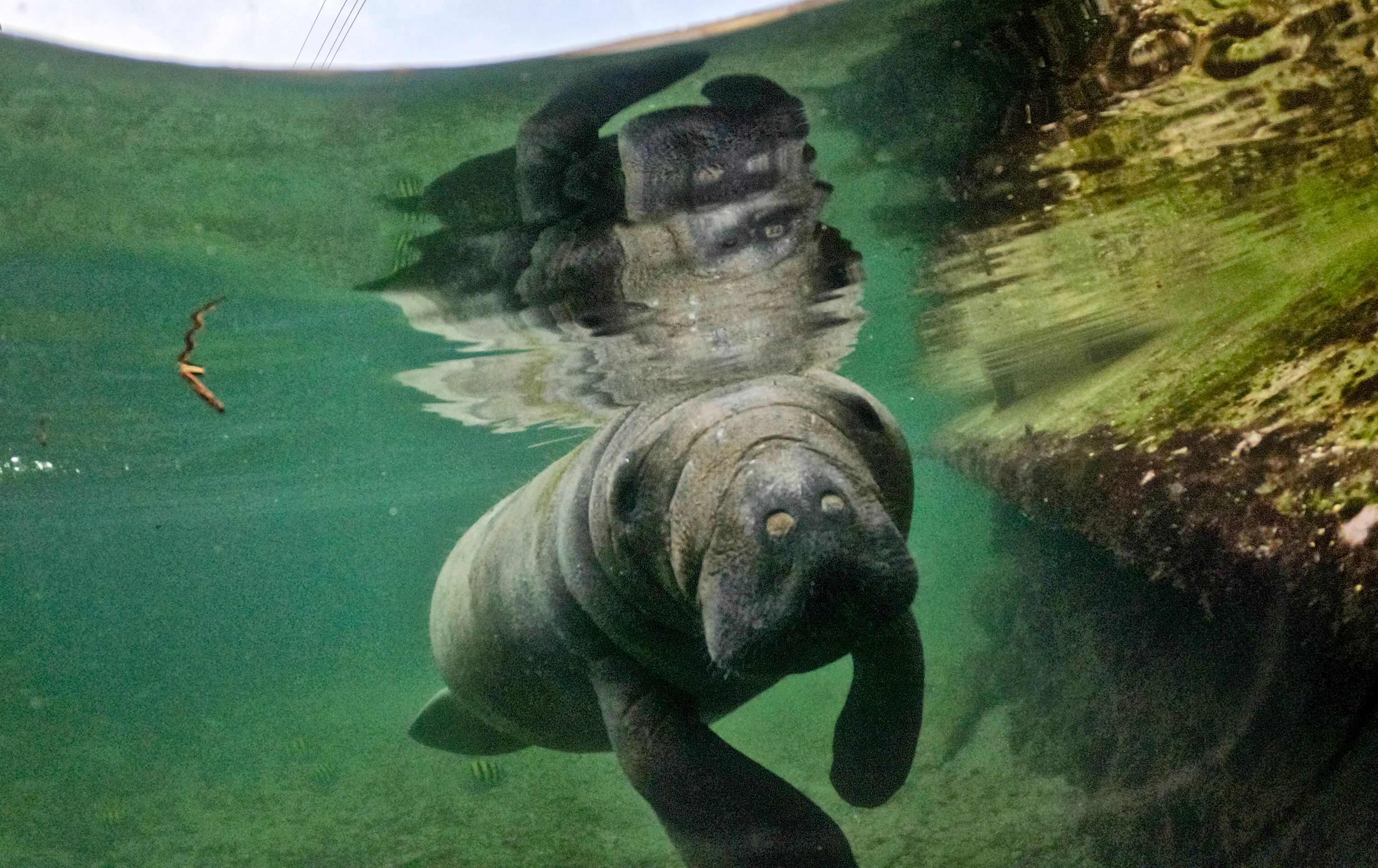
Last September, Tasajerito the manatee was found in a swamp in Colombia, a country in South America. He was just three days old and he had lost his mother.
Nine months later, the baby sea cow weighs as much as an adult human and he is bottle-fed round the clock by aquarium staff.
Though he is much stronger now, Tasajerito is still not out of danger, says Angela Davila, a vet at the Rodadero Aquarium. That's because manatees are usually fed by their mothers for a long time.
"Tasajerito is still in danger," Angela says. "He appears strong, he appears lively and to be feeding well, but things can change in a heartbeat."
Drinking more milk
Tasajerito was found and rescued by fishermen. He was then brought to the aquarium with little hope of survival. A search for his mother was fruitless.
Now safely housed in a special pool at the aquarium, he has clung to life. He has increased his diet of a special vitamin-boosted milk six-fold in a few months.
Today, Tasajerito measures over 1.5 metres in length and weighs 53kg. Yet, he is still "a newborn", says biologist Julieth Prieto. She says that manatees are raised by their mothers for five years, and they drink their mothers' milk for half that time.
"This makes our job a challenge, because we have to meet those needs that the mother usually provides," Julieth says.
Tasajerito's keepers are also teaching him to float, dive and swim. To be released into the wild one day – hopefully in about two years' time – he will have to grow to three or four metres in length and weigh 600kg.
Important ecological role
The American Manatee species, to which Tasajerito belongs, is listed as "vulnerable" to extinction. Its population of about 10,000 manatees is going down.
Threats to manatees include new buildings on the coast, and busy boat traffic on shipping lanes.
In Colombia, hunting by humans is a major threat, as are hippos – a foreign species which came to Colombia as pets in the 1980s.
The hippos now number more than 100, and they compete for food and space with manatees.
The manatee is one of the world's largest aquatic mammals, and Julieth says it plays an important ecological role. Its habitat stretches from Brazil's east coast all the way up to the southeast United States.
Manatees help keep rivers and water channels clear, because each manatee can devour as much as 50kg of aquatic plants every day.
"If this species were to become extinct, the rivers, swamps and sea would become full of water plants, and boats could not move," Julieth says.
Fun facts
Manatees are gentle herbivores. They live in calm, shallow waters where they like to eat sea grass. Manatees are distant relatives of elephants!
Quick questions
- Where can you find Colombia?
- Which other animal competes with the manatee?
- Which word in the story means "eat hungrily"?