Difficulty: Summiteer (Level 3)
Chinese indigo’s light purple blossoms are a stark contrast to the deep, velvety tone its leaves create when dyeing fabric.
This traditional craft coloured everyday life for centuries but has nearly faded in modern times.
Now, Hong Kong students in secondary school laboratories are learning this dyeing heritage.
Art and science lessons
Last November, Tak Oi Secondary School students brought Chinese indigo to their school campus. This plant is native to Hong Kong.
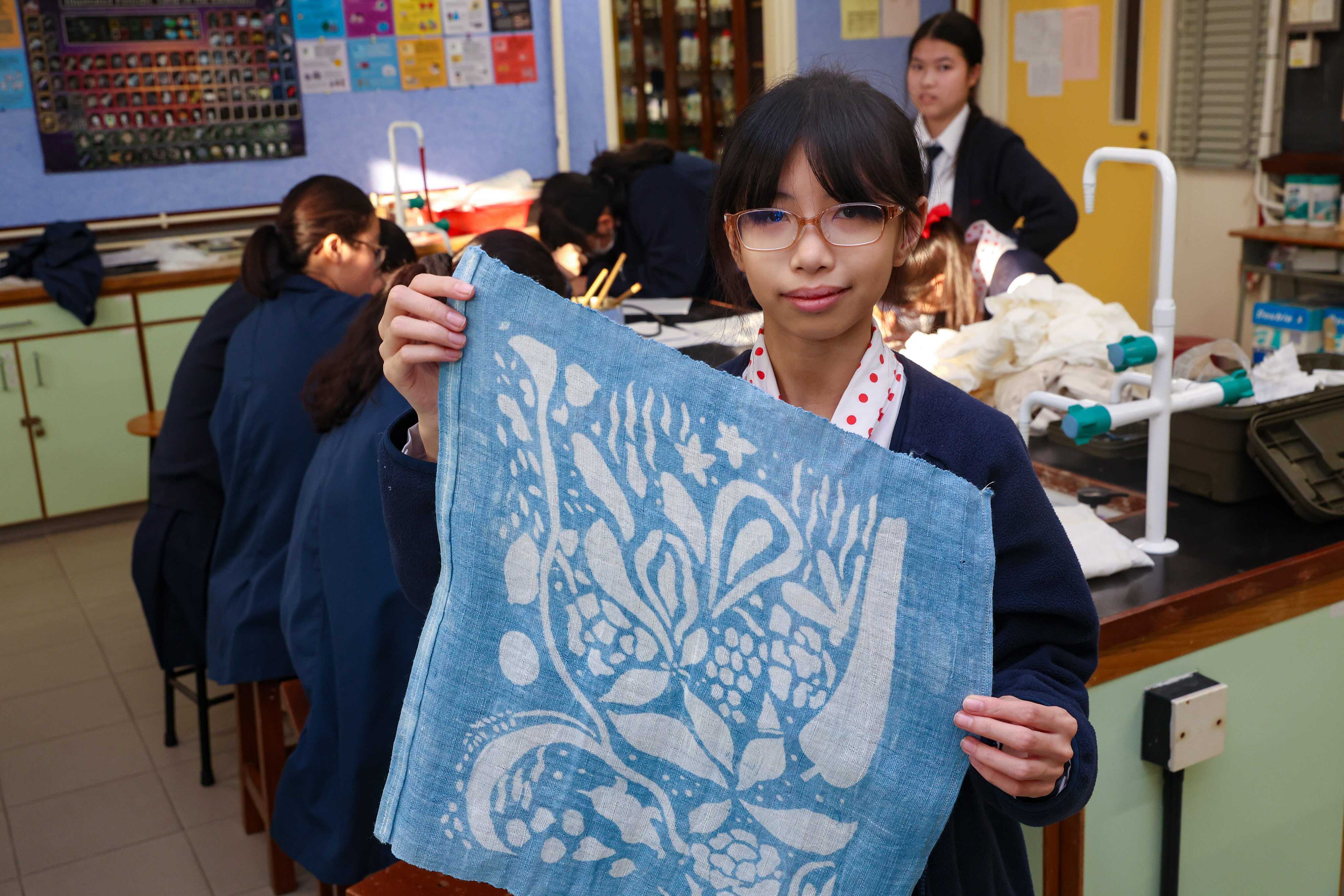
The pupils later fermented its leaves, mixing them with shell ash and banana peels, to make a natural dye. They created designs on fabric using beeswax, before dipping it into the dye. Then, the white fabric transformed into rich shades of blue.
The classroom experiment was part of an indigo dyeing programme. It was made by artist Benjamin Hao Lap-yan, Kadoorie Farm and Botanic Garden, and three chemistry teachers from Tak Oi Secondary School.
Blending art and science, this programme introduces students to Hong Kong’s native plants. It also dives into the culture and science behind this sustainable alternative to synthetic dyes.
Fifteen-year-old Kelly Yip Tsz-ching appreciated this chance to learn about sustainability.
“Before joining this programme, I thought all dyeing processes use chemicals – I never thought we could use such simple ingredients to dye textiles like this,” said the Form Three student at Tak Oi Secondary School. “This is ancient wisdom passed down.”
Made in Hong Kong
Over the past four years, Hao has devoted his research and creative practice to Chinese indigo and its dyeing process.
Centuries ago, indigo dyeing was integral to Hakka village life in Hong Kong. Back then, the plant was cultivated to create blue textiles.
Hao pointed out that this traditional craft could also help us live in a way that is better for the environment.
“In the past, people created things necessary for daily life in harmony with their environment, using what was naturally available,” Hao said.
“In a way, this traditional practice responds to modern problems like fast fashion and pollution caused by industrial dyeing and production.”
‘Play seriously’
Delton Li Yiu-sing is a programme manager from Kadoorie Farm’s holistic education department. Li said he hoped for students to step outside the classroom and “play seriously”.
“We’ve designed this programme to have a spirit of playfulness, but in a serious, meaningful way,” Li said.
He wants indigo dyeing to broaden students’ awareness of sustainability.
“It helps them see that in the past, people didn’t have chemical dyes or factory-style production,” he said.
“When we talk about sustainable development nowadays, it’s really about how we can ... discover alternative ways of doing things.”