Difficulty: Explorer (Level 1)
It is important to be curious! Learning more about ourselves and the world around us involves asking questions and trying new things. Here are two activities that will help us explain why something happens the way it does. Try to come up with an explanation yourself by forming your own theory. Then, learn the science and see if your guess is close.
Magic milk
Materials
-
a shallow dish
-
full-fat milk
-
a squeeze of liquid dishwashing soap in a small container
-
3 or more different food colourings
-
5 cotton buds
Instructions
-
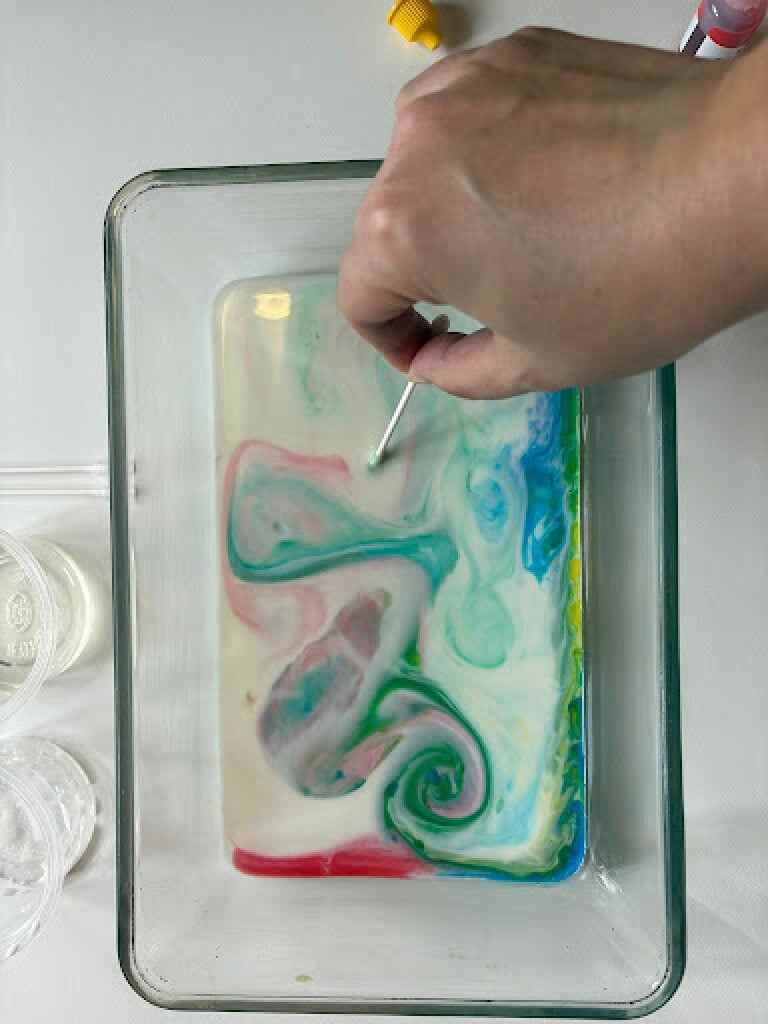
Pour milk into the dish until it is halfway full.
-
Then, add a drop of one of the food colourings into a corner of the dish. Add the other food colouring drops into different parts of the dish. Make sure the different colours do not mix.
-
Dip a cotton bud into the liquid dishwashing soap until one end of the cotton bud is fully coated.
-
Carefully put the coated end of the cotton bud anywhere in the tray of milk. The colours will swirl around it.
-
Continue dipping cotton buds into the soap and into the milk until the colours stop swirling.
Why do the colours swirl?
The dishwashing soap pushes fat in the milk away, causing it to swirl around.
Floating hues
Materials
-
kitchen paper towels
-
a sheet of plain paper
-
markers (black and colours)
-
a shallow dish or tray
-
water
Instructions
-
Fold the kitchen paper towel in half and place it on a sheet of paper. Draw the outline of anything you like using a black marker.
-
Unfold the paper towel and check that the drawing has seeped through to the other side. If it is not identical, use your marker to make both sides the same. Then, colour in only the drawing on the right half.
-
Fold the paper towel so that only the side without colour is visible.
-
Fill your dish or tray with water. Gently place the paper towel into the dish until it is submerged in water. Colour will start to show up in your drawing.
Why do the colours “magically” appear?
The paper towel becomes thin and see-through when submerged in water, allowing colours on the bottom half to seep through and appear on the top half of the towel.

Content provided by