Do you think sharks attack humans because they smell our blood? Turns out, the first thing a shark might notice about humans is the unique sounds we make in the ocean.
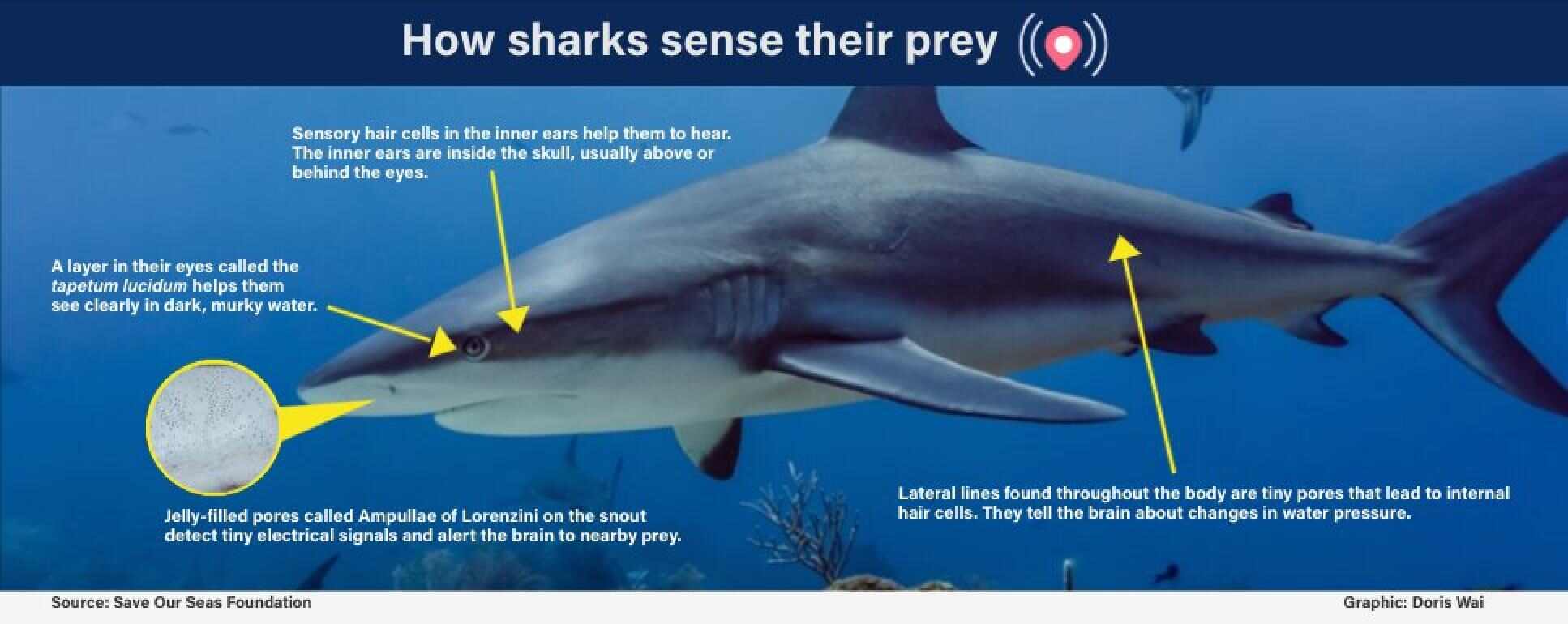
And great white sharks have really good hearing. Even a juvenile can detect you from as far as 100 feet (30.48 metres) away (see graphic). A new study has found that sharks often can tell from just our splashing that we’re not worth the nibble.
“There are dozens – if not potentially hundreds – of encounters daily at a beach with a lot of sharks and people. Why aren’t people being bitten? How do we explain this?” Chris Lowe said. He is the director of the Shark Lab at California State University Long Beach in the US. The research lab studies marine animals.
Shark encounters with humans
For years, Lowe and his lab have documented white sharks getting very close to people in
the water. The shark’s approach is never rushed or aggressive. Usually, something makes the shark curious, and as it creeps closer to investigate, it loses interest and swims on. In a first-of-its-kind study, the lab designed a hearing test for sharks.
Using a special machine that can capture not only sounds but also their three-dimensional movement, scientists recorded themselves doing three common ocean activities: freestyle swimming, kayaking and paddling on a surfboard.
They played the “sound bites” at different distances under water and observed whether a shark would move towards the speaker.
Study reveals sound differences
This study is ongoing, but the preliminary findings
are striking. Sharks could tell the difference between the three water activities. The louder, more chaotic sound of freestyle swimming can make a shark more likely to approach from a distance. This swim style is in the same frequency range as the sounds of a struggling fish.
With paddling on a surfboard, the sharks could recognise the sound, but they often tuned it out.
They did not react much to the gentle, continuous sounds of kayaking, said Whitney Jones, who led and designed the study.
“This is the first study to empirically show that they seem to be using sound to cue in to people at these greater distances,” Jones said.
Jaida Elcock is a shark biologist with the Marine Predators Group at Woods Hole Oceanographic Institution. It is a leading independent NGO in the US dedicated to the ocean. Elcock said more data would
make it easier for us to understand how important sharks are for their ecosystems.
“Sharks can be found in every type of ocean ecosystem – they’re deep-sea, they’re in shallow reefs, there’s even an Arctic shark,” Elcock said.
“If we don’t even fully understand how they function in the world the way it is now, it is going to be even harder for us to understand how those vital parts of our ecosystems will function as the ocean continues to change.”