
Deep Dive delves into hot issues in Hong Kong and mainland China. Our easy-to-read articles provide context to grasp what’s happening, while our questions help you craft informed responses. Check sample answers at the end of the page.
News: More Chinese graduates opt for gig work
-
63 per cent of jobseekers who graduated in 2025 moved to smaller cities
-
Those who graduated in 2025 made 7.7 per cent more starting pay compared with those from 2021
China’s recent university graduates are seeking flexible jobs instead of higher studies, a Beijing-based education consultancy has reported. Meanwhile, starting pay is not rising as fast as average pay.
In the past five years, more university graduates have gone for flexible jobs. The percentage went up by 2.7 points, from 4.2 per cent in 2021 to 6.9 per cent now.
This increase is even higher for students who attended vocational schools, according to the MyCOS Research Institute.
Around 12.7 million students will graduate from university in 2026, and many will struggle to find work.
The report stated that only 3.4 per cent of graduates took graduate school admission examinations before getting jobs, falling from 5.6 per cent in 2023.
After finishing university in 2025, 63 per cent of jobseekers moved to smaller cities or towns at or below the prefecture level. This is a rise from 58 per cent in 2021.
“The traditional one-way flow patterns of following the trend for further studies and preferring first-tier cities are gradually being broken, replaced by more pragmatic and diversified career paths,” MyCOS said. “Employment characteristics of the new generation of [university] graduates are rooting themselves in prefecture-level cities, rationally viewing further education and embracing diverse and flexible employment.”
The report found that last year’s graduates were earning 7.7 per cent more starting pay than those who graduated in 2021, even after inflation. But this pay rise is small compared to overall urban wage growth.
National Bureau of Statistics data showed that last year’s urban non-private sector pay increased by 14.2 per cent compared to 2021. Private sector pay rose 9.8 per cent.
Salaries for vocational college graduates rose by 5.8 per cent over the past five years, reaching 4,882 yuan (HK$5,627) per month, according to the 2026 China College Graduates Employment Report.
Spending was unlikely to keep pace with the recent growth in starting salaries, said Gary Ng. He is a senior Asia-Pacific economist at the French investment bank Natixis.
“A lot of people are still worried about their future and are saving up for rainy days,” he said.
Last year, 14.2 per cent of graduates found jobs in education, while 9.3 per cent worked in software and IT. Meanwhile, 7 per cent found jobs making electronic and electrical equipment. These were the three main job areas, according to MyCOS.
It added that more workers were attracted to advanced manufacturing and new ways of doing business.
Staff writers
Question prompts
1. Which of the following statements is false, according to the information in the news?
(1) University graduates from the class of 2025 were making a lower starting pay compared with those from 2021.
(2) Sixty-three per cent of jobseekers who graduated last year chose to live in smaller cities.
(3) University graduates were paid less than vocational school graduates.
(4) The majority of graduates from 2025 are employed in education, information technology and electronics manufacturing.
A. (1), (2) only
B. (1), (3) only
C. (2), (4) only
D. (3), (4) only
2. Based on your understanding of the news, why do you think more Chinese graduates are living in smaller cities?
3. How have starting salaries for graduates changed in the past five years? Could this lead to a change in people’s spending? Explain using the news, glossary and your own knowledge.
Graph
Question prompts
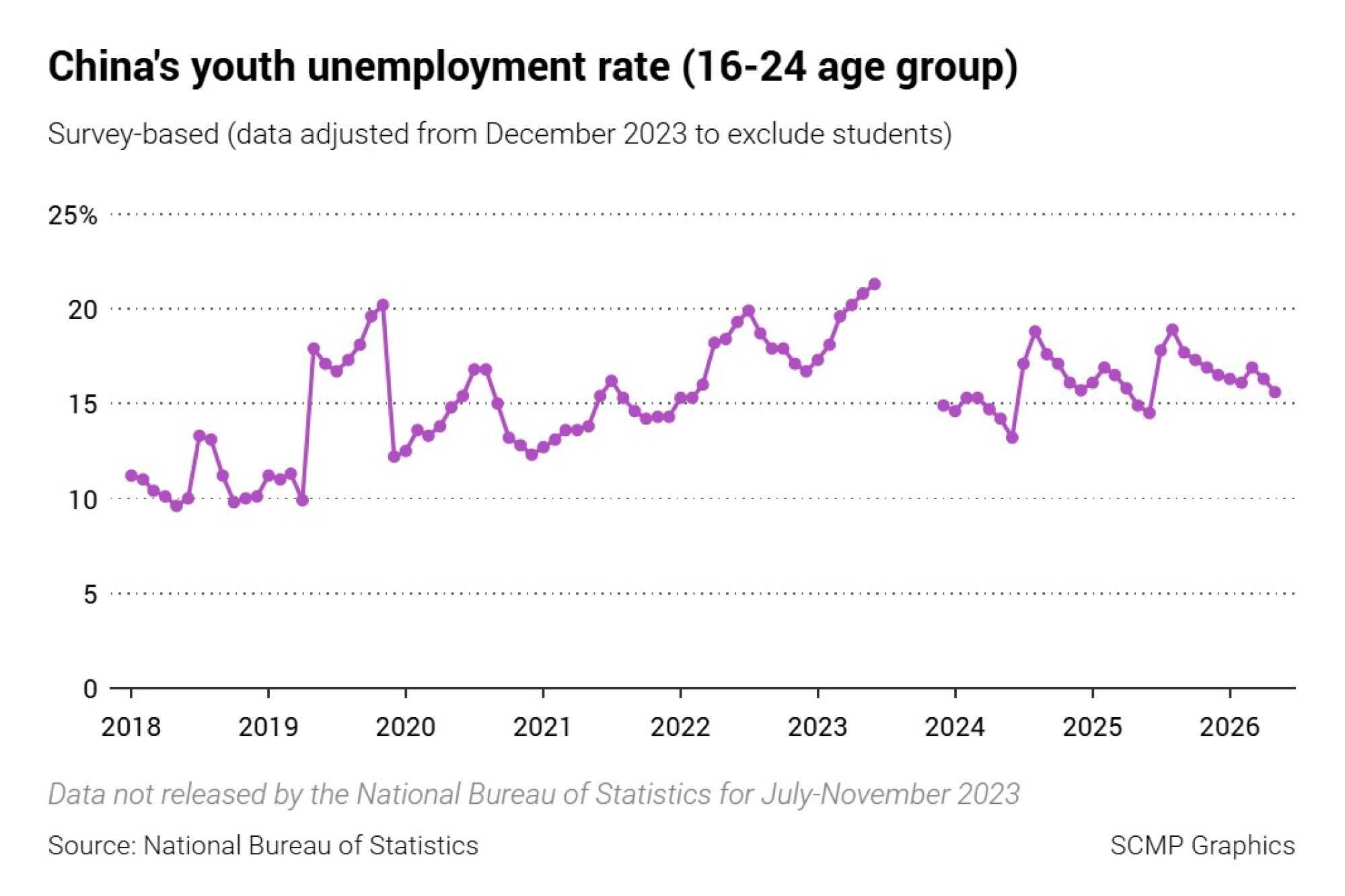
1. Using the chart, note TWO observations about the youth unemployment situation in China from 2018 to 2026.
2. What impacts do you think the unemployment trend in China will have on the country’s gig economy in the long term? Explain using News, Glossary and your own knowledge.
Glossary
-
prefecture-level cities: an administrative region in China that ranks below a province. The biggest prefecture-level cities include Beijing, Shanghai, Guangzhou and Shenzhen, which are often unofficially called “first-tier” cities. There are also dozens of other prefecture-level cities that are smaller than these “first-tier” cities.
-
inflation: the general increase in the prices of goods and services over time, which reduces your money’s purchasing power. When inflation occurs, a single unit of currency buys less than it did previously, meaning you need to spend more to buy the same items.
-
overall urban wage growth: the average rate at which the salaries of city-dwelling workers increase over a specific period, typically tracked on an annual basis
Sample answers
News
1. B
2. New graduates might prefer living in smaller cities because they may offer more practical and diverse career paths and opportunities. In addition, the cost of living is generally lower than in Tier 1 cities, which is important because although starting wages have risen in the last few years, average pay has not. Living in a smaller city could help people save money. (accept all reasonable answers)
3. According to reports, starting salaries for university graduates in 2025 were 7.7 per cent higher than those for the class of 2021; the same is true for those who attended vocational school. However, Gary Ng, a senior Asia-Pacific economist at Natixis, suggested that people’s spending is unlikely to change despite these increases in starting salaries. This reluctance may stem from the instability of the job market in recent years, leading many individuals to feel uncertain about their futures and prefer saving for potential downturns. (accept all reasonable answers)
Graph
1. First, the graph indicates a steady rise in youth unemployment in China over the period from 2018 to 2026. Second, the highest levels of youth unemployment tend to occur in the middle of each year.
2. The persistently high youth unemployment rate is likely to increase the size of the gig economy and could fundamentally change its role within the labour market. As more people enter the gig economy, this sector may become the primary employment buffer for urban areas in the long run. The younger workforce may come to accept precarious, low-paid gig work as a permanent substitute for the diminishing availability of stable middle-income jobs.