
Deep Dive delves into hot issues in Hong Kong and mainland China. Our easy-to-read articles provide context to grasp what’s happening, while our questions help you craft informed responses. Check sample answers at the end of the page.
News: China looks for new treatments for Alzheimer’s, Parkinson’s
-
Researchers are exploring new ways to treat symptoms of these neurodegenerative diseases
-
Cases are expected to rise as China’s population continues ageing
China is stepping up efforts to find new treatments for Alzheimer’s disease and Parkinson’s disease.
As its population ages, the country already has more cases of these neurodegenerative diseases than anywhere else in the world. These are conditions that destroy parts of your nervous system, especially your brain.
Rates in China are rising faster than the global average.
Cases of Parkinson’s disease in China are forecast to rise from 3.6 million in 2024 to 10.5 million in 2050. Between 69 million and 92 million people will have Alzheimer’s disease by this time.
Both diseases mainly affect the elderly. China had 320 million people aged 60 and over at the end of 2025.
Chinese researchers are working to develop new Western medicines to treat the symptoms of these diseases. They are also exploring the potential of formulas and ingredients from traditional Chinese medicine (TCM) to complement or replace conventional drugs.
A national project backed by institutes under the Chinese Academy of Sciences was launched in March. The project aims to accelerate the development of original treatments for Alzheimer’s disease.
The global market for Parkinson’s drugs is expected to grow from US$6.1 billion in 2025 to US$9.2 billion (HK$47.8 billion to HK$72 billion) by the end of 2030, according to Boston-based BCC Research. The market for Alzheimer’s drugs is expected to be worth US$13.1 billion (HK$102.6 billion) by this time.
Alzheimer’s and Parkinson’s are both associated with changes in the brain caused by abnormal protein build-ups.
Oxidative stress occurs when the brain’s antioxidant defences break down. This can contribute to the build-up, as can the inflammation of nervous tissue.
In Parkinson’s disease, certain protein clumps lead to the death of nerve cells that produce dopamine. Meanwhile, Alzheimer’s disease is caused by protein build-ups blocking the brain’s communication channels.
Imbalances in the gut microbiome contribute to inflammation through signals transmitted via the body’s gut-brain axis. This network links the gastrointestinal tract – the major organs of the digestive system – and the central nervous system.
Hong Kong scientists have investigated links between this and the onset of Parkinson’s: “This research allows us to ... map the disease progression, which may tell us how we can prevent [it],” said Professor Wing Yun-kwok, chairman of the Chinese University of Hong Kong’s department of psychiatry.
Staff writers
Question prompts
1. Which of the following statements is false, according to the information in the news?
(1) Alzheimer’s disease is caused by a blockage of the brain’s communication channels.
(2) The rate of Parkinson’s disease in China is rising more slowly than the worldwide average.
(3) The global market for drugs to treat Parkinson’s is expected to drop by the end of 2030.
(4) Parkinson’s disease causes slowing and loss of movement and digestive problems.
A. (1), (2) only
B. (1), (3) only
C. (2), (3) only
D. (3), (4) only
2. What TWO problems can lead to the build-up of proteins in the brain, according to the news?
3. Why is China prioritising the development of new treatments for Alzheimer’s and Parkinson’s disease? Explain using the news, glossary and your own knowledge.
Graph
Question prompts
1. List ONE observation regarding the prevalence of Alzheimer’s disease worldwide.
2. What impact could an increase in Alzheimer’s cases have on China and the world? Explain using the news, glossary and your own knowledge.
Glossary
-
Alzheimer’s disease: a disease that slowly kills brain cells. It affects different parts of the brain, but has its most severe effects on the areas that control memory, language and thinking skills.
-
Parkinson’s disease: a disease that slowly damages the central nervous system. Symptoms include slowed and reduced movement, involuntary shaking of the hands, feet and jaw, difficulty swallowing and digestive problems.
-
oxidative stress: an imbalance of free radicals – unstable molecules – and antioxidants in your body that leads to cell damage
-
gut microbiome: the complex community of microorganisms, including bacteria, fungi and viruses, living in the digestive tract
Sample answers
News
1. C
2. Two problems that can lead to abnormal protein build-ups in the brain are oxidative stress and the inflammation of nervous tissue.
3. China is prioritising the development of new treatments primarily because of its rapidly ageing population, a demographic shift that is driving a surge in age-related neurodegenerative diseases, which could burden the country’s healthcare system. Currently, China has more cases of Parkinson’s and Alzheimer’s than anywhere else in the world, and these rates are climbing faster than the global average. If researchers can find new treatments for these diseases, people can be more independent as they age, reducing the burden on the healthcare system. / There is also an economic incentive. The global markets for Parkinson’s and Alzheimer’s drugs are projected to reach US$9.2 billion and US$13.1 billion respectively by 2030. Developing original treatments through state-backed national projects allows China to capture a lucrative share of this growing global market. / Furthermore, by exploring traditional Chinese medicine (TCM) alongside Western methods, China is leveraging its unique cultural heritage to potentially create accessible treatments for its citizens, thereby reducing its reliance on foreign pharmaceutical imports. (accept all similar answers)
Chart
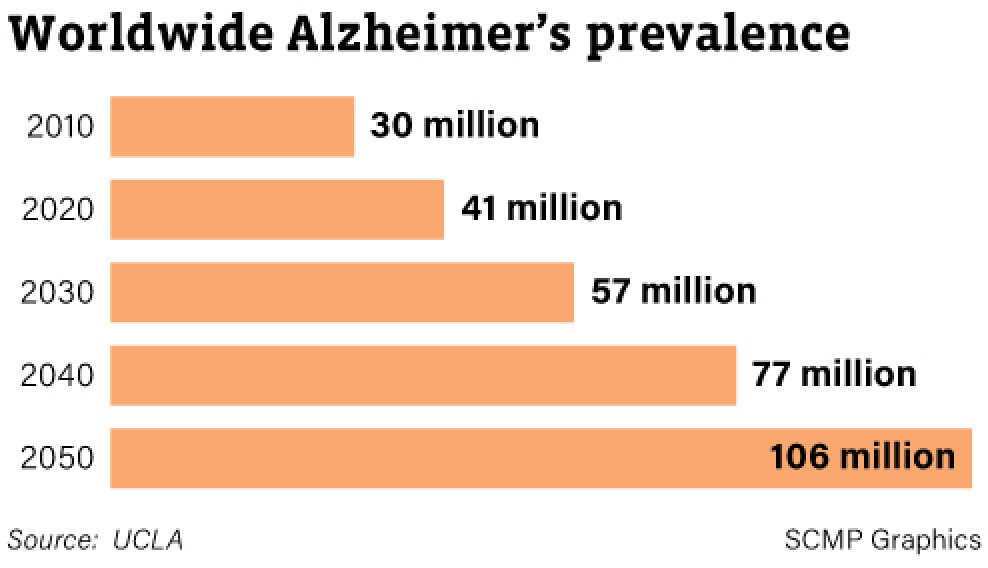
1. The worldwide prevalence of Alzheimer’s disease is projected to experience continuous and dramatic growth over a 40-year period, more than tripling from 30 million cases in 2010 to an estimated 106 million cases by 2050. (accept all similar answers)
2. An increase in Alzheimer’s cases could burden healthcare systems and families. Because it is a neurodegenerative disease destroying parts of the brain, patients require intensive, long-term care, straining public and private budgets as well as availability of carers. / This public health crisis could accelerate global medical innovation. Soaring demand is driving the Alzheimer’s drug market towards an estimated US$13.1 billion by 2030. This incentivises governments and institutes to fund research for treatments for these diseases. (accept all similar answers)