News: More elderly people choose care homes in Guangdong
-
Over 1,100 elderly people have opted for residential care services in Guangdong
-
The Hong Kong government says it will negotiate with Guangdong operators to increase capacity
Hong Kong authorities will negotiate with operators of popular care homes in mainland China’s Guangdong province. They aim to secure more places for elderly Hongkongers, the city’s welfare minister has said.
Hong Kong’s Social Welfare Department launched the Residential Care Services Scheme in Guangdong in 2014.
The scheme is aimed at elderly residents on Hong Kong’s central waiting list for subsidised care and attention. It gives them the choice to live in designated care homes in Guangdong. The scheme provides fully subsidised care, covering accommodation, nursing and meals.
Secretary for Labour and Welfare Chris Sun Yuk-han said that the number of elderly Hongkongers living in care homes under the scheme has multiplied by nine in recent years. He said it represents the rising popularity of retiring in mainland China.
“By March this year, there were 1,100 elderly people in Hong Kong who opted for residence in one of the 26 residential care homes in Guangdong,” he said. “Just by the end of 2022, the number was 120.”
Sun noted that facilities in Shenzhen and Guangzhou were among the most popular choices. He said authorities would negotiate with operators to increase capacity if demand continued to rise.
“Based on the usage statistics, response from the users and also the service level, we can always adjust ... we can always renegotiate the contract,” he said. “We’re trying to grow, to develop the whole programme, so there are different choices all over the Greater Bay Area.”
The number of facilities under the scheme has risen from the initial two to 26. It is part of a government push to help older residents relocate to nine Guangdong cities in the bay area. The scheme hopes to address Hong Kong’s ageing population.
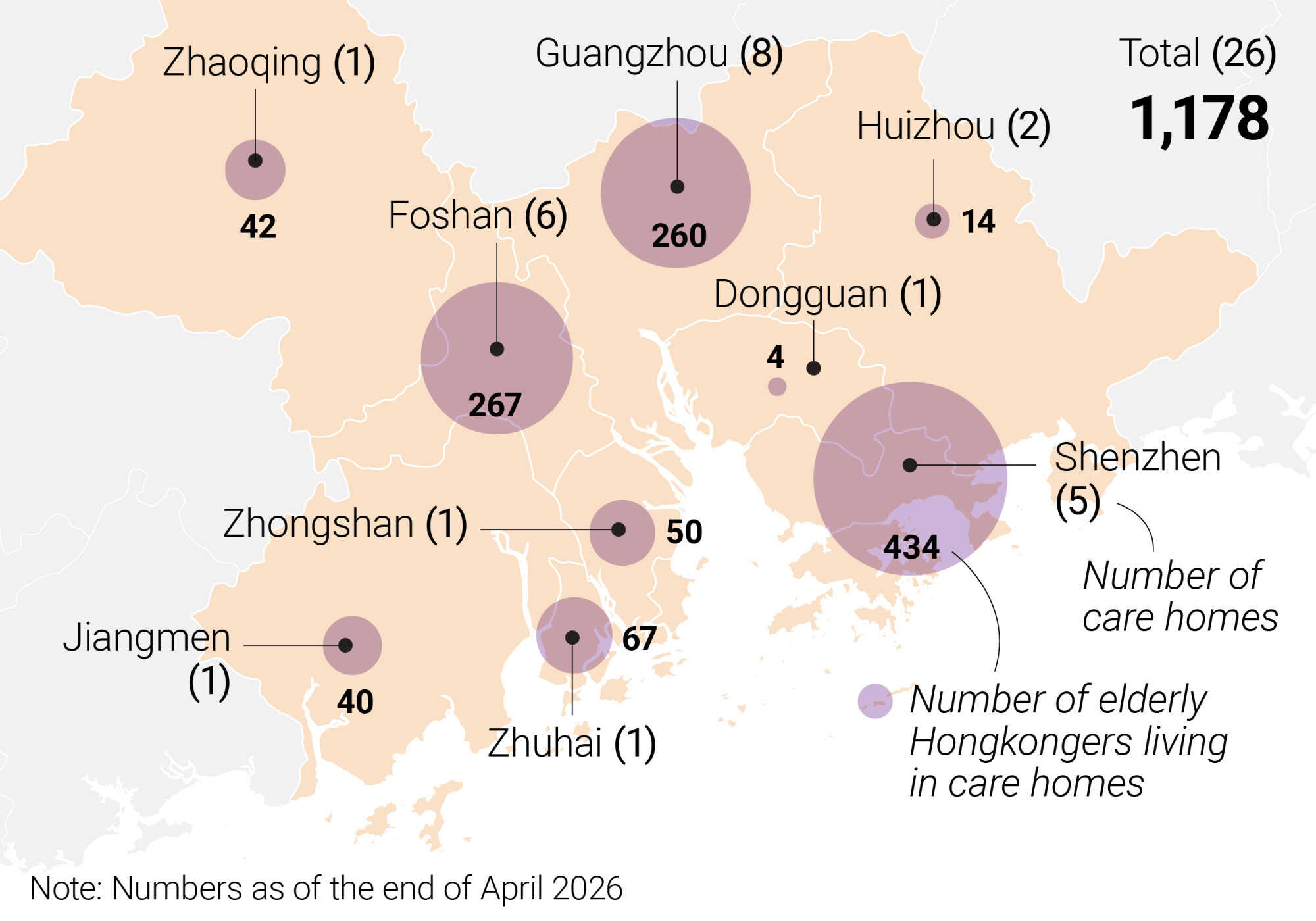
Of the cities, Guangzhou has the most care homes – eight. There are six in Foshan, five in Shenzhen and two in Huizhou. Zhongshan, Zhaoqing, Jiangmen, Zhuhai and Dongguan each have one care home.
Statistics from the Social Welfare Department showed that 1,178 Hongkongers were living in the 26 care homes under the scheme by the end of March this year.
Under the scheme, the department negotiates and signs contracts with care homes based on the type of facility, service packages and location. It pays the service fees based on the number of elderly participants.
Since last December, participants have also been able to apply for a subsidy for medical expenses received at designated medical institutions under the coverage of China’s National Basic Medical Insurance Policy.
Staff writers
Question prompts
1. Which of the following statements is false, according to the information in the news?
(1) The number of older Hongkongers moving into care homes in mainland China has increased by nine times in recent years.
(2) The number of available facilities under the elderly care scheme was initially set at 26
(3) There were 1,178 Hongkongers living in 26 care homes under the scheme by April.
(4) The government negotiates and signs contracts with care homes in Guangdong based solely on location, then pays the fees for elderly Hongkongers.
A. (1), (2) only
B. (2), (3) only
C. (2), (4) only
D. (3), (4) only
2. Why do you think some elderly Hongkongers are choosing care facilities outside the city? Explain using the news, glossary and your own knowledge.
3. Why might some elderly people choose not to join the Guangdong care services scheme? Use the glossary to identify how many are on the central waiting list for subsidised care in Hong Kong to illustrate your point.
Graph
Question prompts
1. Which THREE cities have the most elderly Hongkongers living in care homes? Why might they be so popular?
2. Based on the news and your own knowledge, what are some possible long-term challenges of shifting elderly care to the Greater Bay Area?
Glossary
Residential Care Services Scheme in Guangdong: a cross-border programme run by the Hong Kong Social Welfare Department. It provides fully subsidised care, covering accommodation, nursing and meals. It is an alternative for elderly residents who face long wait times for government-funded beds in Hong Kong, letting them move to high-quality, spacious nursing homes across the border instead.
central waiting list: a list of Hongkongers waiting for subsidised residential care services for the elderly. As of April 30, 18,338 applicants were on the list, with an average waiting time of 12 months.
ageing population: refers to a group of people with a larger proportion of people aged 65 and over. The number of people aged 65 and above in Hong Kong is expected to nearly double from 1.45 million in 2021 to 2.74 million by 2046, when more than one in three residents will be elderly, according to official projections.
National Basic Medical Insurance Policy: refers to China’s state-run, universal healthcare system that provides subsidised medical and hospital coverage to residents through a tiered, cost-sharing framework.
Sample answers
News
-
C
-
Many elderly residents are currently on the central waiting list for subsidised care in Hong Kong, where the average waiting time is about 12 months. Therefore, they might opt for options close to the city, such as the Residential Care Services Scheme in Guangdong, which provides fully subsidised care covering accommodation, nursing, and meals.
-
According to News, the Guangdong care services scheme provides fully subsidised care across various mainland cities outside Hong Kong, such as Foshan, Huizhou, and Jiangmen. These cities offer different lifestyles, languages, and facilities. Elderly residents who have lived in Hong Kong their entire lives might struggle to adapt to a new environment, with language barriers a major concern. Local Hong Kong seniors may find it difficult to communicate basic and urgent needs, such as requesting bathroom use, describing their body discomfort, or explaining dietary preferences, to care home staff who only speak Mandarin. This communication gap can cause immense frustration and even lead to dangerous misunderstandings of medical instructions. Second, moving across the border can place psychological pressure on elderly residents due to social disconnection. Relocating to Guangdong means leaving behind a lifelong social safety net. Elderly citizens who have spent their lives in Hong Kong, even those currently living in dilapidated subdivided flats, remain in a familiar urban area close to their families, neighbours, and local communities. To them, familiar surroundings and emotional proximity outweigh a larger room. Additionally, there were 18,338 applicants in Hong Kong waiting for subsidised residential care services for the elderly as of April 30. This figure reflects that a vast number of residents still hope to stay in the city, despite the government having established the cross-border scheme more than 10 years ago.
Map
-
Shenzhen, Foshan, and Guangzhou have the highest number of elderly Hongkongers living in care homes. It could be because these three cities are the most connected cities to Hong Kong. Shenzhen is right next to the Hong Kong border, while Foshan and Guangzhou are along the High-Speed Rail network from Hong Kong.
-
There are two possible long-term challenges of shifting elderly care services to the Greater Bay Area. One major issue is the lack of integration between the medical histories held by Hong Kong’s Hospital Authority and those of mainland hospitals. Consequently, when a Hong Kong senior falls ill in Guangdong, mainland doctors may struggle to efficiently review their history and prescribe suitable treatments. Another challenge is pharmaceutical accessibility. Hong Kong seniors may not be able to obtain the specific medications they rely on, as Hong Kong and the mainland operate under different pharmaceutical standards and regulatory frameworks.