
Deep Dive delves into hot issues in Hong Kong and mainland China. Our easy-to-read articles provide context to grasp what’s happening, while our questions help you craft informed responses. Check sample answers at the end of the page.
News: Older Hongkongers are pushing back retirement due to finances
-
Survey finds that more than half of respondents do not plan to retire at age 65 because of concerns about money
-
Many say they want to continue working to keep their minds active, find a sense of achievement
More than half of Hong Kong residents do not plan to retire at the typical retirement age of 65. Many feel they cannot reach the average HK$5 million (US$637,000) savings target necessary for a comfortable post-work life, according to the T. Rowe Price Hong Kong Retirement Survey.
About 52 per cent of the 600 respondents said they would not retire at age 65. Among them, about 80 per cent preferred not to retire at all or preferred a “micro-retirement”. This involves taking a break for several months to a few years before returning to work.
“Financial pressure is certainly one factor, especially in a high-cost city like Hong Kong,” said Shen Wenting, who works at T. Rowe Price.
About 60 per cent of respondents had a retirement savings target between HK$2 million and HK$10 million. The average was HK$5 million, considered enough for them to feel secure in completely stopping work.
However, one-third of respondents felt they could not achieve their goals, and 40 per cent reported not having any retirement savings target at all. This may explain why 62 per cent cited the need to maintain an income as their reason for not retiring at age 65.
The survey showed that non-financial motivations were equally influential. Shen noted that 69 per cent of respondents wanted to continue working to keep their minds active, while 40 per cent sought the sense of accomplishment that work provided.
“These findings suggest a growing desire to reprioritise life beyond just income,” Shen said.
Shen said about 54 per cent of respondents kept their retirement savings in time deposits, which currently offer interest rates of only 1 per cent to 2 per cent. Meanwhile, 52 per cent chose savings accounts with almost zero interest.
Shen credited the conservative investment choices to the belief that “cash is king”, as well as economic uncertainty. She urged retirees to consider a different investment approach to meet their retirement goals.
For those wishing to retire at 65, Shen suggested that investing more in stocks at a younger age could yield higher returns. Then, residents could shift to lower-risk fixed income as they aged.
For micro-retirees, taking a career break of a couple of years “will not substantially change their retirement horizon”, Shen said.
Staff writer
Question prompts
1. Based on the information in News, which of the following is true?
(1) Around 65 per cent of survey respondents use time deposits for their retirement savings.
(2) Eighty per cent of survey respondents will not retire or choose micro-retirement.
(3) Forty per cent of respondents feel a sense of accomplishment from their jobs.
(4) A micro-retirement is when you retire with less money.
A. (1), (2) only
B. (2), (3) only
C. (2), (4) only
D. (1), (4) only
2. According to News, what are TWO reasons why older Hongkongers are pushing back retirement or choosing not to retire at all?
3. According to Shen, why are many older Hongkongers cautious about their investments? How are they saving money, and what are the disadvantages of their choices? Explain using News and your own knowledge.
Cartoon

Question prompts
1. How does the cartoon relate to the information in News?
2. Using News and your own knowledge, list ONE advantage and ONE disadvantage of retiring at age 65.
Issue: Hong Kong’s seniors look across the border for retirement
-
Survey finds that 24 per cent of respondents may leave the city when they retire, with many citing mainland China as a destination
-
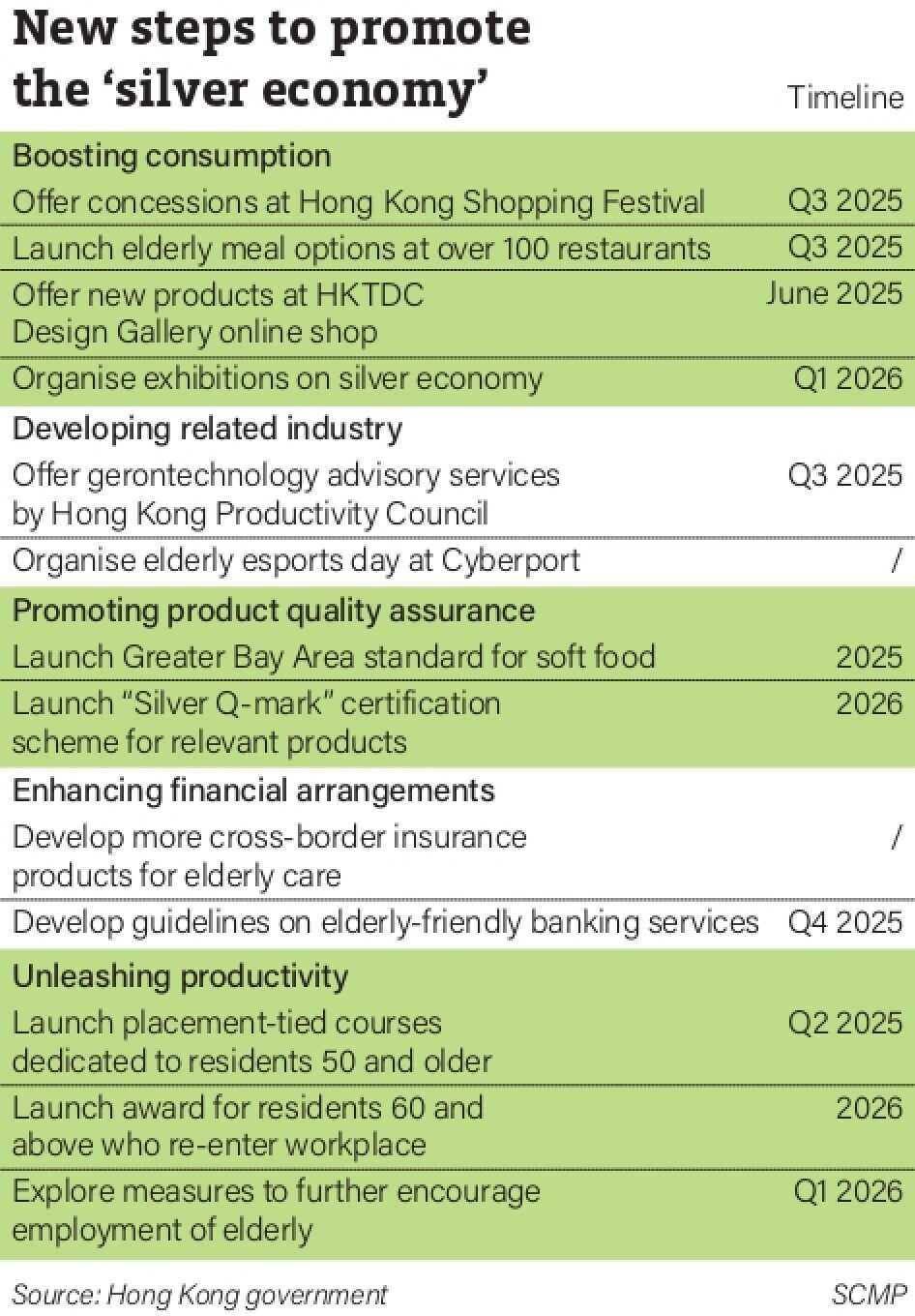
Hong Kong has been promoting the silver economy to encourage spending and make the city more elderly-friendly
A recent survey sponsored by the Golden Age Foundation for BOC Life found that 24 per cent of respondents were seriously considering relocating outside Hong Kong for retirement in the next decade. This is up from less than 5 per cent 10 years ago.
The study polled 428 professionals aged 45 or above in sectors such as healthcare, social welfare, construction and business between May 28 and June 3 this year.
The Greater Bay Area cities of mainland China were the most popular destinations at 42 per cent, followed by the UK, Canada and Australia at 33 per cent and Southeast Asia at 12 per cent.
The survey also found that 14 per cent of respondents had sought medical treatment in mainland China within the past five years, primarily due to lower costs.
Wilson Tang, the chief executive of BOC Life, said the shift was significant and expected the trend would continue as the healthcare system in China improved and gained the trust of baby boomers.
“Cross-border healthcare and cross-border retirements are interconnected,” said Tang. “When you move to a new location, having a good healthcare system nearby is essential. Otherwise, you may have to return to Hong Kong for medical care when you’re unwell, which is not practical.”
Tang said the healthcare costs across the border were a lot lower than in Hong Kong.
“For example, people can pay as low as below half of the Hong Kong price for a magnetic resonance imaging test in cities within the Greater Bay Area, such as Zhuhai and Shenzhen. And the quality is good,” he said.
According to Hong Kong’s Census and Statistics Department, by 2043, over one-third of the city’s population will be aged 65 or older.
In light of this demographic shift, the Hong Kong government unveiled 30 measures in May to boost the silver economy. This move seeks to create a more elderly-friendly society and increase consumption by enhancing financial and security arrangements among seniors.
Government data showed the spending of people aged 60 and above reached HK$342 billion (US$43.6 billion) in 2024, accounting for 11 per cent of the city’s gross domestic product.
Think tank Public Policy Institute estimated that spending by elderly residents would grow to HK$745 billion in 2046, with the figure accounting for inflation and the ageing population.
“No one can be sure how the silver economy will evolve in terms of demand and products as we have yet to experience it,” said Tang. “However, as the large retirement scale from the baby boomers group is coming, this will bring tremendous business opportunities to foster the growth of the silver economy.”
Staff writers
Question prompts
1. Based on the information in Issue, which of the following is true?
(1) The Hong Kong government has announced 30 measures to boost the silver economy.
(2) A majority of survey respondents say they have gone to mainland China for medical treatment in the last decade.
(3) About 24 per cent of survey respondents considered leaving Hong Kong to retire 10 years ago.
(4) More than 40 per cent of respondents who may relocate for retirement are considering cities in the Greater Bay Area.
A. (1), (2) only
B. (1), (3) only
C. (2), (4) only
D. (1), (4) only
2. Using the information in Issue, name TWO reasons why Hongkongers might consider moving to the Greater Bay Area to retire.
3. List ONE reason why the government is focusing on Hong Kong’s seniors and ONE measure they have introduced.
Chart
Question prompts
1. Which TWO measures to promote the silver economy do you think will be the most effective, and why?
2. How could Hong Kong’s economy be affected if many seniors leave the city when they retire? Explain using the information in Issue and your own knowledge.
Glossary
retirement age: the age at which a person is expected to or required to stop working
time deposits: a money deposit at a banking institution that cannot be withdrawn for a certain period of time
interest rates: for borrowers, the interest rate is the amount you are charged for borrowing money – shown as a percentage of the total amount of the loan. If you are a saver, the interest rate (or savings rate) tells you how much money will be paid into your account, as a percentage of your savings. The higher the savings rate, the more you will get.
baby boomers: the demographic of people born after World War II, from around 1946 to 1964, when there was a large and sustained increase in birth rates
inflation: a measure of how much the prices of goods and services have increased over time. When inflation occurs, more money is needed to purchase the same amount of goods and services.

Sample answers
News
-
B
-
The biggest reason why older Hongkongers are choosing not to retire or retire later is financial. With Hong Kong being such an expensive city, many are finding that their retirement savings are not sustainable. One third of people surveyed do not expect to meet their retirement savings goals. Many respondents also reported that they would continue working because they enjoy their job or the sense of fulfilment it brings them, and because it keeps their minds active.
-
According to the survey, more than half of people kept their retirement savings in time deposits with interest rates of only 1 or 2 per cent, while many chose savings accounts with zero interest. Due to inflation, this means that their money will be devalued, giving them less purchasing power in the future. Shen said that old beliefs that “cash is king” and economic uncertainty were the reasons for these financial decisions.
Cartoon
-
The man in the cartoon appears to be elderly and is shaking a piggy bank, only to find there is nothing inside it. This is representative of the News article because it details how older Hongkongers are not retiring due to financial instability.
-
[Answers may vary]. This might mean it is harder for young people to find jobs, as there would be fewer people leaving jobs and creating job openings. However, this can sustain seniors and their families, and can help with Hong Kong’s ageing population, given that there are so few babies born in recent years.
Issue
-
D
-
For many retirees, close proximity to good hospitals and doctors is essential. According to Issue, the quality of healthcare in the mainland has significantly improved, as seen in the increasing number of older Hongkongers who go across the border to visit the doctor. In addition, as Tang pointed out, healthcare is significantly cheaper in the mainland, which is a greater incentive for seniors who are no longer working and need to save money.
-
According to Hong Kong’s Census and Statistics Department, by 2043 over one-third of the city’s population will be aged 65 or older. This is a major demographic shift, and although seniors generally use more resources – such as healthcare – it also presents an opportunity to develop products and services catering to this population. Seniors will make up one-third of Hong Kong’s population by 2043, meaning more resources should be spent on the elderly in preparation for this demographic shift. In light of this demographic shift, the Hong Kong government unveiled 30 measures in May to boost the silver economy – consumption by elderly people – through enhancing financial and security arrangements among seniors. Measures like these could encourage seniors to stay in Hong Kong, which could benefit the economy.
Chart
-
Answers vary
-
Seniors already have a large amount of purchasing power, and the amount of money they spend is only expected to grow. This creates many potential business opportunities, especially as Hong Kong seeks to develop its silver economy. If these elderly Hongkongers leave, it means they will spend their money elsewhere (accept all reasonable answers).