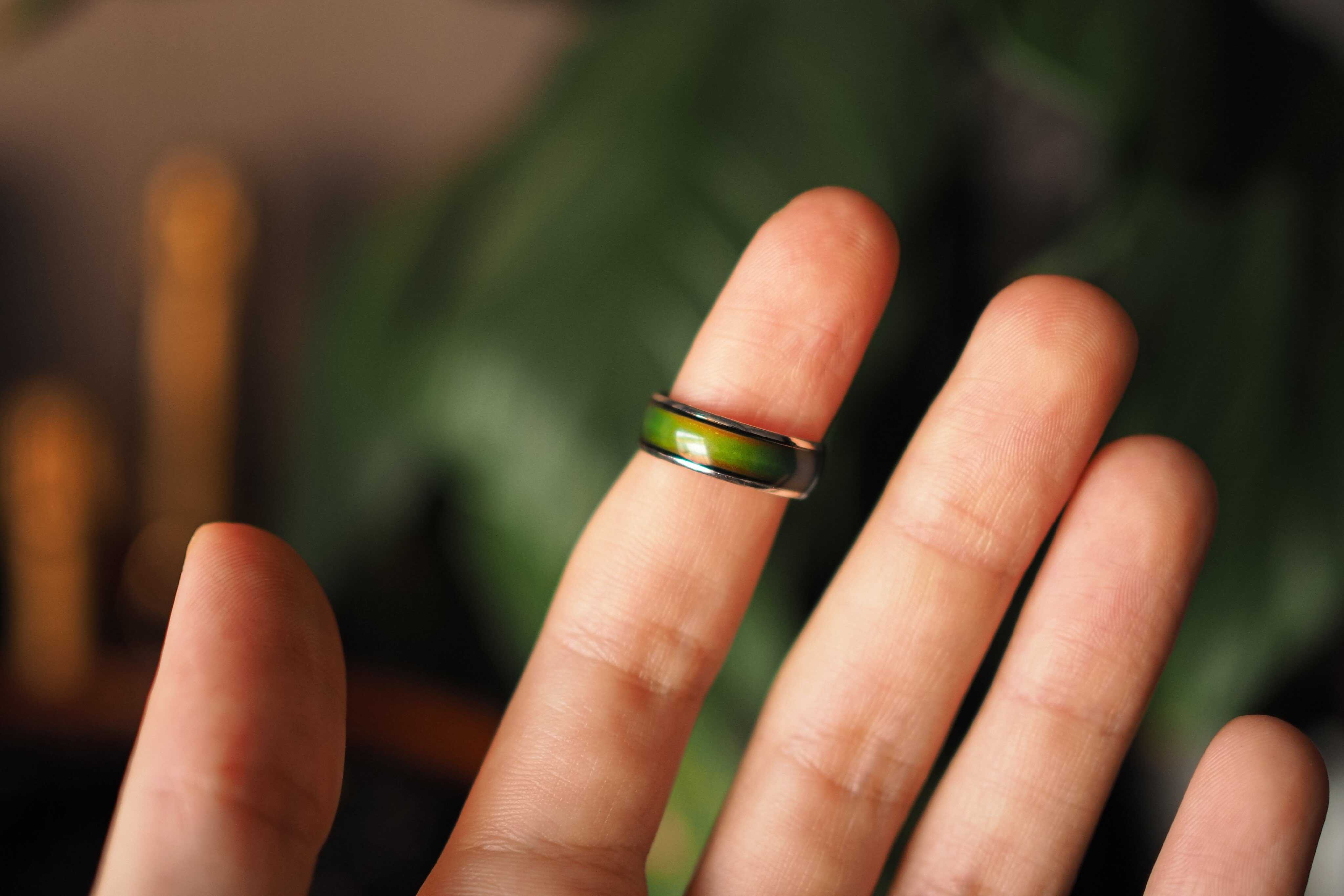
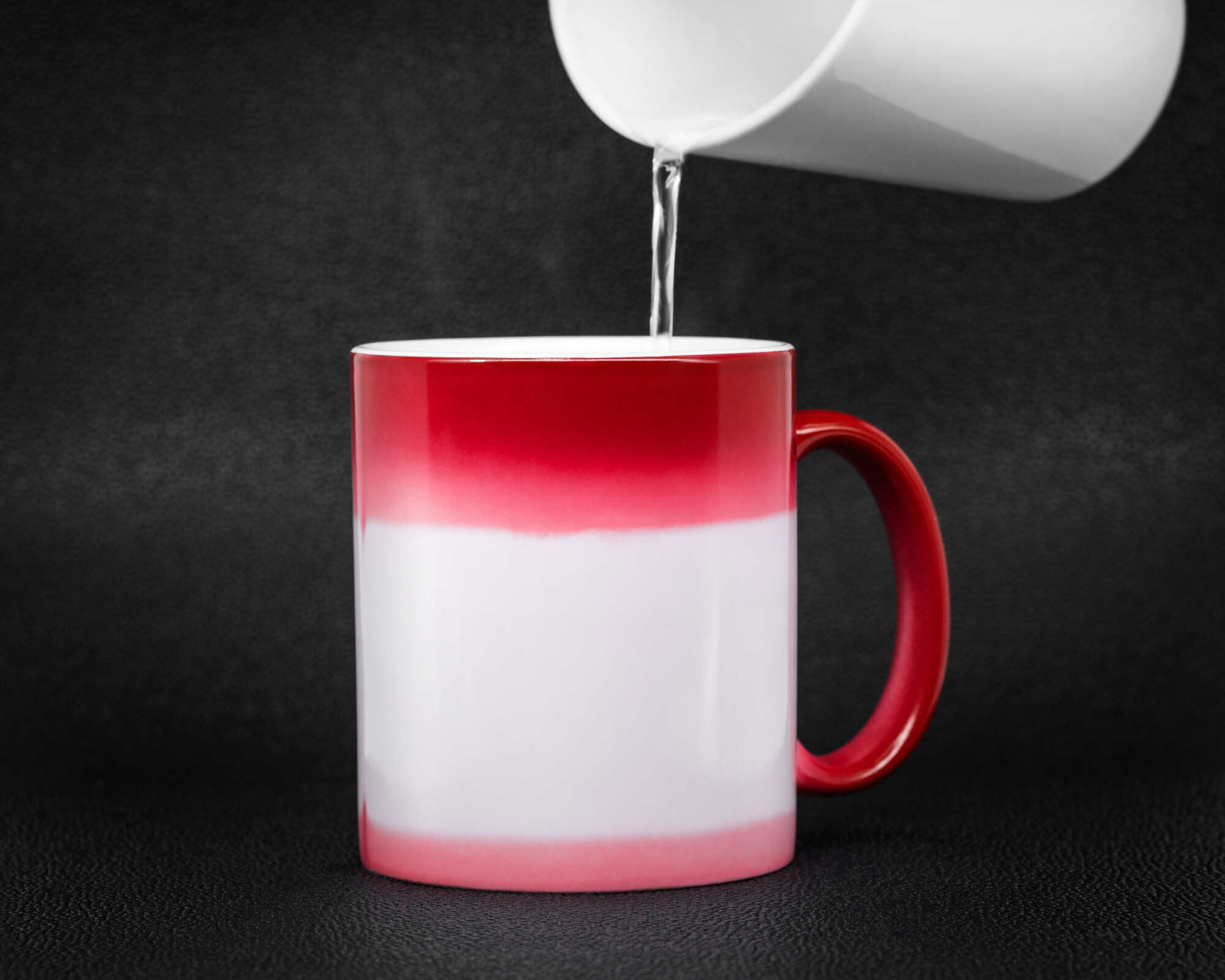
Who can resist the charm of a magical colour-changing mug or eye-catching mood ring?
Both of these items use thermochromic materials. The colour of these substances is affected by changes in temperature. This effect is usually reversible, meaning the material returns to its original colour when the temperature goes back to its starting point.
Thermochromic inks can also be used in practical applications such as temperature indicators. By merging functionality with eye-catching visual cues, these materials enhance everyday convenience and make our lives a little more interesting.
Leuco dyes in heat-sensitive mugs
At the heart of heat-sensitive mugs’ colour-changing magic are leuco dyes. The dyes contain many tiny capsules. Each capsule holds a dye, a colour developer – which is an organic acid – and an organic solvent.
The leuco dye is on the top layer of the mug, and when it is at room temperature, the colour covers a lower layer that has an image. So how does heat make the layer with leuco dye transparent so that we see the image below it?
When the mug is cold, the solvent is in its solid state and cannot dissolve the colour developer. This allows the dye and colour developer to combine and form specific visible colours.
As a hot beverage is poured in the mug, the solvent melts and shifts into its liquid state, dissolving the colour developer. This causes the dye to separate from the colour developer and become transparent. This reveals the hidden design of the mug.
Thermochromic liquid crystals in mood rings
In mood rings, thermochromic liquid crystals – which are another type of colour-changing material – produce a range of enchanting colours that vary based on your finger’s temperature.
This is because heat changes how the liquid crystal molecules are arranged. Depending on the arrangement, these molecules reflect light of different colours.
To make the colours stand out, the liquid crystals are usually put onto a dark surface.
At lower temperatures, the crystal molecules are aligned in layered structures that reflect minimal light. This is called the smectic phase. In this phase, the crystals look transparent, so you only see the dark surface beneath them.
The activation region is the temperature range within which liquid crystals change colour. For mood rings, this region is typically set near human body temperature.
When the temperature rises to the activation region, the liquid crystals change to a different state called the chiral nematic phase. In this phase, the molecules are arranged in layers, with each layer of molecules oriented in a specific direction, forming a twisted, helical structure that repeats at regular intervals.
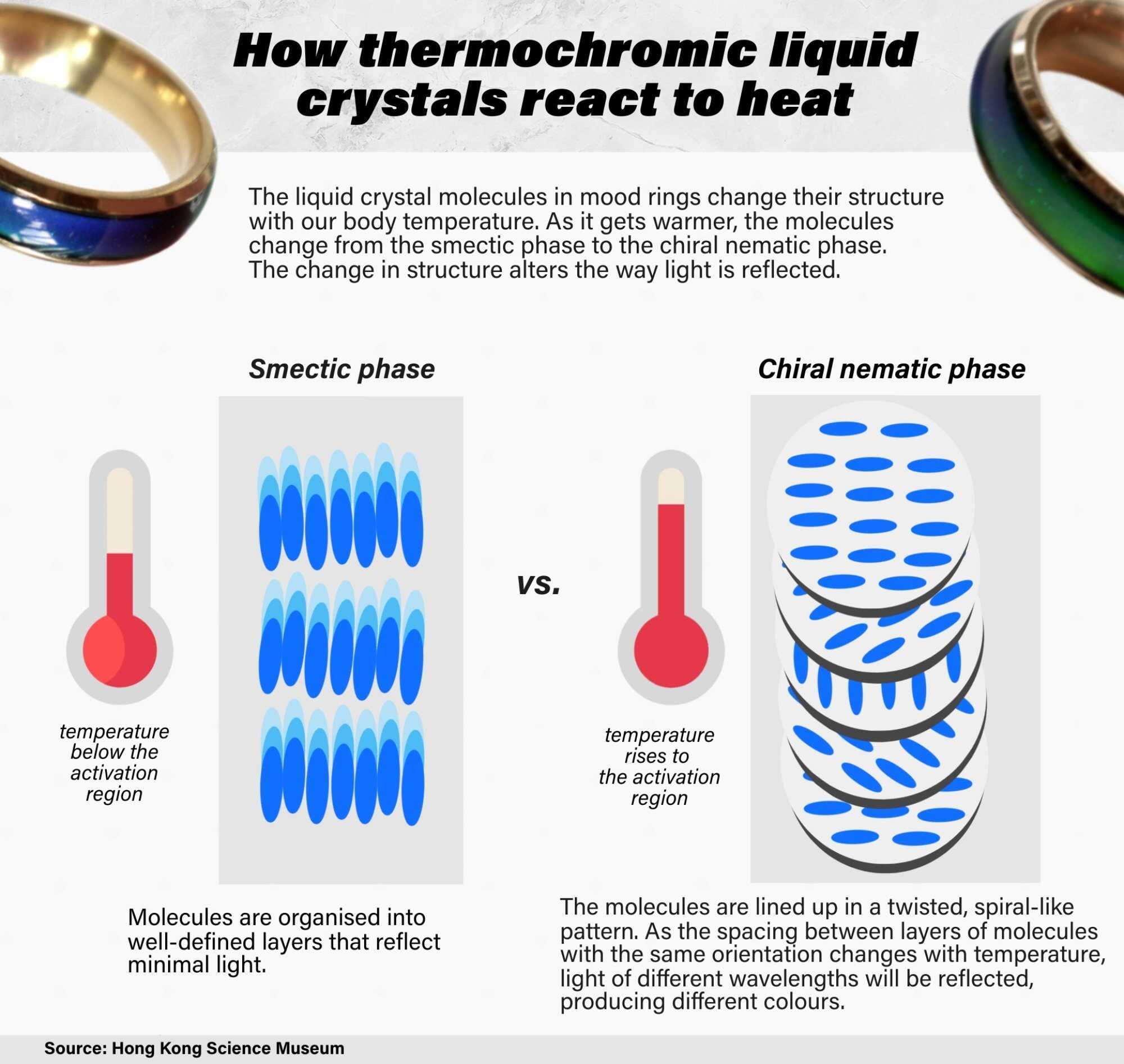
In this arrangement, a certain wavelength of light is reflected from layers of liquid crystal molecules with the same orientation. When reflected light waves meet, constructive interference can occur. This is when the waves combine to produce a wave with a larger amplitude. The colour we see is the wavelength where maximum constructive interference happens.
But as the temperature continues to change, thermal expansion alters the spacing between the layers of liquid crystal molecules with the same orientation. This causes the layers to reflect light at different wavelengths, which results in the colours we perceive (see graphic).
This dynamic colour variation gives mood rings their signature effect – but just remember that these colour changes primarily reflect heat rather than your feelings!