Emily Tang Cho-yi’s journey with Putonghua began with a timid voice and grew into a confident practice of linguistic artistry.
“I think my passion started when I was really young, when I was in kindergarten,” recalled the 18-year-old Form Five student at Diocesan Girls’ School.
A teacher encouraged her to enter a speech contest. Though she spoke softly and did not win an award, the sight of her supportive mother and teacher in the audience planted a seed: language could be a bridge between her inner thoughts and others.
Tang’s bilingual upbringing fanned that seed into a steady flame. She was born in Hong Kong but spent a few years in Beijing before returning to Hong Kong for kindergarten, learning Cantonese while speaking Putonghua at home.
Moving between cities and tongues gave her a lived fluency in shifting cultural frames and a sensitivity to how language carries identity. Home conversations in Putonghua and school life in Hong Kong created a foundation that made Chinese literature and performance feel both intimate and expansive.
For Tang, Putonghua is “a very convincing language” – one that can be shaped by tone, rhythm and emotional colour to move an audience.
Competitions taught Tang that mastery is painstaking and performance is deliberate. She recalled long hours with teachers correcting mispronunciations and studying the precision of televised Spring Reception cultural variety shows as models of exacting delivery.
“Through repeated practice, I have learned to treat pronunciation, pacing and tonal variation as instruments,” she said.
Each rehearsal sharpened her ability to instil feeling into words and to structure a speech so listeners are led, line by line, into agreement and reflection.
Tang’s most memorable competition moment came in Form Three, when she spoke in Putonghua about Hong Kong’s future and the role of youth as “super connectors” between mainland China and the wider world.
She stressed that code-switching – being fluent in Putonghua, English and Cantonese – was essential to cultural exchange.
On stage, she uses soft questions that invite reflection, followed by powerful declarations to build emotional arcs that draw listeners in.
“I also compose scripts with careful attention to rhyme, parallelism and symbolic condensation, so each sentence carries weight and musicality,” she shared.
As a writer of Chinese lyrics, Tang centres her work on hope, heroism and harmony, deliberately weaving classical cultural motifs into modern narratives.
“My creative approach is to fill the spaces with cultural texture, so the picture becomes more vibrant and resonant,” she said.
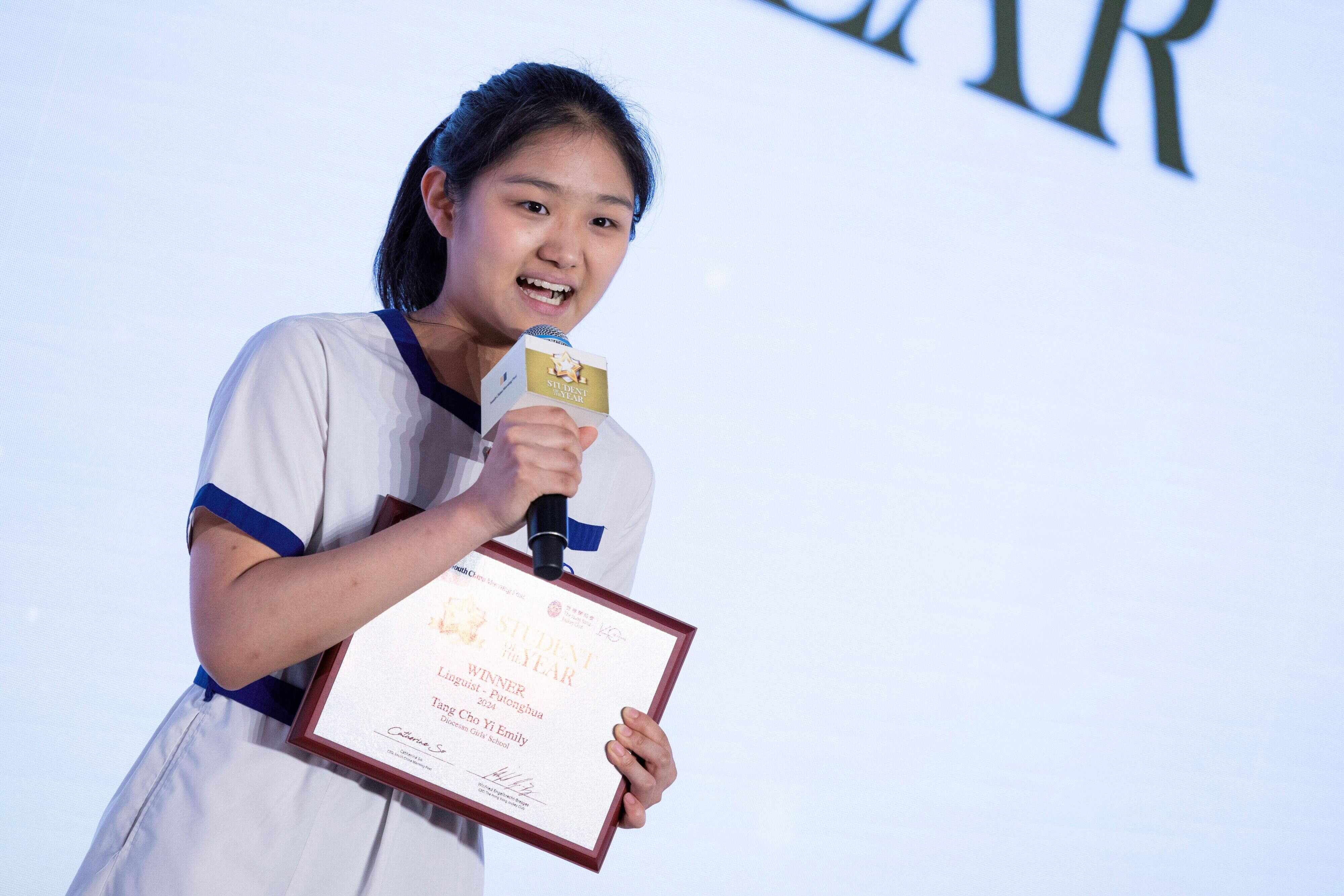
Tang’s pursuit of excellence in Putonghua was recognised when she won the Linguist (Putonghua) category at the 2024/25 Student of the Year Awards, organised by the South China Morning Post and exclusively sponsored by The Hong Kong Jockey Club.
The accolade affirmed not only her technical skill but also the emotional reach of her work.
Looking ahead, Tang sees language and performance as tools she will carry into any career.
By continuing to fuse linguistic craft with cultural storytelling, she hopes to create human connections that outlast a single speech or song.
“Language is a very powerful tool,” she said.