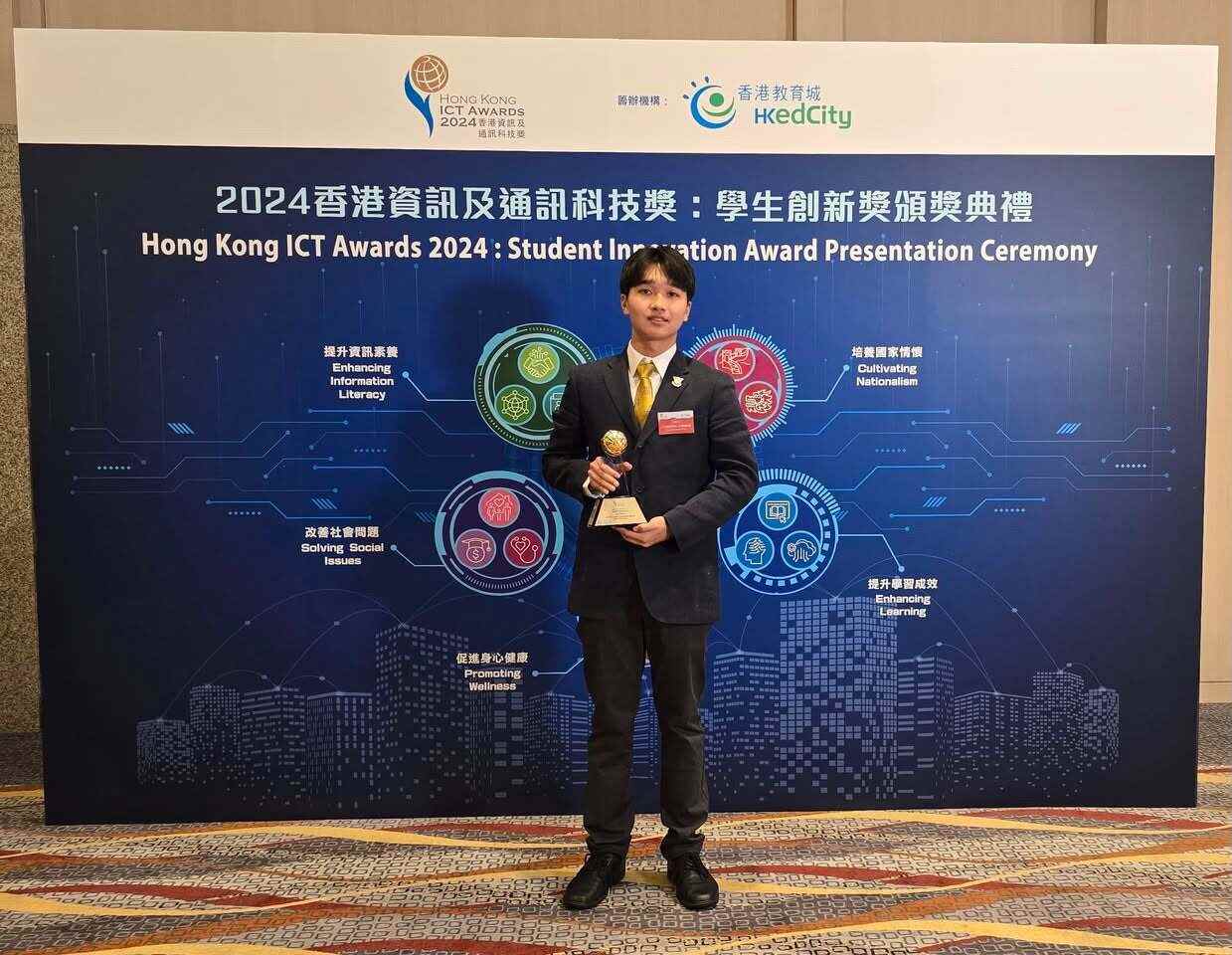
A Hong Kong student has developed a mobile application to help visually impaired individuals navigate retail spaces, showing the practical application of digital skills currently being promoted across local secondary schools.
Eighteen-year-old Ken Mochizuki created “A-EYE”, a free assistive tool that uses smartphone cameras to act as a digital guide, helping users locate items and compare product prices across different brands while they shop.
“If [a blind person] downloads the app, the only thing they need to do is turn on the phone camera,” Mochizuki said, noting that traditional assistive aids, such as guide dogs and specialised walking tools, can cost between HK$10,000 and HK$50,000.
The project won the Gold Award in the Secondary School category at the 2024 Asia-Pacific ICT Awards. Following this recognition, Mochizuki was admitted directly to City University of Hong Kong’s School of Electrical Engineering after graduating from ELCHK Lutheran Secondary School.
Mochizuki attributes his technical foundation to courses provided by the SEED Foundation – a charity supported by the Alibaba Hong Kong Entrepreneurs Fund, the Lee Hysan Foundation, and Contempo. Alibaba also owns the South China Morning Post.
Now, more students will have the chance to build their digital skills. Earlier this month, the SEED Foundation signed a Memorandum of Understanding with The Association of Hong Kong Chinese Middle Schools to launch the “SEED Centre” network.
The initiative will transform participating school campuses into digital learning hubs, allowing students from neighbouring districts to enrol in technology courses.
Over the next three to five years, the programme is expected to serve 1,300 to 2,300 students, offering training in cloud computing, data analytics with assistive artificial intelligence (AI), and UX/UI design.
More than 10 schools have already enlisted as network partners to bring structured digital education to secondary students across all 18 districts.
Ken Lo, CEO of the SEED Foundation, said: “In line with the Hong Kong SAR government’s objectives to nurture local digital talent, our vision for ‘SEED Centre’ is simple: a SEED in every district.”
“Giving young people early exposure to digital technologies, problem solving and innovation helps prepare them not only for future careers, but also to become the next generation of builders and entrepreneurs,” said Cindy Chow, executive director and CEO of the Alibaba Hong Kong Entrepreneurs Fund.

“We are proud to support the ‘SEED Centre’ initiative and hope it encourages more companies to contribute their expertise, networks and resources to help expand opportunities for Hong Kong’s youth.”
“Many students are interested in technology, but not everyone has the same access to learn it properly. ‘SEED Centre’ aims to close that gap,” said Cecilia Ho, president of the Lee Hysan Foundation. “It opens doors for students and gives them more options as they plan for what comes next.”
Mochizuki’s interest in technology began with video games. “I realised games have backends, servers and data stored remotely,” he said. That curiosity led him to explore programming and cloud technology through the SEED course.
“SEED’s course may not accompany you for life, but it can definitely change your life,” he reflected. “When I first started coding, SEED helped me build a deeper digital foundation and gave me direction, confirming my choice to pursue innovation.”
For students like Mochizuki, such educational networks provide crucial workplace exposure. Through a 30-day internship at an AI-focused company facilitated by the SEED programme, he learned to shift his focus from merely building technology to understanding consumer needs and market viability.
“In the new era of advanced AI technology, it is not necessary to acquire technical skills like computing, as AI is able to do it perfectly. The core is soft skills – skills related to pitching ideas and problem solving,” Mochizuki said.
Looking ahead, Mochizuki plans to upgrade the application and develop further solutions for the disabled community. “My dream is establishing a brand tailored for the visually impaired and being the pioneer in this industry,” he said.