Hong Kong will consider letting more junior secondary school pupils use English as their medium of instruction (MOI), with the education minister pointing to an improved learning environment, better qualified teachers and other developments in the sector.
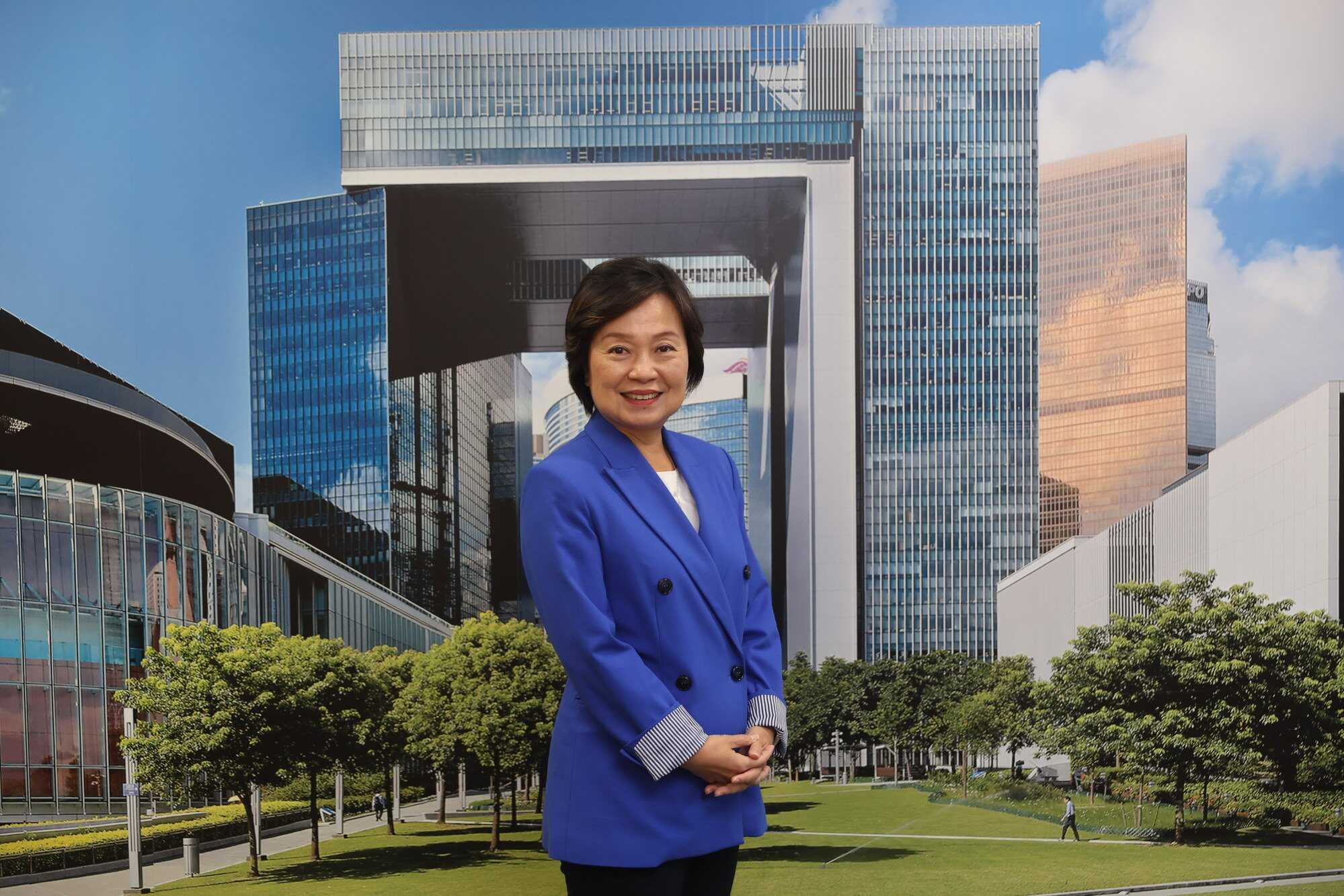
Secretary for Education Christine Choi Yuk-lin also said on Thursday that publicly funded primary and secondary schools could expect more cuts in resources in the coming two years as the government tightened its belt further.
The existing MOI policy, fine-tuned in 2010, allows schools to determine their own medium of instruction in each class if they fulfil certain criteria including student ability, or they can teach English in up to two subjects, in a six-year cycle.
Schools in which all classes are taught in English are regarded as elite and are highly popular with parents and students.
Choi said the policy was now so stringent that only the top 40 per cent of students were allowed to learn in English in junior secondary schools. But she said improvements in the sector led her to consider whether the threshold could be relaxed.
“We have implemented many different support measures like digital education. In fact, there is no big difference in the language environment and teachers’ qualifications [among schools],” she said at an annual spring gathering with the press.
“I think it is worth considering whether we should factor in this ‘student criteria’ [of the top 40 per cent] strictly. Therefore, we will review the future policy of MOI based on the new development model of learning and teaching, Hong Kong as a cosmopolitan city and equipping our students.”
Schools that wish to use English as the MOI have to fulfil three criteria: student ability to learn in English; teacher capability; and adequate support.
To fulfil the first criterion on student ability, for a class to use English as the MOI, at least 85 per cent of the Form One intake must be within the top 40 per cent for English ability in the previous two years of the cycle.
Choi said adjusting the threshold would also depend on the result of a MOI study that the Education Bureau had commissioned the University of Hong Kong to conduct.
She said she was also open to reviewing the duration of the six-year cycle as she wanted to simplify the mechanism. The next cycle will run from 2028-29 to 2033-34.
“I think we can also optimise the mechanism on schools switching MOI, such as whether they will have this review cycle, but now it is too early to say … I am open to suggestions whether the duration should be kept at six years,” she said.
Lee Yi-ying, chairwoman of the Hong Kong Subsidised Secondary Schools Council, said she agreed that the academic performance of students should not be regarded as a rigid threshold ruling out that they could be taught in English.
“A 12-year-old’s mind and abilities are in a dynamic growth stage, possessing extremely high malleability,” she said.
“Whether a student can learn in English effectively depends not on their test scores in their youth, but on the creation of a conducive learning environment, the school’s meticulous cultivation and the individual’s perseverance.”
The existing arrangements allow schools to adopt a “within-school streaming approach” – where English can be used as the medium of instruction for a maximum of two non-language subjects. Previously, institutions adopted only Chinese or English as their MOI.
Choi, meanwhile, also said that primary and secondary schools should expect further cuts in resources in the coming two years as the government reduced spending and that the decision would not be affected by recent improvements in its financial situation.
“When we cut the resources for universities last year, we also cut their resources for three years; secondary and primary education will be the same,” she said.
“We have to finish the process of resource optimisation in three years. So we will still do this in the coming two years.”
In this academic year, one of the largest sources of funding for the city’s public schools – the Expanded Operating Expenses Block Grant – has been cut by 10 per cent.
Authorities last year announced proposed cuts to expenditure, saying the total reduction including the Education Bureau’s internal budget would amount to 7 per cent from 2024-25 to 2027-28.