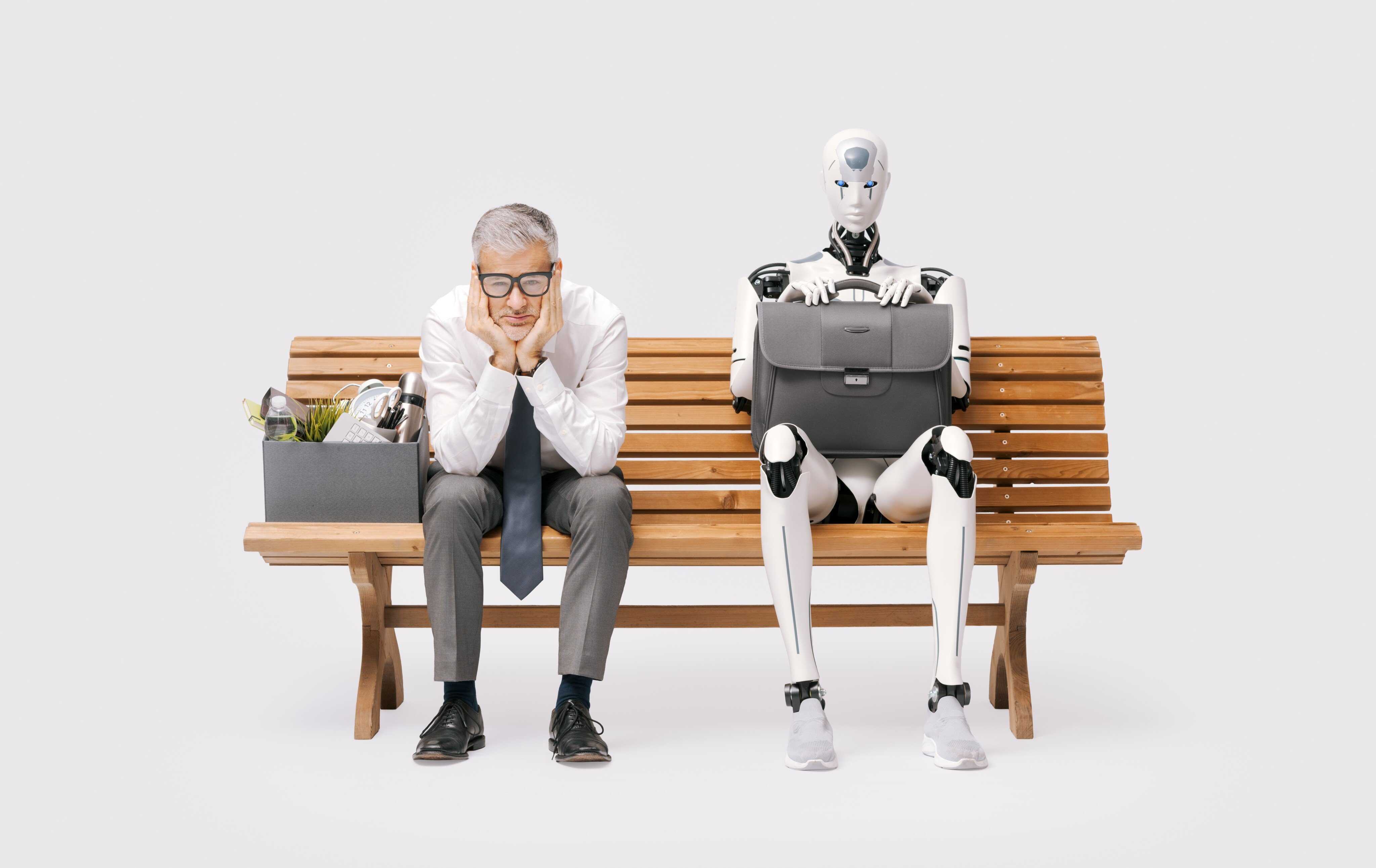
Background: It has only been a few years since the boom in generative AI. Still, many people already fear it could replace human workers, especially those in white-collar office jobs. Recent research from Stanford University suggests this change has been particularly hard on younger workers as companies turn to AI to take on tasks once performed by entry-level employees. New and experienced workers alike are re-evaluating their skills to make their mark as employees that technology cannot replace.
People used to be excited about artificial intelligence. Now, many worry about being replaced by technology. But in fact, what we might be seeing is the unbundling of routine tasks, with AI freeing us to focus on jobs and tasks that require real human connection.
Clinical psychologist Dr Kristie Craigen and Justine Campbell, a clinical counsellor and leadership coach, said many professional roles involve pattern recognition and data processing. These roles require minimal human judgment and can be outsourced to AI.
In the legal industry, for example, AI can now read contracts and spot standard clauses. This leaves junior lawyers to handle the parts AI cannot, such as negotiating with clients and giving advice.
For future generations of the workforce, this can be an upside, as less time is spent on repetitive tasks and on clearing administrative backlog. However, this shift away from traditional output reveals a deeper, more personal challenge regarding how we measure value.
“When a teenager’s entire sense of worth is built on being the one who gets the right answer, and AI can do that faster, this becomes an identity crisis,” Campbell said.
This crisis is a by-product of an educational system that prioritises completing tasks and following instructions while ignoring the human side of work.
The Hong Kong education system, in particular, produces brilliant exam takers. However, it does not teach students how to handle unpredictable situations or how to succeed without someone else telling them they did a good job.
“The education system spent 12 years training students to excel at exactly what’s going to be automated: compliance, following instructions [and] producing correct answers efficiently. That’s what AI does,” Campbell said. “Capability, judgment [and] adaptation when there’s no rubric? That’s the human factor, and that’s what we need to double down on.”
Craigen stressed that AI should be treated as a co-pilot, not an autopilot. A co-pilot assists one in flying the plane, but they still make critical decisions, assess conditions and adjust course when something unexpected happens. Autopilot, on the other hand, removes one from the thinking process entirely.
Craigen, the founder of Craigen Evaluations, a Hong Kong clinic that offers psychological and psychoeducational testing services to students, added that most entry-level jobs include components that can be easily automated, while other functions will be tweaked due to the adoption of AI.
As such, the most resilient careers are those centred on human connection and presence.
Campbell shared an example from her own life: she once had a client who cried for 40 minutes during a counselling session. She said that the client did not say much; she just needed not to be alone with her feelings.
“My job as a therapist isn’t to make people feel better,” Campbell said. “My job is to help them feel what they’re actually feeling – then provide support to navigate it and beyond. AI can’t do that. It would soothe, offer solutions [and] make the discomfort go away.”
For Hong Kong students undecided on a career path, fields such as elderly care, mental health services and neurodiversity support are worth exploring. These roles address critical gaps in existing systems – work that demands independent thinking, complex problem-solving and empathy.
These fields also have something in common: they require confidence when making judgment calls.
While this may seem like a simple concept, it can be difficult for teenagers to grasp in an age of information overload. To develop this skill, three habits are essential.
Curate what not to know
Knowing more information does not necessarily make one smarter. Often, it just drowns out a person’s own voice. If someone is always consuming, they are not thinking.
One challenge is to spend one day a week without using AI or doing any online research. “Resist the urge to turn to AI for every answer. Sitting with your own thoughts builds the self-trust and clarity that endless information can drown out,” Craigen said.
Do something physical
Activities such as cooking, indoor rock climbing and growing plants help one to connect with the real world. They also teach people to trust their experiences rather than just repeating what someone else told them.
Be open to other perspectives
Teenagers tend to disregard opposing views, and any challenge feels like an attack on who they are. However, staying open to different perspectives helps you identify your blind spots and leads to more informed, mature decision-making.
“This isn’t about rejecting AI. It’s about refusing to outsource the one thing it can never replicate ... knowing who you are,” Campbell said.
Ultimately, the goal is not simply to find a job that AI can’t do, but to become a person that AI can’t replace. Craigen emphasised: “For Hong Kong’s next generation, the future does not belong to those who have the most information, but to those who have the clarity to know what to do with it.”