With haunted houses, spooky costumes and frightening films, Halloween is almost here. As a holiday for fearful fun, it begs the question: why can being scared be such a blast? According to experts, it’s about how the brain processes threats.
“When you enter a haunted house during Halloween season, for example, anticipating a ghoul jumping out at you and knowing it isn’t really a threat, you are able to quickly relabel the experience,” Linda Saab and Arash Javanbakht told the Conversation.
“In contrast, if you were walking in a dark alley at night and a stranger began chasing you, both your emotional and thinking areas of the brain would be in agreement that the situation is dangerous, and it’s time to flee,” they added.
According to the assistant professors of psychology from Wayne State University in the US, the relationship between fear and fun comes down to context.
“When our ‘thinking’ brain gives feedback to our ‘emotional’ brain and we perceive ourselves as being in a safe space, we can then quickly shift the way we experience that high arousal state, going from one of fear to one of enjoyment or excitement,” they said.
The sensation of fear begins in the amygdala, where the brain decides what commands to send throughout the body to defend itself. This fight-or-flight response is how the amygdala processes threats.
“A threat stimulus, such as the sight of a predator, triggers a fear response in the amygdala, which activates areas involved in preparation for motor functions involved in fight or flight,” Saab and Javanbakht said. “It also triggers the release of stress hormones and [the] sympathetic nervous system.”
The hippocampus, which is connected to the amygdala, then works with the brain’s prefrontal cortex to interpret the possible threat. This is when the emotional information provided by the amygdala is processed for context through reasoning, allowing a person to differentiate between a legitimate threat and a fun form of fear (see graphic).
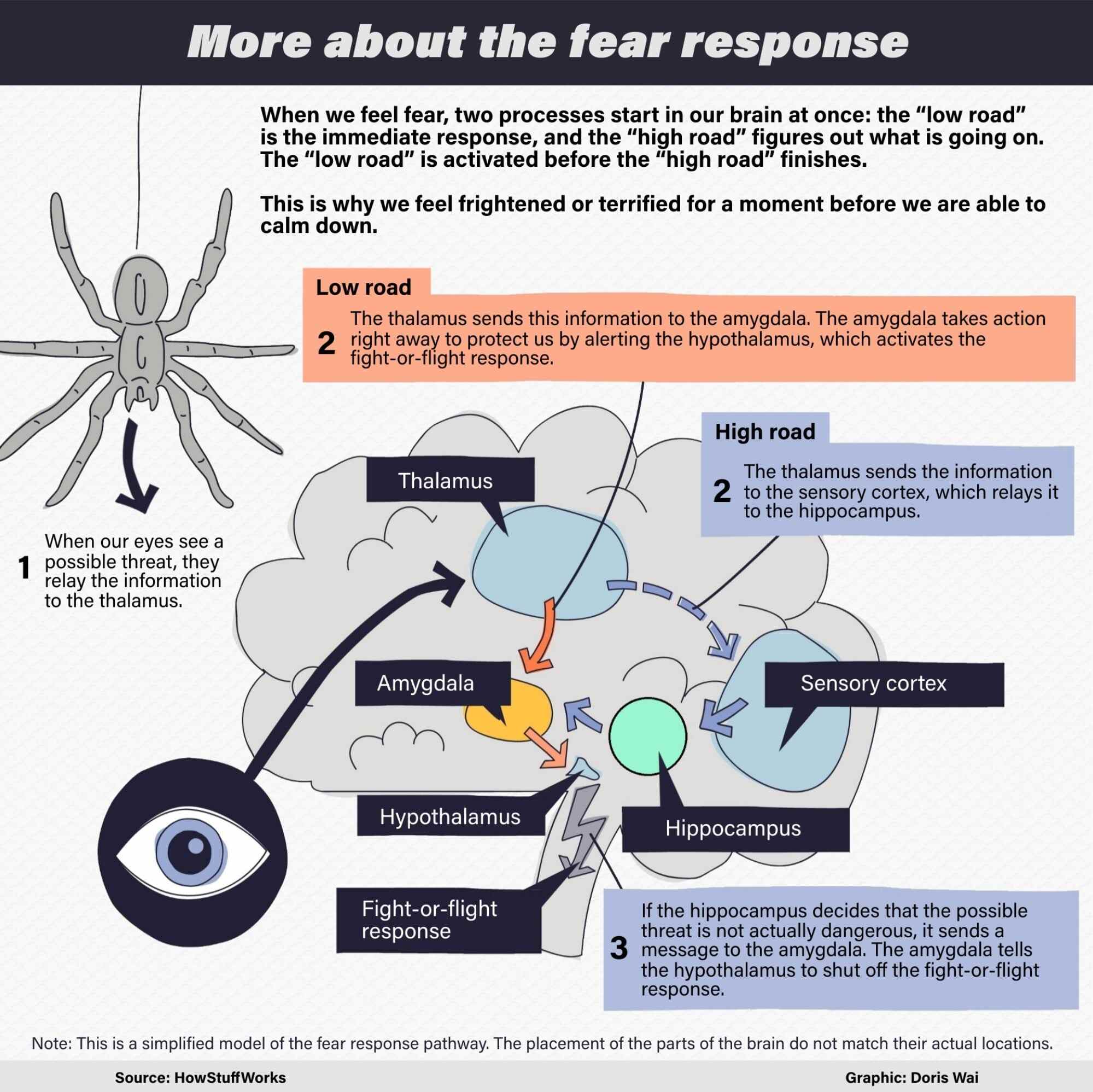
“Our ‘thinking’ circuitry of [the] brain reassures our ‘emotional’ areas that we are, in fact, OK,” Saab and Javanbakht said.
For some, the sensation of fearful fun is a distraction from everyday stresses. For others, it is a bonding experience shared between friends and loved ones.
But the most important reason, according to the experts, is our sense of control.
“While each of these factors – context, distraction [and] social learning – has potential to influence the way we experience fear, a common theme that connects all of them is our sense of control,” they said.
“When we are able to recognise what is and isn’t a real threat, relabel an experience and enjoy the thrill of that moment, we are ultimately at a place where we feel in control.”
Once we realise we are safe and in control, we can overcome that initial fight-or-flight response and enjoy the experience.
What happens to our body when it initiates the fight-or-flight response?
Our body quickly releases hormones that cause our sympathetic nervous system to stimulate the pituitary gland and adrenal glands. This triggers the release of neurotransmitters, such as adrenaline, noradrenaline and cortisol.
This dramatically increases our heart rate, blood pressure and breathing. Our body stays in this fight-or-flight state for 20 to 60 minutes after the danger has passed. It takes the same amount of time for the sympathetic nervous system to return to its normal state.
The parasympathetic nervous system then helps brings the body back to a calm state after the threat is gone.