Difficulty: Challenger (Level 2)
Have you ever wondered why some people dislike bitter foods, like broccoli, while others enjoy them? The answer lies primarily in a gene known as TAS2R38.
The TAS2R38 gene is an integral part of our DNA that helps us taste bitterness. It creates a protein that allows the tongue to taste things.
This gene makes people sensitive to some bitter chemicals, such as phenylthiocarbamide (PTC) and propylthiouracil (PROP). These chemicals are not naturally found in foods, but how we taste them is similar to how we taste other bitter things – and some of these can be toxic.
The TAS2R38 gene comes in different forms known as alleles. There are two main types: the “taster” allele (T) and the “non-taster” allele (t). Those with at least one T allele are called “tasters” and are more sensitive to bitter tastes.
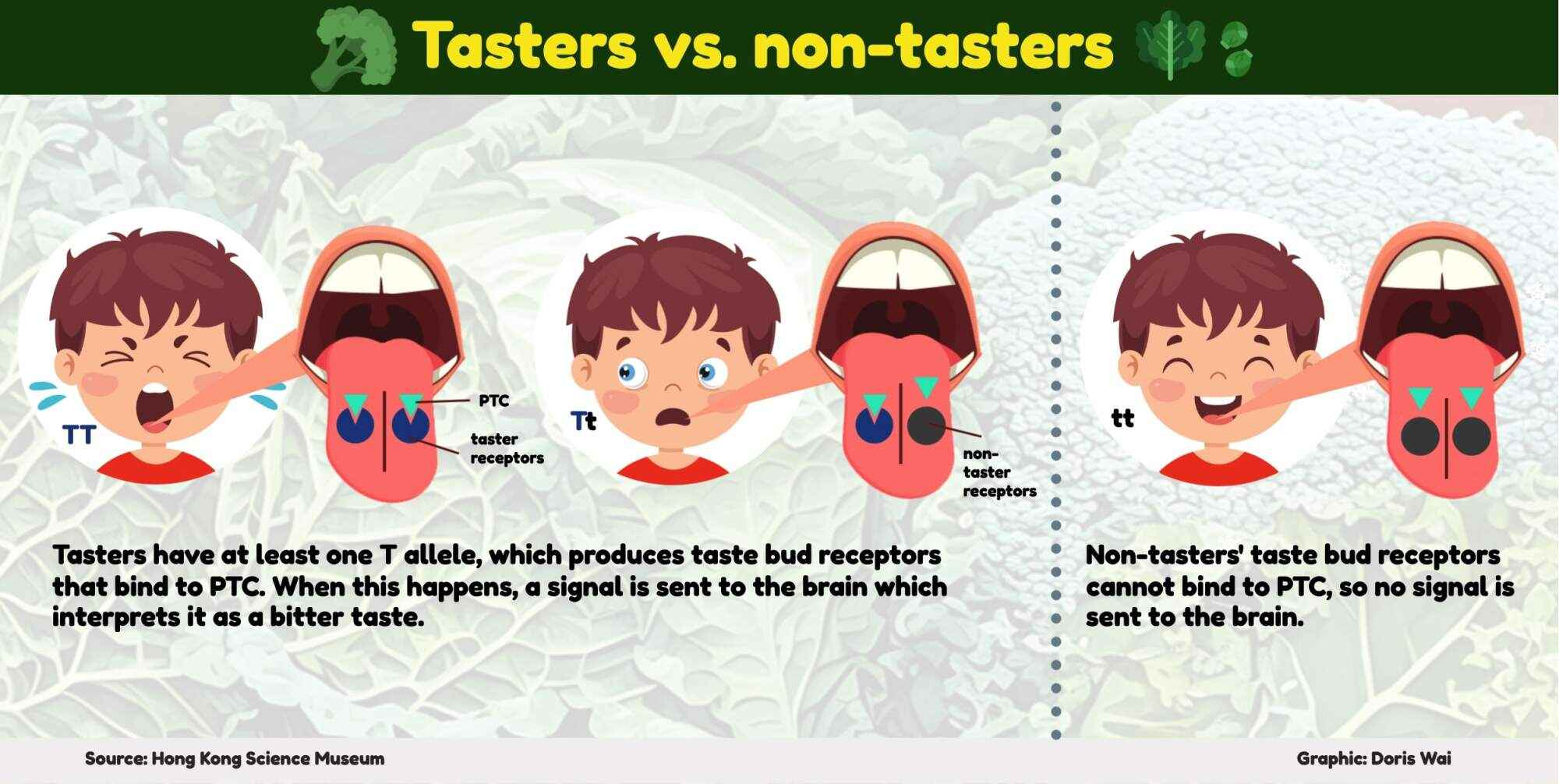
On the other hand, individuals with the tt genotype (two non-taster alleles) are known as “non-tasters” (see graphic). These individuals would not be able to notice the bitterness from PTC and PROP.
But if PTC and PROP are not naturally found in foods, why do vegetables such as kale and broccoli taste bitter to some people? These foods have chemicals called glucosinolates, which are similar in structure to PTC and PROP. Because of this, tasters may find that these vegetables have a strong, unpleasant taste.
Questions
-
What does the TAS2R38 gene do?
-
What is the term for people with at least one “T” allele?