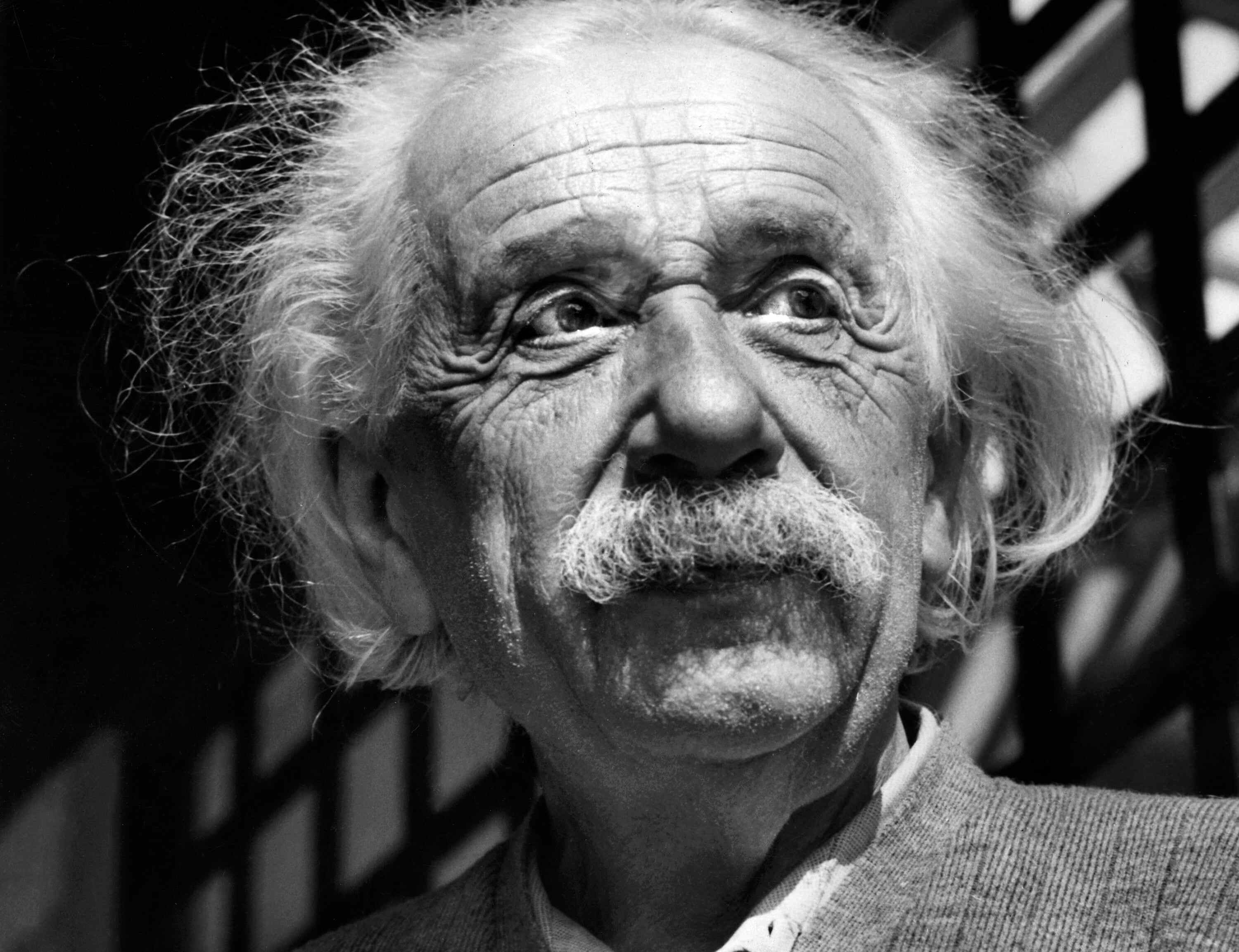
Albert Einstein was born on March 14, 1879, in Ulm, a city in southern Germany. His father, Hermann Einstein, worked as a salesman and engineer. His mother, Pauline Koch, took care of the house. He died on April 18, 1955, in New Jersey, United States.
He is most famous for his work in physics. For example, he developed the theory of relativity and the famous equation E=mc².
Albert Einstein’s ideas about relativity are really important in science.
His thoughts explain how things change when people move. His theories also gave scientists the maths they needed to understand atoms. Atoms helped create nuclear energy.
Early years
When Einstein was a child, he talked later than most kids. He would also get very angry sometimes. His parents were concerned that he might have trouble learning because he developed slowly.
When he was 16, he did not pass the entrance test for the federal polytechnic school in Zurich, Switzerland. This was surprising, as he was good at physics and maths. He would later pass the test and enrol in the university.
Einstein missed many classes to study on his own. This made his teachers unhappy. Because of this, he had a hard time finding a job after he finished school.
Nobel Prize
In 1905, Einstein wrote a paper about light. This paper helped him get a doctoral degree from the University of Zurich in Switzerland. By 1915, he would write many papers on how gravity works. The papers were on the general theory of relativity. It helped him win the 1921 Nobel Prize in Physics.
Scientists are still finding new ways to use Einstein’s ideas today. In 1926, Einstein helped invent a fridge. This appliance used natural things such as ammonia, butane and water. It needed very little electricity to work. This was different from today’s fridges. They used a gas called Freon that is not safe for us.
Curiosity is a superpower
Einstein started thinking about relativity by asking simple questions about life and the world. His story shows us that we should always ask “why”. He wasn’t a genius just because he was smart or knew everything. He was a genius because he kept asking questions that others thought were silly or too simple. By staying curious, he found amazing things that no one else could see.