Deep Dive delves into hot issues in Hong Kong and mainland China. Our easy-to-read articles provide context to grasp what’s happening, while our questions help you craft informed responses. Check sample answers at the end of the page.
News: Birth rate plunges to record low
-
Registered births in Hong Kong hit record low last year, ending 2-year uptick
-
Experts and parents say city should tackle underlying causes, not offer short-term incentives
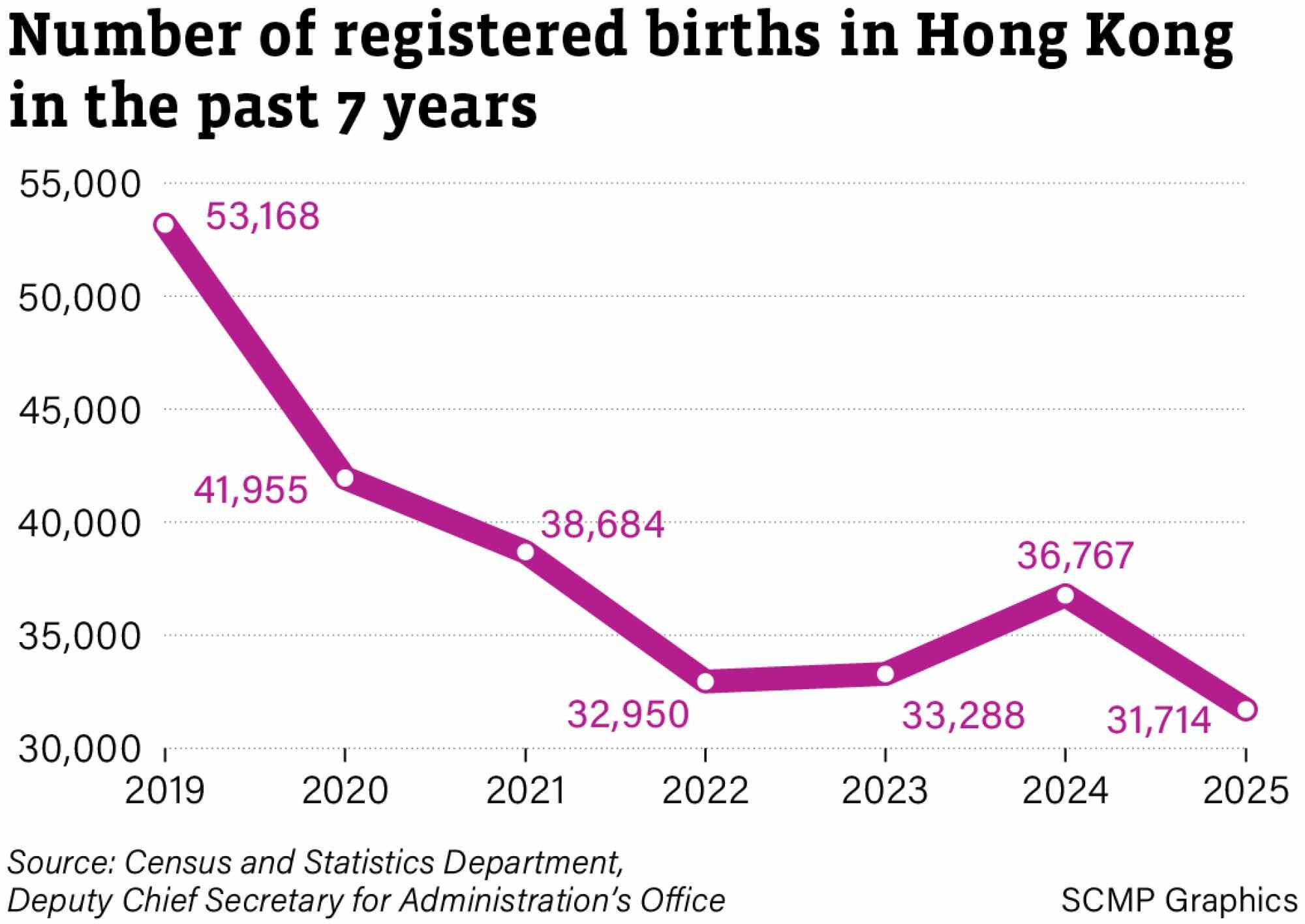
The number of registered births in Hong Kong plunged to a record low of 31,714 in 2025, despite a range of government incentives to encourage families to have more children. The new number ended two years of growth.
The Census and Statistics Department said last month that the city’s population was provisionally estimated at 7.51 million in 2025, up 0.1 per cent year on year. Some 50,000 deaths were recorded in the year.
The number of births last year was 1,400 fewer than the previous record low of 32,500 in 2022. The figure was also well below the government’s target of increasing births by 20 per cent from the previous historic low recorded in 2022. It is also 14 per cent fewer than the previous year.
Experts and parents said the government needed to tackle the underlying causes of the city’s low birth rates.
“Those incentives were short-term only and did not motivate me to have my second child last year,” Lilian Chan Lai-lai said.
Chan made headlines when she gave birth to her second daughter in August last year at the age of 58 – a decision she described as the result of “thoughtful consideration and pursuit”.
Chan said the government needed to offer “longer-term measures,” such as ensuring housing security for newborns, “to encourage young people to have children”.
To tackle the low birth rate, the government has adopted a multipronged approach since 2023 to boost the city’s population. Last April, the government said the declining trend in fertility had begun to reverse, citing the easing of the pandemic and the roll-out of various initiatives to encourage childbirth.
Among the measures was a one-off cash reward of HK$20,000 for each eligible baby born from October 25, 2023, over a three-year period, with a total budget of HK$2.28 billion.
But the low birth rate meant that only 54 per cent, or HK$1.23 billion, of the funds had been disbursed as of December 31. The programme is set to expire in nine months, according to the office. A total of 61,758 applicants had received the reward as of the end of last year.
“My baby got that cash allowance, and we treated it like a red packet,” Chan said.
Staff writers
Question prompts
1. Which of the following statements is false, according to the information in the news?
(1) Government incentives motivated more Hong Kong couples to give birth last year.
(2) The city’s birth rate hit a record low in 2025.
(3) The government adopted a multipronged approach from 2023 to boost the city’s population.
(4) The cash allowance is one of the government’s long-term measures to encourage residents to have children.
A. (1), (2) only
B. (1), (4) only
C. (2), (3) only
D. (2), (4) only
2. Describe ONE government incentive to encourage families to have more children.
3. In your opinion, do you think this incentive is enough to encourage more Hong Kong couples to have children?
Chart
Question prompts
1. Describe how the number of registered births in Hong Kong has changed in the past seven years.
2. What could be done to increase the city’s birth rate? Explain using the news, glossary and your own knowledge.
Glossary
registered births: the number of newborns who are registered with the Immigration Department in Hong Kong. By law, parents must register their child and obtain a birth certificate within 12 months of the child’s birth. Many typically do so about two months after a baby is born. The number of registered births is generally considered to closely mirror the actual number of newborns, with figures in 2023 and 2024 nearly identical to the corresponding total.
incentives: a payment or other measure that encourages someone to do something
multipronged: (of an approach or strategy) having several distinct aspects or elements to achieve a goal or solve a complex problem
Sample answers
News
-
B
-
A one-off cash reward of HK$20,000 for each eligible baby born from October 25, 2023, over a three-year period.
-
In my opinion, this incentive is not enough to encourage more Hong Kong couples to have children. Although the government offered a one-off HK$20,000 cash reward, the birth rate still fell to a record low of 31,714 in 2025, which shows that the measure had a limited effect. Experts and parents point out that the incentive is only short-term and does not address deeper issues, such as housing security and the high cost of raising children. Therefore, longer term and more comprehensive policies are needed to effectively boost the birth rate. (accept all reasonable answers)
Chart
-
A downward trend is evident in the number of registered births in Hong Kong in the past seven years, a drop from 53,168 in 2019 to just 31,174 in 2025, which was a record low.
-
The government should address the underlying causes of Hong Kong’s low birth rate instead of relying mainly on short-term incentives. According to News, the HK$20,000 one-off cash reward did not significantly increase births, and some parents described it as merely a “red packet”. This suggests that financial bonuses alone are not enough to change couples’ decisions. The government should introduce longer-term measures, such as improving housing security for families with newborns and reducing the financial burden of raising children. Expanding childcare services, increasing parental leave and offering more education subsidies could also help. Many couples in Hong Kong face high living costs, long working hours and intense academic pressure for children. Therefore, creating a more family-friendly environment and improving work-life balance would likely be more effective in encouraging people to have children. (accept all reasonable answers)