Deep Dive delves into hot issues in Hong Kong and mainland China. Our easy-to-read articles provide context to grasp what’s happening, while our questions help you craft informed responses. Check sample answers at the end of the page.
News: Fuelled by cheap wind power and a cool climate
-
Ulanqab is leveraging its cool climate and abundant wind and solar energy to build massive green-powered AI data centres
-
Rapid AI expansion is straining energy grids worldwide
While an artificial intelligence (AI) query might take mere seconds for users to receive an answer, the process behind that response is complex. It involves a journey back to places like Ulanqab.
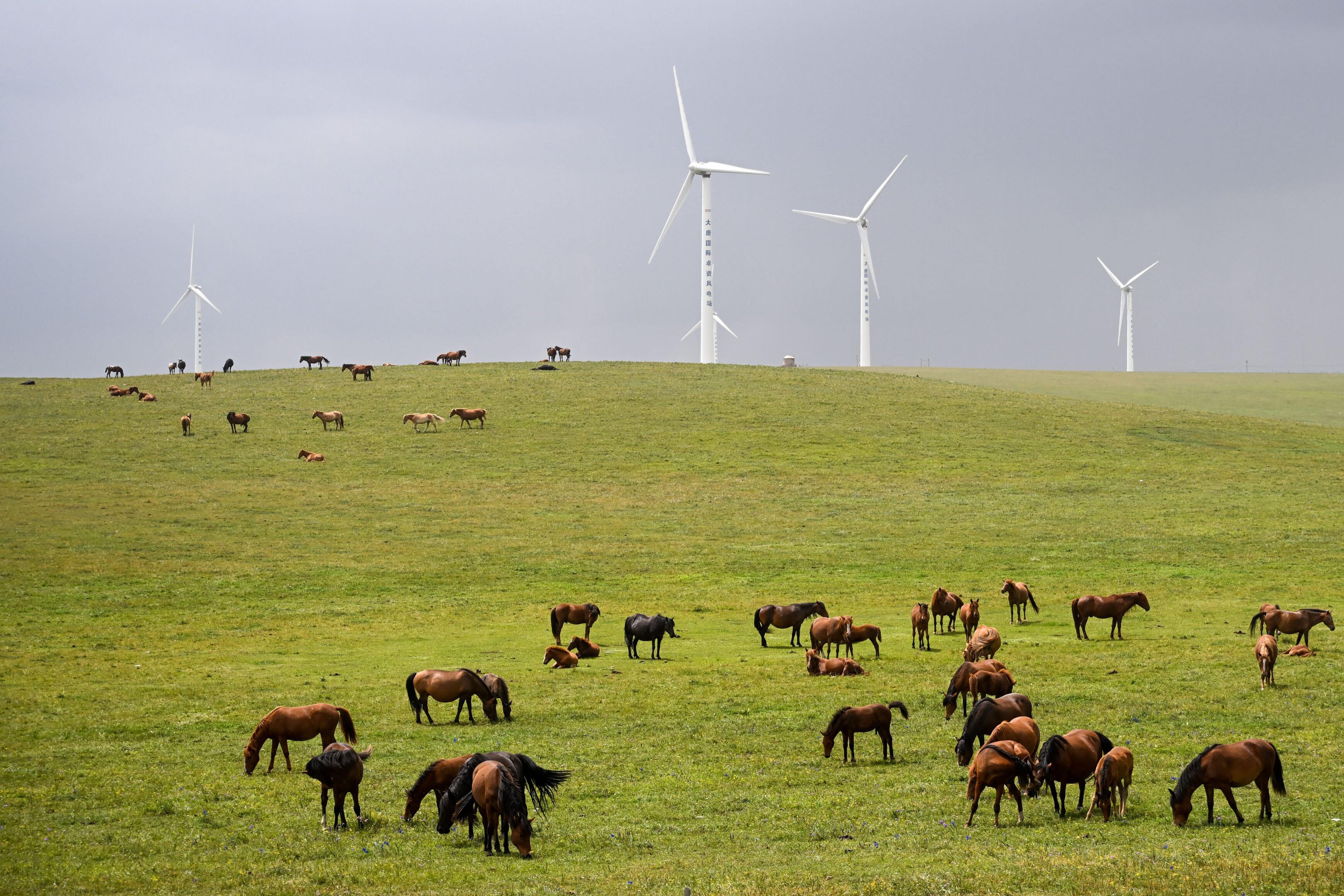
In this region, servers consume electricity, cooling systems manage heat and wind turbines harness the movement of air across the grasslands to generate power.
For generations, Ulanqab – a city several hundred kilometres northwest of Beijing – was known for its windswept pastureland.
Strong breezes sweep through the Yinshan mountain range, powering giant wind turbines.
As AI’s rapid growth increases global demand for computing power and electricity, Ulanqab’s cool climate is transforming this pastoral city in Inner Mongolia into one of China’s most valuable industrial assets.
Envision, a green technology company, is developing its Galaxy Campus in Ulanqab. It is set to become one of the world’s largest AI computing hubs.
Envision selected this city to power its data centres with renewable energy sources, which provide 67 per cent of Ulanqab’s electricity. The region’s chilly temperature allows the facility to use outside air for cooling instead of energy-heavy air conditioning.
Power usage effectiveness (PUE) measures the ratio between a data centre’s total electricity consumption and the electricity delivered to its servers.
Leading data-centre clusters in Ulanqab’s region have a PUE below 1.15, against a national average of nearly 1.5. This means in Ulanqab, a greater proportion of each watt of electricity is effectively reaching the server chips.
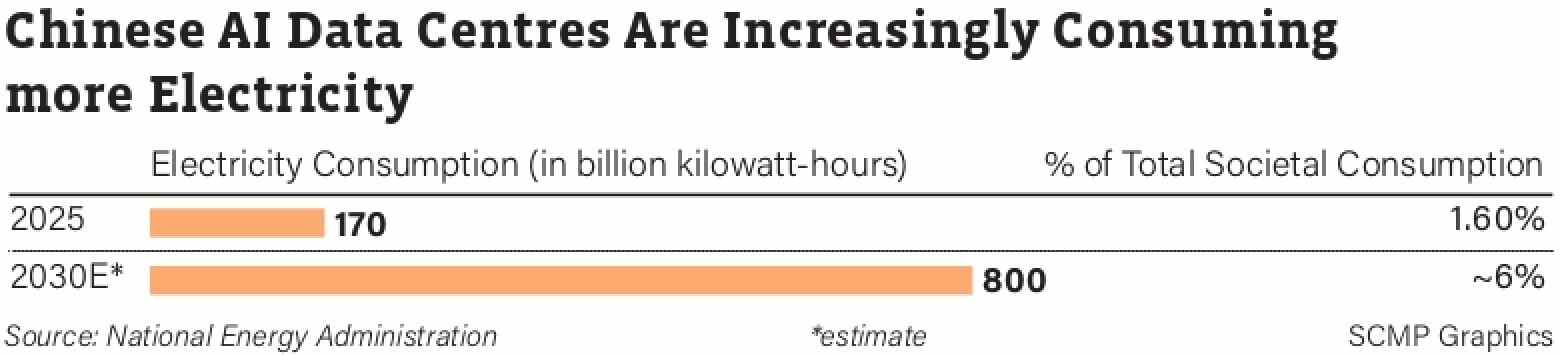
According to the National Energy Administration (NEA), China’s data centres consumed approximately 170 billion kilowatt-hours of electricity in 2025. This accounted for around 1.6 per cent of the country’s total electricity usage.
By 2030, the annual consumption by data centres is expected to increase to about 800 billion kilowatt-hours, nearly five times the 2025 levels. It will represent roughly 6 per cent of national electricity use in 2030, as stated by Wang Hongzhi, the director of the NEA.
Greenpeace’s recent Clean Cloud report tracked the renewable energy use of 25 Chinese technology companies. By August, it found that eight reported achieving annual renewable energy ratios that exceeded 30 per cent.
In their 2024 report, only one company had achieved this ratio.
Staff writers
Question prompts
1. How is an AI query related to Ulanqab in China? Choose two statements that apply.
(1) Ulanqab’s wind turbines run the servers that might power an AI chatbot’s answers.
(2) Ulanqab’s cold weather helps to cool down the data centres behind many AI companies.
(3) Ulanqab’s economy relies heavily on importing electricity from Beijing to support its AI companies.
(4) Ulanqab provides the human effort needed to manually calculate AI queries.
A. (1), (2) only
B. (1), (3) only
C. (2), (4) only
D. (3), (4) only
2. Explain two factors that make Ulanqab a good location for hosting AI data centres.
3. Do you think Chinese tech companies are getting most of their power from sources like those found in Ulanqab? Explain your answer using information from the news.
Chart
Question prompts
1. What is the difference between the electricity consumption of China’s AI data centres in 2025 and what is projected for 2030?
2. How does the power usage effectiveness (PUE) of data-centre clusters in the Ulanqab area compare with the national average? If more data centres had a PUE closer to what Ulanqab has, how might this affect the electricity consumption projection for 2030?
Glossary
-
Ulanqab: accounts for about one-tenth of China’s total wind resources and one-third of the Inner Mongolia autonomous region’s wind resources, according to China’s Xinhua news agency. As of June, Ulanqab had signed 89 data centre deals, 86 of which were AI computing projects, based on local government data.
-
wind turbines: giant spinning towers with blades that convert wind movement into electrical power
-
power usage effectiveness: a measure of energy efficiency of a data centre. Perfect efficiency is represented by a PUE of 1.0, where every watt goes directly to computing, while higher numbers indicate energy wasted on supporting systems.
Sample answers
News
1. A. (1), (2) only
2. Ulanqab’s cool climate allows for efficient cooling of data centres using outside air, reducing the need for energy-heavy air conditioning. Additionally, the region’s renewable energy sources ensure a sustainable power supply.
3. Only eight out of 25 Chinese tech companies mentioned in the Clean Cloud report achieved annual renewable energy ratios above 30 per cent. This indicates that the majority of these companies rely on non-renewable energy sources, which are harmful to the environment.
Chart
1. In 2025, China’s AI data centres consumed approximately 170 billion kilowatt-hours of electricity. By 2030, this consumption is expected to rise to about 800 billion kilowatt-hours, indicating an increase of nearly five times the 2025 levels.
2. The PUE of data-centre clusters in Ulanqab is below 1.15, significantly better than the national average of nearly 1.5. If more data centres could achieve a similar PUE, they would be more efficient in electricity usage, potentially lowering the overall electricity consumption projections for 2030. This could help reduce the anticipated increase in demand from 800 billion kilowatt-hours. More efficient data centres would allow for greater sustainability in powering AI infrastructure.