Deep Dive delves into hot issues in Hong Kong and mainland China. Our easy-to-read articles provide context to grasp what’s happening, while our questions help you craft informed responses. Check sample answers at the end of the page.
News: Hong Kong’s sustainable aviation fuel goal
-
China’s gutter oil has evolved from a waste product to a key ingredient for producing clean energy
-
Financial uncertainties surround the production of sustainable aviation fuel in Hong Kong
China was once notorious for its “gutter oil”, recycled from kitchen and drainage waste. Now, this oil is nicknamed liquid gold.
The substance has become a popular feedstock for producing clean energy. This is especially true for sustainable aviation fuel (SAF). Biofuel producers such as Hong Kong-based EcoCeres are sourcing gutter oil across the Greater Bay Area.
There are many types of feedstocks, such as animal fat and agricultural waste. They can be used to produce renewable jet fuel. This alternative can reduce life-cycle carbon emissions by up to 80 per cent.
SAF can be safely blended with conventional jet fuel. It can also be used in aircraft engines without any changes. However, the price remains a challenge.
EcoCeres’ co-chairman is Alan Chan Ying-lung. He explained how the value of gutter oil has changed in the past decade: “I can recall that the gutter oil we collected was basically free 10 years ago, and authorities even offered subsidies [to collectors], but now the unit cost is even more expensive than fuel,” he said.
The Hong Kong government initially set a goal for SAF use. It wanted SAF to account for between 1 and 2 per cent of all fuel consumed by flights departing from Hong Kong International Airport by 2030.
The city released its first five-year plan in September. In the plan, Chief Executive John Lee Ka-chiu revised the target to 1 to 3 per cent. He also said the city would aim to develop an internationally competitive SAF supply chain in the Greater Bay Area.
Despite setting a 2030 target for SAF use, the government has yet to clarify who will pay for it.
“Producers need confidence that demand will be there. Airlines need fuel that is available and affordable. Investors need clarity on the direction of policy. A well-designed policy can connect these needs,” said Ronald Lam Siu-por. He is the CEO of Hong Kong’s flagship airline, Cathay Pacific Airways.
Niki Wang Yangwen is the Asia-Pacific associate director of biofuels at S&P Global Energy. Wang said some industry players expected the city to be a trial site for mainland China. Hong Kong may be used as a spot to test market reactions. If things worked out in Hong Kong, mainland China might roll out similar measures.
Hong Kong is not alone in setting green fuel targets. Elsewhere, demand for SAF is being driven more by mandates than pledges by airlines.
The International Civil Aviation Organisation has adopted a collective goal to cut global aviation emissions by 5 per cent by 2030. It aims to reach net zero by 2050.
Staff writers
Question prompts
1. Which of the following statements are false, according to the news?
(1) Sustainable aviation fuel (SAF) is a substitute for conventional jet fuel that can be blended with it and used in aircraft engines without modification.
(2) The Hong Kong government recently lowered its yearly overall baseline for the use of SAF on all flights leaving Hong Kong International Airport.
(3) John Lee aims to make Hong Kong part of an internationally competitive SAF value chain in the Greater Bay Area.
(4) All governments have decided to mandate cutting their national aviation emissions to net zero by 2050.
A. (1), (2) only
B. (1), (3) only
C. (2), (4) only
D. (3), (4) only
2. According to Ronald Lam, why must the Hong Kong government clarify how the additional cost of SAF will be shared among stakeholders?
3. What role might Hong Kong play in mainland China’s overall SAF adoption? How could this work? Explain using the news and your own knowledge.
Illustration
Question prompts
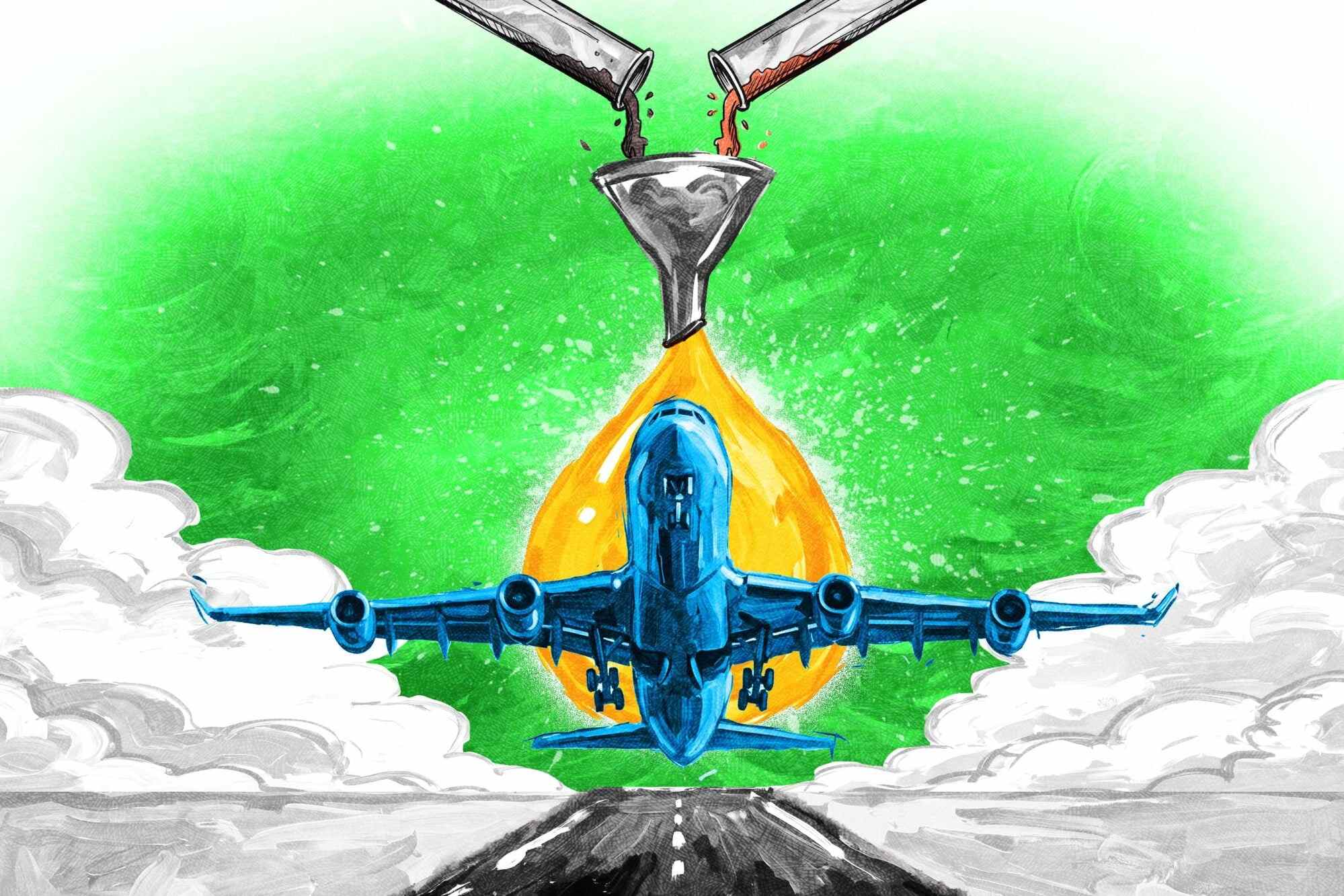
1. What is being shown in the illustration? How does it relate to the information in the news?
2. Do you think adopting SAF in aviation does enough to reduce carbon emissions in the industry? Explain using the news and your own knowledge.
Glossary
gutter oil: oil that has already been used for cooking. Safety codes do not permit the reuse of this oil because it is not fit for human consumption. In the past, some restaurants were illegally reusing this oil, and some people even tried to sell it.
feedstock: the raw, unprocessed organic material, such as waste cooking oil, animal fats or agricultural residues, used as the primary input for refining sustainable aviation fuel (SAF). Hong Kong uses cooking oil collected locally and across the Greater Bay Area as the primary feedstock for producing SAF.
mandates: official, legally enforceable requirements issued by a governing authority that compel certain parties to comply with specific standards, quotas or rules
Sample answers
News
-
C
-
According to Ronald Lam, the Hong Kong government must clarify how the additional cost of SAF will be shared among stakeholders to ensure transparency and fairness while implementing the new fuel requirements. This clarification is essential for all parties involved, including airlines, fuel suppliers and consumers, as it will help manage expectations and foster cooperation during the transition to more sustainable aviation practices. (accept all reasonable answers)
-
According to Niki Wang, Hong Kong may serve as a trial site for mainland China’s adoption of SAF, allowing stakeholders to gauge market reactions and test the feasibility of SAF initiatives. If successful, the insights gained could inform broader implementation strategies across mainland China. This aligns with global trends, in which regulatory mandates are increasingly driving the aviation industry’s shift towards greener fuels, positioning Hong Kong as a critical testing ground for future developments in the region. (accept all reasonable answers)
Illustration
-
The illustration depicts liquid being poured from two tubes into a jet through a funnel. This visually represents how SAF can be blended with traditional jet fuel. The transformation of feedstock into SAF is symbolised by a golden liquid droplet, emphasising SAF’s highly refined, clean nature as a viable substitute for conventional fuels. The green background further underscores the eco-friendliness of this initiative, reflecting the aviation industry’s commitment to reducing carbon emissions. (accept all reasonable answers)
-
While adopting SAF can help reduce carbon emissions, it does not eliminate them entirely. Since SAF is often blended with fossil jet fuel, flights are still burning a certain amount of fossil fuel, which continues to generate carbon emissions. (accept all reasonable answers)