Read the following text and answer the quiz below.
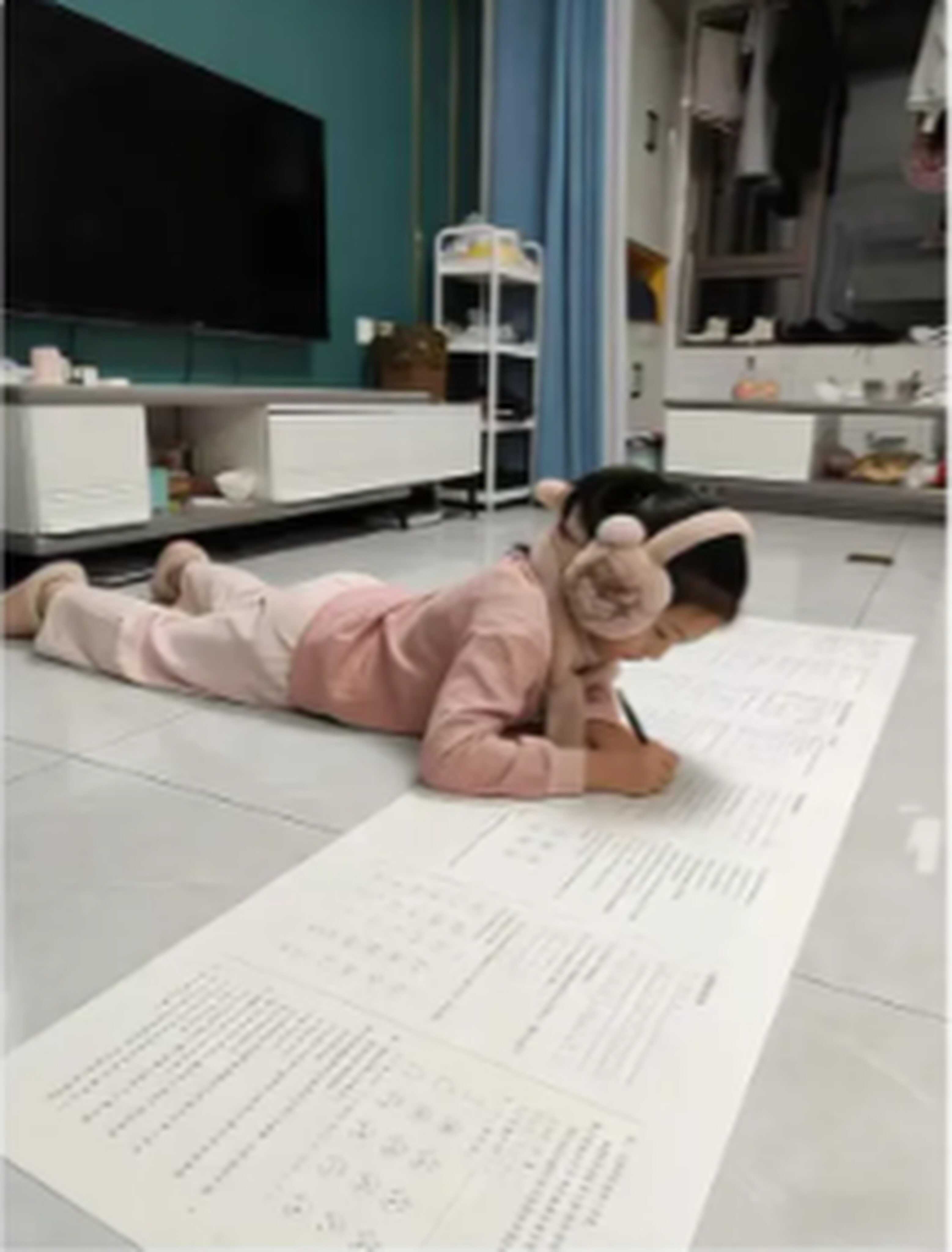
[1] Some parents in China are trying a new way to motivate their children by making big homework papers, and it’s getting a lot of laughs online. In January, a mother from Hubei province printed large test papers for her son. She said, “This way, he won’t miss any questions.” Pictures showed her young son working on a Chinese test paper that was almost a metre long, with empty spaces that were almost as big as his hand.
[2] The mother said she had two large homework papers printed at a print shop for 25 yuan (HK$28). The large size made her son enjoy homework more and stay focused.
[3] Her post got over 100,000 likes on social media in mainland China, and many other parents joined the trend. Wang, a mother from Sichuan province in southwestern China, said her child wanted to do another set of big test papers after finishing the first one.
[4] However, not all children like giant test papers. A mother from Heilongjiang province in northern China said she paid 60 yuan to print four big papers, but things didn’t work out as she hoped. She told a news outlet, “At first, my son thought the giant papers were toys. But when he realised they were homework, he became disappointed and even more resistant to studying.”
[5] In China, the education system puts a lot of pressure on students, mainly because of the gaokao, which is the national university entrance exam. Many secondary schools use a method called “sea of questions,” giving very little time off and requiring students to do a lot of homework for long hours.
[6] A report from a school in China says that more than half of secondary students do more than two hours of homework every day, and some study until after 10pm. Recently, the government started new rules to lessen schoolwork. Some parents are also looking at teaching methods that focus on mental health.
[7] A widely supported comment from a father on mainland social media said: “Children who love learning will embrace any homework papers, no matter how big. But for kids like my daughter, their passion may lie in sport, the arts or other areas. As parents, we respect her interests and give her the freedom to explore.”
Source: South China Morning Post, February 3
Content provided by British Council