
You finally donate blood, learn your blood group and notice something that seems strange: you don’t match what either of your parents has. Before you jump to any wild conclusions, take a breath. Blood group inheritance is more complex than it appears.
Your blood group is determined by specific markers, called antigens, on the surface of your red blood cells. Two of the most important blood group systems are the ABO system and the Rhesus (Rh) system. Doctors rely on these markers to perform safe blood transfusions.
In the ABO system, your blood group is controlled by the ABO gene, which comes in three different versions, known as alleles: A, B and O.
You inherit one allele from each parent, and the pair you receive decides whether your blood group is A, B, AB or O. This predictable pattern of inheritance is explained by Mendelian inheritance, which describes how single-gene traits are passed from parents to offspring.
In the ABO system, the A and B alleles are codominant. This means if you inherit A from one parent and B from the other, your blood group will be AB, showing both traits.
The O allele, however, is recessive. You will only be in blood group O if you receive an O allele from both parents. If you receive an O allele along with an A or B allele, your blood group will be A or B.
This explains why parents in blood group A or B might quietly carry an O allele and pass it on to you without showing it themselves. This also explains why siblings can have completely different blood groups, and why yours might not match your parents’ groups.
While the ABO system determines the letter in your blood group, the positive or negative sign next to it indicates the presence or absence of the Rh factor.
Like the ABO system, the Rh system is inherited.
The Rh-positive allele (Rh⁺) is dominant, while the Rh-negative allele (Rh⁻) is recessive. So if both parents are Rh‑positive but each carries a hidden Rh-negative allele (genotype: Rh⁺Rh⁻), they can still have an Rh‑negative child (genotype: Rh⁻Rh⁻) if both pass on the recessive allele.
Together, the ABO gene and the Rh gene determine your complete blood group (see graphic).
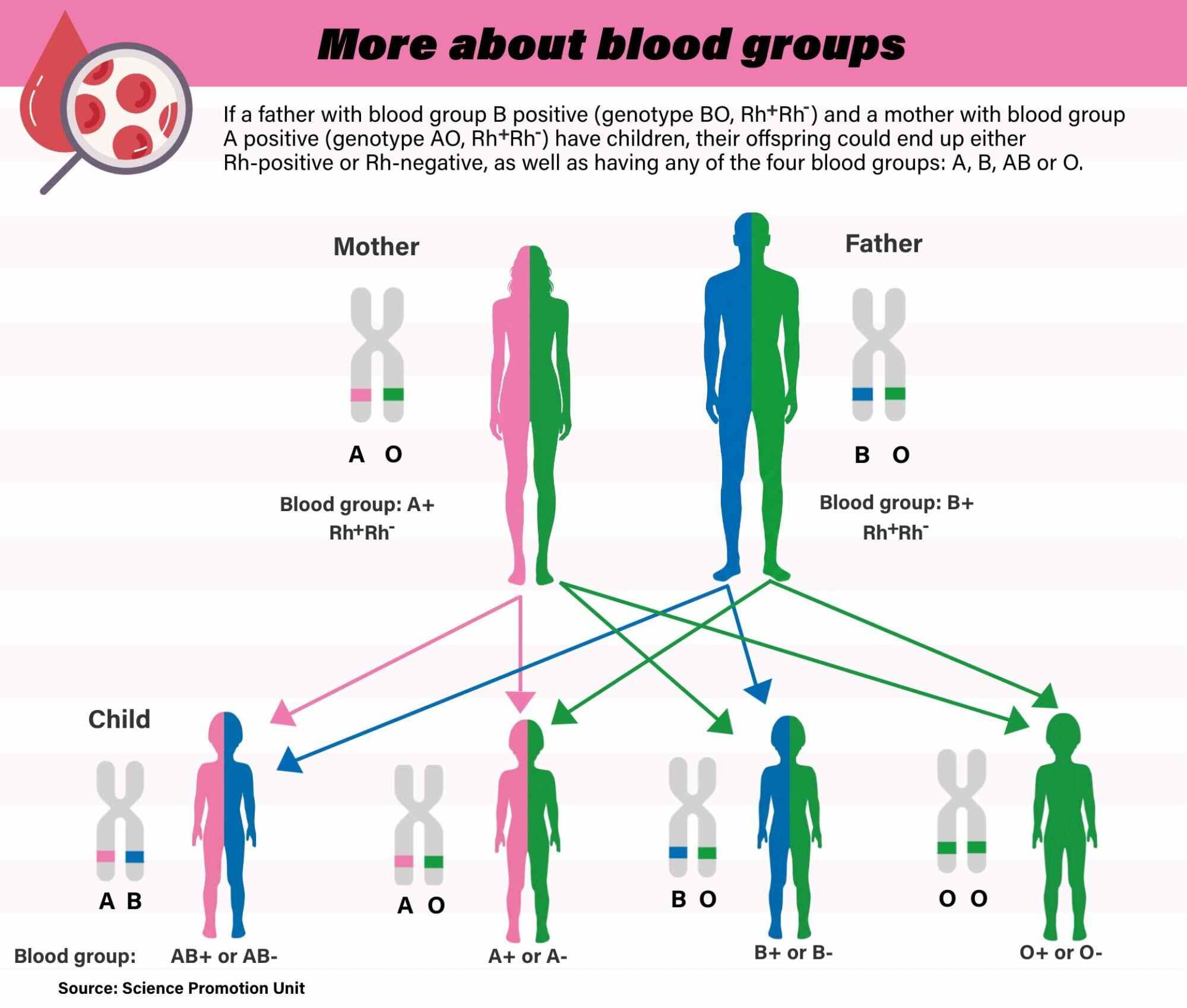
So, if your blood group does not match what your parents have, don’t worry. Genetics usually works predictably, even when its outcomes are wonderfully diverse. If someone asks about your blood group, you can explain that it is simply Mendelian inheritance at work and that you are a great example of genetic diversity.
Young Post has partnered with Hong Kong Science Museum and Hong Kong Space Museum to encourage your pursuit of science. Every month, the museums answer questions about the world around us, the cosmos and beyond.