




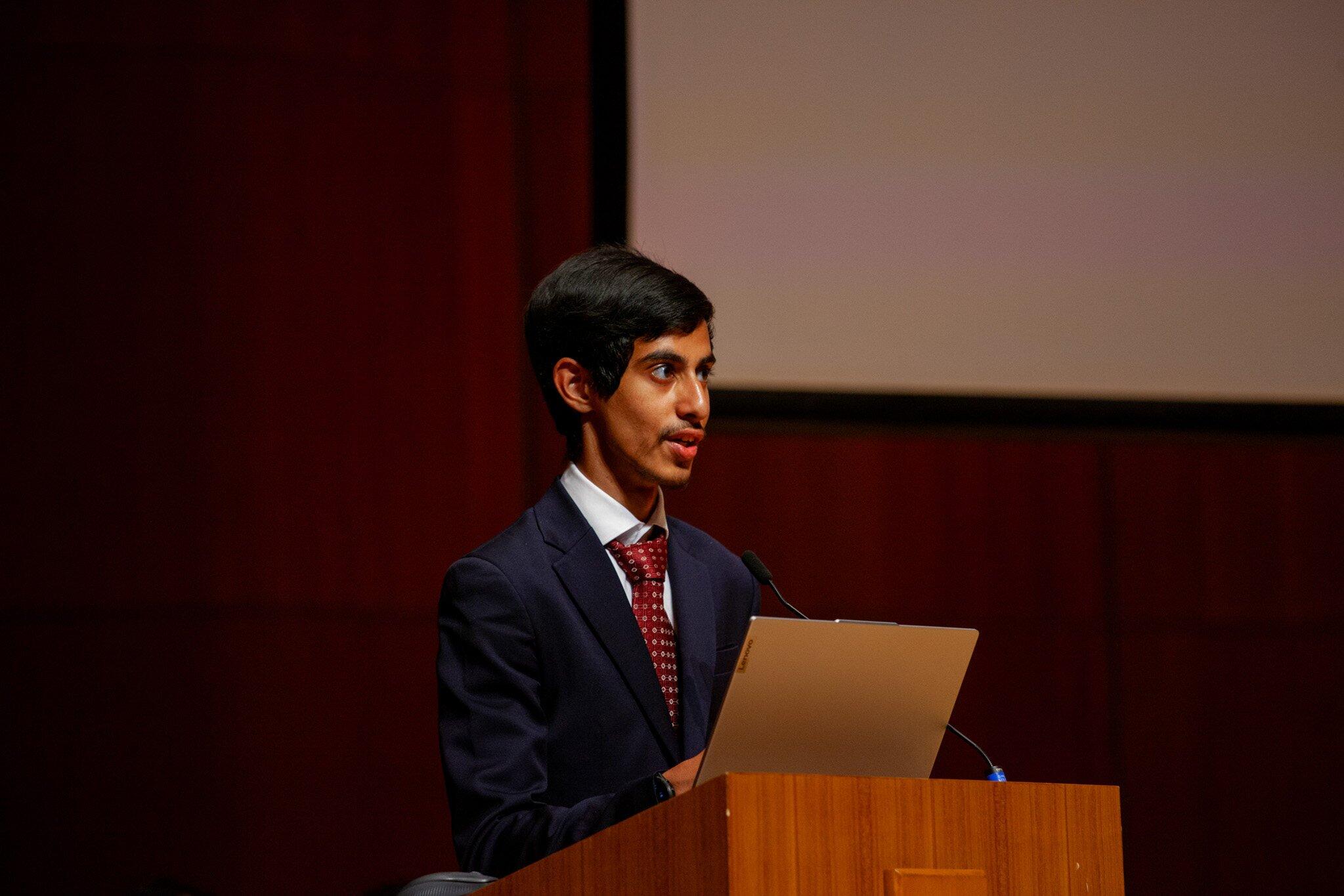
Adhit Ranjan, a Year 13 student at German Swiss International School, has always been captivated by the power of technology.
“What my eyes have witnessed, my hands have sought to solve and improve,” he said.
His motivation comes from personal experience. “When my grandfather was diagnosed with glaucoma, I watched helplessly as his world dimmed,” he said. “Had early detection technology existed earlier, his journey might have been different.”
This painful realisation sparked a burning desire to act.
He has since worked on multiple innovations, including WasteShark, a remotely operated underwater vehicle (ROV) designed to collect ocean waste, and a prosthetic arm developed in collaboration with a team at the University of Michigan in the United States.
SOTY 2023/24: Hong Kong teen coding champion breaks gender stereotypes
The inspiration for WasteShark came from his evening walks along Repulse Bay Beach, where he noticed brown splotches in the ocean.
“I researched the issue to discover that eutrophication caused by nutrient run-offs combined with the burgeoning plastic waste was creating these mini-islands,” he said.
WasteShark is designed to collect waste from the sea, operating at depths of up to 25 metres. “It employs computer vision, specifically the YOLO object detection model, for automatic identification and collection of waste,” he explained.
“It has a battery life of 12 hours and is well adapted to challenging conditions, including low visibility.” So far, he has organised three cleaning drives using WasteShark and collected 20 kilograms of waste.

Adhit is also a member of the Hong Kong junior national hockey team and has seen firsthand the impact of sports injuries.
“Over 13 per cent of hockey players will experience a serious impact injury in their careers, often requiring surgery and severely impacting their performance,” he said.
His visits to India further shaped his desire to help people with arm injuries. “I encountered individuals with limb amputations struggling to endure cold winters outdoors,” he said. “I realised science alone wasn’t enough; it had to serve a larger purpose.”
During an internship at the University of Michigan’s Precision Systems Design Laboratory, he worked on developing a prosthetic arm powered by Continuously Variable Transmission (CVT) technology.
“Unlike traditional prosthetic devices, a CVT-powered prosthetic arm enables smoother, multi-speed operations, enhancing dexterity and improving grip control,” he said.
SOTY 2023/24: Language is expression and connection for Linguist (Mandarin) second runner-up
“The existing design not only increases grip strength by 18 per cent but is also lighter than most competitors,” he said. His team is working on producing models at a lower cost to make them more widely accessible.
Adhit was the second runner-up for the Grand Prize at last year’s prestigious Student of the Year (SOTY) awards, organised by the South China Morning Post and solely sponsored by the Hong Kong Jockey Club (HKJC).
He said the award has reaffirmed his ambitions. “It serves as a benchmark for me, and is recognition that I am on the right path to helping solve societal challenges using technology,” he said.
Looking ahead, Adhit is focused on healthcare technology. “With Hong Kong potentially facing a shortage of medical workers in the future, I look forward to exploring and designing telesurgery robots, allowing doctors to remotely perform surgeries,” he said.
For young innovators, his advice is simple: “Be fearless. Don’t be afraid that you lack technical skills. Don’t be daunted by the scope of any project. Making a mistake isn’t the same as failing.”
