Deep Dive delves into hot issues in Hong Kong and mainland China. Our easy-to-read articles provide context to grasp what’s happening, while our questions help you craft informed responses. Check sample answers at the end of the page.
News: Birth rate plunges to record low
-
Registered births in Hong Kong hit record low last year, ending 2-year uptick
-
Experts and parents say city should tackle underlying causes, not offer short-term incentives
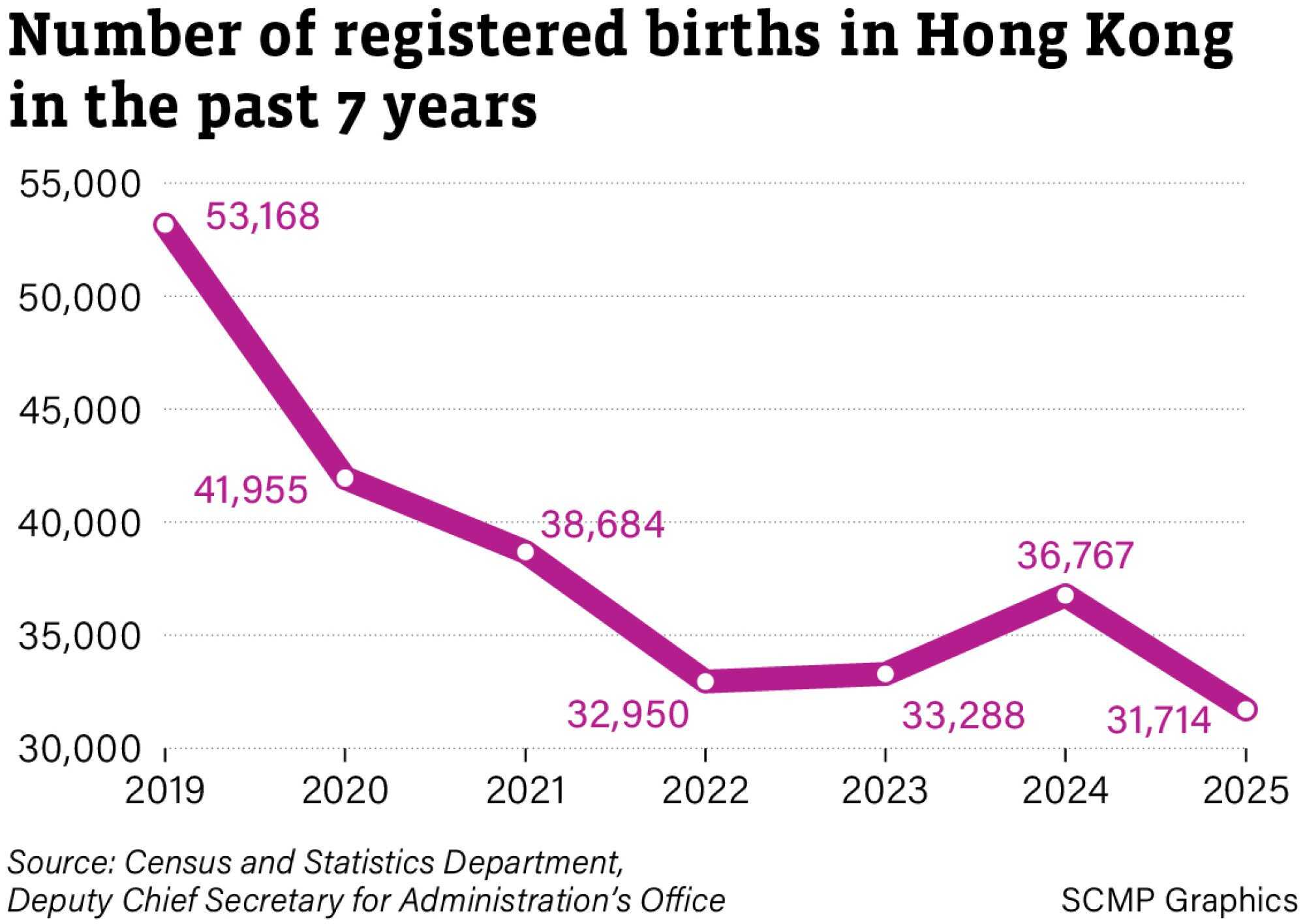
The number of registered births in Hong Kong plunged to a record low of 31,714 in 2025, despite a range of government incentives to encourage families to have more children. The new number ended two years of growth.
The Census and Statistics Department said last month that the city’s population was provisionally estimated at 7.51 million in 2025, up 0.1 per cent year on year, with a net inflow of 29,100 Hong Kong residents.
Some 50,000 deaths were recorded in the year.
The number of births last year was 1,400 fewer than the previous record low of 32,500 in 2022. The figure was also well below the government’s target of increasing births by 20 per cent from the previous historic low recorded in 2022. It is also 14 per cent fewer than the previous year.
Experts and parents said the government needed to tackle the underlying causes of the city’s low birth rates.
“Those incentives were short-term only and did not motivate me to have my second child last year,” Lilian Chan Lai-lai said. She made headlines when she gave birth to her second daughter in August last year at the age of 58 – a decision she described as the result of “thoughtful consideration and pursuit”.
Chan said the government needed to offer “longer-term measures,” such as ensuring housing security for newborns, “to encourage young people to have children”.
To tackle the low birth rate, the government has adopted a multipronged approach since 2023 to encourage childbirth and boost the population.
Last April, the government said the declining trend in fertility had begun to reverse, citing the easing of the pandemic and the roll-out of various initiatives to encourage childbirth.
Among the measures was a one-off cash reward of HK$20,000 for each eligible baby born from October 25, 2023, over a three-year period, with a total budget of HK$2.28 billion.
But the low birth rate meant that only 54 per cent, or HK$1.23 billion, of the funds had been disbursed as of December 31, with the programme set to expire in nine months, according to the office.
A total of 61,758 applicants had received the reward as of the end of last year.
“My baby got that cash allowance, and we treated it like a red packet,” Chan said.
Staff writers
Question prompts
1. Which of the following statements is false, according to the information in News?
(1) Government incentives motivated more Hong Kong couples to give birth last year.
(2) The city’s birth rate hit a record low in 2025.
(3) The government adopted a multipronged approach from 2023 to boost the city’s population.
(4) The cash allowance is one of the government’s long-term measures to encourage residents to have children.
A. (1), (2) only
B. (1), (4) only
C. (2), (3) only
D. (2), (4) only
2. Describe ONE government incentive to encourage families to have more children.
3. In your opinion, is a government incentive enough to encourage more Hong Kong couples to have children? Explain using News and your own knowledge.
Chart
Question prompts
1. Describe how the number of registered births in Hong Kong has changed in the past seven years.
2. What could be done to increase the city’s birth rate? Explain using News, Glossary and your own knowledge.
Issue: What will encourage residents to have children?
-
The increase in births in 2024 was largely due to the auspicious Chinese zodiac animal of the year, the lucky Dragon
-
Hongkongers need more than traditional beliefs to encourage them to raise children, experts say
In early 2024, Hong Kong authorities noted that the number of births in the city was predicted to increase by 20 per cent, from about 32,500 in 2022 to around 39,000 per year.
Besides a one-off cash reward for newborns, other measures aimed at boosting the birth rate included a tax break and shorter wait times for public rental housing or priority to buy subsidised flats for families with newborns.
The government also pledged to expand infant and child day care services by setting up 15 new child care centres from 2026–27. That would provide about 1,500 places for babies and children up to age three, almost double the current supply.
Service quotas for in vitro fertilisation (IVF) in public hospitals would also be gradually increased from 1,100 to 1,800 per year by 2028–29.
The Hospital Authority has already raised the annual quota for IVF services by 100 to 1,200 in 2024–25, with a further 300 places to be added in 2025–26. The authority has also included IVF medicines as “special drugs” in its formulary to ease the financial burden on patients.
But are these measures enough to encourage Hong Kong residents to raise children?
Paul Yip Siu-fai, the chair professor in population health at the University of Hong Kong’s department of social work and social administration, said the uptick in births in 2024 was largely due to it being the Year of the Dragon, a year people deem auspicious for having children.
“The number naturally came down after [2025],” he said.
Yip added that higher educational attainment among women and the prevalence of small-family norms in Hong Kong have led many couples to have no children or just one, keeping the birth rate persistently low.
Yip said the government’s one-off newborn baby bonus was a “show [of] appreciation and gratitude” towards parents, but not a reason for families to have children.
He added that the government must address the fundamental reasons Hongkongers are choosing not to have babies.
“Some people tend not to have babies because they think Hong Kong is not a suitable place to raise children, whereas they might consider having them after they leave the city,” he said.
Staff writers
Question prompts
1. How does the government’s predicted number of births per year after 2022 compare to the reality? Use News, Graph and Issue to explain your answer.
2. List TWO measures introduced to support families besides the HK$20,000 newborn baby bonus. Explain how they could encourage people to have babies.
3. To what extent do you agree with Paul Yip that the HK$20,000 newborn baby bonus is not enough to significantly increase Hong Kong’s birth rate?
Photo
Question prompts
1. Using Issue, explain ONE reason why Hong Kong’s birth rate is low.
2. What potential effects could arise if the city’s birth rate continues to decline? Explain using News, Issue and your own knowledge.
Glossary
registered births: the number of newborns who are registered with the Immigration Department in Hong Kong. By law, parents must register their child and obtain a birth certificate within 12 months of the child's birth. Many typically do so about two months after a baby is born. The number of registered births is generally considered to closely mirror the actual number of newborns, with figures in 2023 and 2024 nearly identical to the corresponding total.
multipronged: (of an approach or strategy) having several distinct aspects or elements to achieve a goal or solve a complex problem
tax break: a reduction in the amount of taxes needed to be paid to the government. Chief Executive John Lee Ka-chiu announced in his 2025 policy address that, starting from the 2026–27 financial year, parents of newborns would receive an annual tax allowance of HK$130,000 (US$16,667) for two years after birth, up from one year. The measure would apply to all children under the age of two at the end of the year of assessment.
in vitro fertilisation (IVF): an effective form of assisted reproductive technology that can lead to a pregnancy; a treatment for infertility
Sample answers
News
-
B
-
A one-off cash reward of HK$20,000 for each eligible baby born from October 25, 2023, over a three-year period.
-
In my opinion, this incentive is not enough to encourage more Hong Kong couples to have children. Although the government offered a one-off HK$20,000 cash reward, the birth rate still fell to a record low of 31,714 in 2025, which shows that the measure had a limited effect. Experts and parents point out that the incentive is only short-term and does not address deeper issues, such as housing security and the high cost of raising children. Therefore, longer term and more comprehensive policies are needed to effectively boost the birth rate. (accept all reasonable answers)
Chart
-
A downward trend is evident in the number of registered births in Hong Kong in the past seven years, a drop from 53,168 in 2019 to just 31,174 in 2025, which was a record low.
-
The government should address the underlying causes of Hong Kong’s low birth rate instead of relying mainly on short-term incentives. According to News, the HK$20,000 one-off cash reward did not significantly increase births, and some parents described it as merely a “red packet”. This suggests that financial bonuses alone are not enough to change couples’ decisions. The government should introduce longer-term measures, such as improving housing security for families with newborns and reducing the financial burden of raising children. Expanding childcare services, increasing parental leave and offering more education subsidies could also help. Many couples in Hong Kong face high living costs, long working hours and intense academic pressure for children. Therefore, creating a more family-friendly environment and improving work-life balance would likely be more effective in encouraging people to have children. (accept all reasonable answers)
Issue
-
The government predicted that births would increase by 20 per cent from about 32,500 in 2022 to around 39,000 per year. However, in reality, births did not reach this target and even fell after 2024. According to News and Graph, the 2024 uptick was due to the auspicious Year of the Dragon, and the number dropped again afterwards. It is evident that the rise was temporary and influenced by cultural beliefs rather than government policies.
-
A tax break, a shorter wait for public rental housing or priority to buy subsidised flats for families with newborns, and service quotas for in vitro fertilisation (IVF) in public hospitals will also be gradually increased from 1,100 to 1,800 per year by 2028–29. A tax break reduces the amount of tax owed to the government, easing financial strain on couples. In vitro fertilisation (IVF) is a treatment for infertility, which could help people experiencing difficulty getting pregnant increase their chances. Adding service quotas helps people access this treatment.
-
I largely agree with Paul Yip. The HK$20,000 bonus is only a one-off cash grant and may not be enough to cover the long-term costs of raising a child in Hong Kong, such as housing, education and daily expenses. The temporary rise in births during the Year of the Dragon suggests that cultural factors had a stronger influence than financial incentives. Therefore, deeper social issues, such as work pressure, small-family norms and concerns about the living environment, must be addressed to significantly raise the birth rate. (accept all reasonable answers)
Photo
-
Higher educational attainment among women and the prevalence of small-family norms in Hong Kong have led many couples to have no children or just one, keeping the birth rate persistently low.
-
If the city’s birth rate continues to decline, several negative effects could arise. First, Hong Kong may face an ageing population, with a smaller proportion of young people supporting a growing number of elderly residents. This would put pressure on the healthcare system, welfare services and pension schemes. Secondly, a shrinking workforce could slow economic growth and reduce the city’s competitiveness. With fewer young workers entering the labour market, businesses may face labour shortages. Last but not least, schools and child-related services may close due to declining enrolment, further affecting communities. In the long term, the imbalance in population structure could create serious social and economic challenges for the city. (accept all reasonable answers)