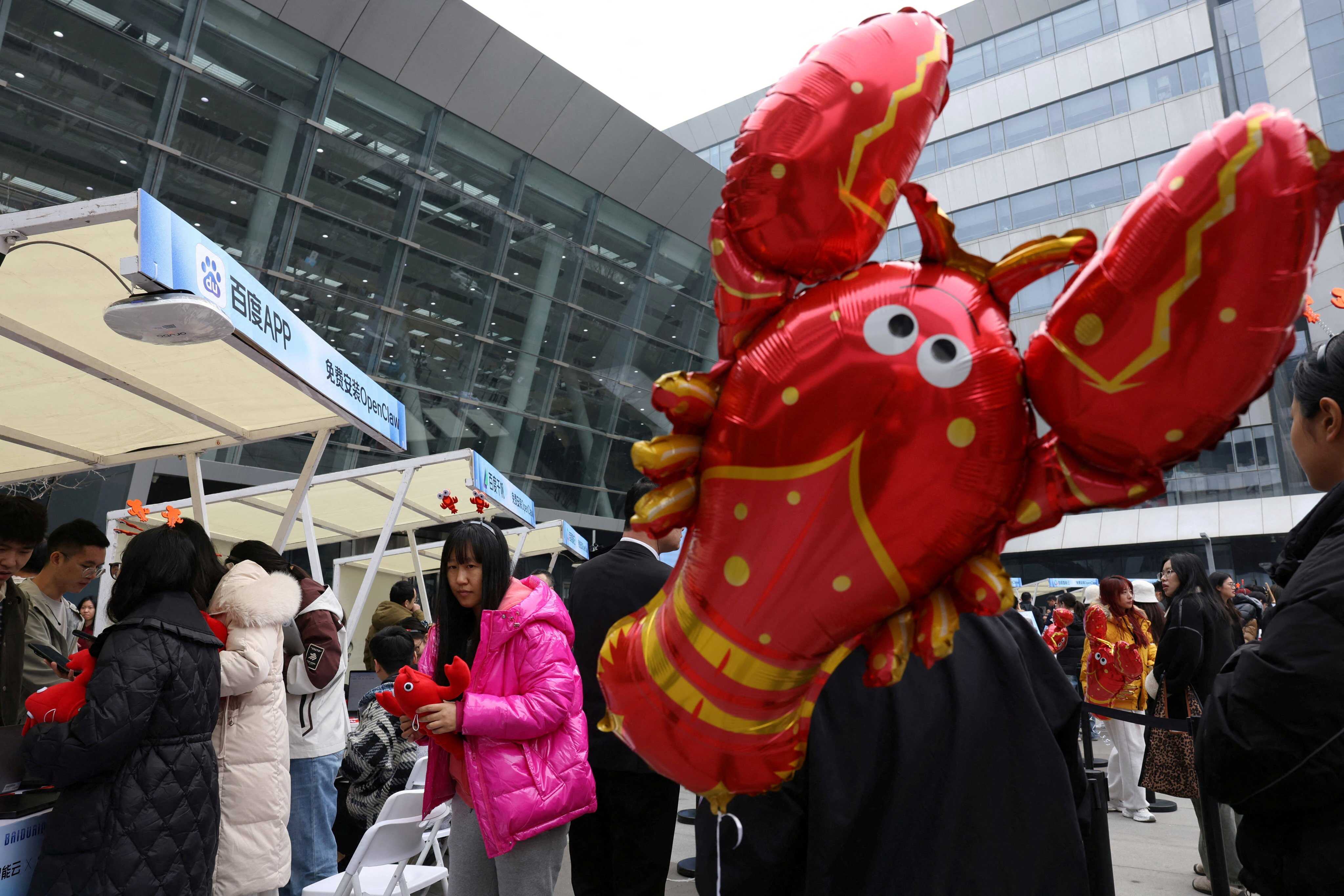
Deep Dive delves into hot issues in Hong Kong and mainland China. Our easy-to-read articles provide context to grasp what’s happening, while our questions help you craft informed responses. Check sample answers at the end of the page.
News: New graduates face tough outlook as Hong Kong’s job market declines
-
Local job vacancies in 23 out of 33 sectors fell to the lowest in six years
-
AI is taking over data entry and bookkeeping tasks, and even customer services
Hong Kong’s fresh graduates are facing increasingly challenging career prospects due to the rise of artificial intelligence (AI) and a sluggish economy.
Figures from the Joint Institution Job Information System, a centralised online job information platform shared by the city’s eight publicly funded universities, also showed that the number of job vacancies fell to a five-year low of 30,798 last year, down by 51.5 per cent from 2021.
In 2025, 23 out of 33 job sectors – 69 per cent – recorded their lowest number of vacancies in six years.
Industries with fewer job openings were those heavily associated with the use of artificial intelligence. These include information technology and programming, customer service, and administrative or clerical work.
Figures from the University Grants Committee showed 22,255 students completed an undergraduate degree in the 2024-25 academic year among the eight universities. The number is slightly lower than the 22,333 recorded in 2020-21, the year when the Covid-19 pandemic broke out.
In terms of the overall number of graduates, 2024-25 recorded 29,676, while 2020-21 had 28,861.
Michael Chau is a professor in innovation and information management at the University of Hong Kong’s HKU Business School. He said AI was likely a contributing factor to the limited job opportunities for fresh graduates.
“Artificial intelligence can do more clerical work than before, and every industry always has some paperwork,” Chau said. He attributed part of the decline in programming jobs to the growing use of AI, which could generate code rapidly.
He also noted that there were macroeconomic challenges, as the economy had worsened during the pandemic.
Dylan Kwan works for the Hong Kong software start-up Wati. He is the general manager for the Greater China region.
The company provides a range of AI services to help businesses engage their customers on WhatsApp.
While the obvious victims of AI are jobs in data entry and bookkeeping, Kwan said customer support roles were also among those that would have to evolve.
He noted that his firm had seen the proportion of customer support tickets resolved by AI increase from 10 per cent to nearly 30 per cent throughout 2025.
“Up to 60 per cent of the customer support tickets are resolved by our AI for some of our customers, so we can see that there are efficiency improvements,” Kwan said.
Staff writers
Question prompts
1. Which of the following statements is false, according to the information in News?
(1) Figures from the Joint Institution Job Information System show that the overall number of job vacancies in Hong Kong hit a four-year low.
(2) The total number of students who completed an undergraduate degree in 2024-25 was higher than the year the pandemic began.
(3) AI is able to create code quickly, resulting in fewer job openings in computer programming.
(4) According to Kwan, roles involving data entry, bookkeeping, customer support and tourism are the obvious victims of AI.
A. (1), (2) only
B. (1), (4) only
C. (2), (3) only
D. (3), (4) only
2. According to Chau, list TWO reasons why there are fewer career opportunities for fresh university graduates.
3. Identify TWO jobs that are being affected by AI. Using News and your own knowledge, explain what puts them at risk and why they are being impacted.
Chart
Question prompts
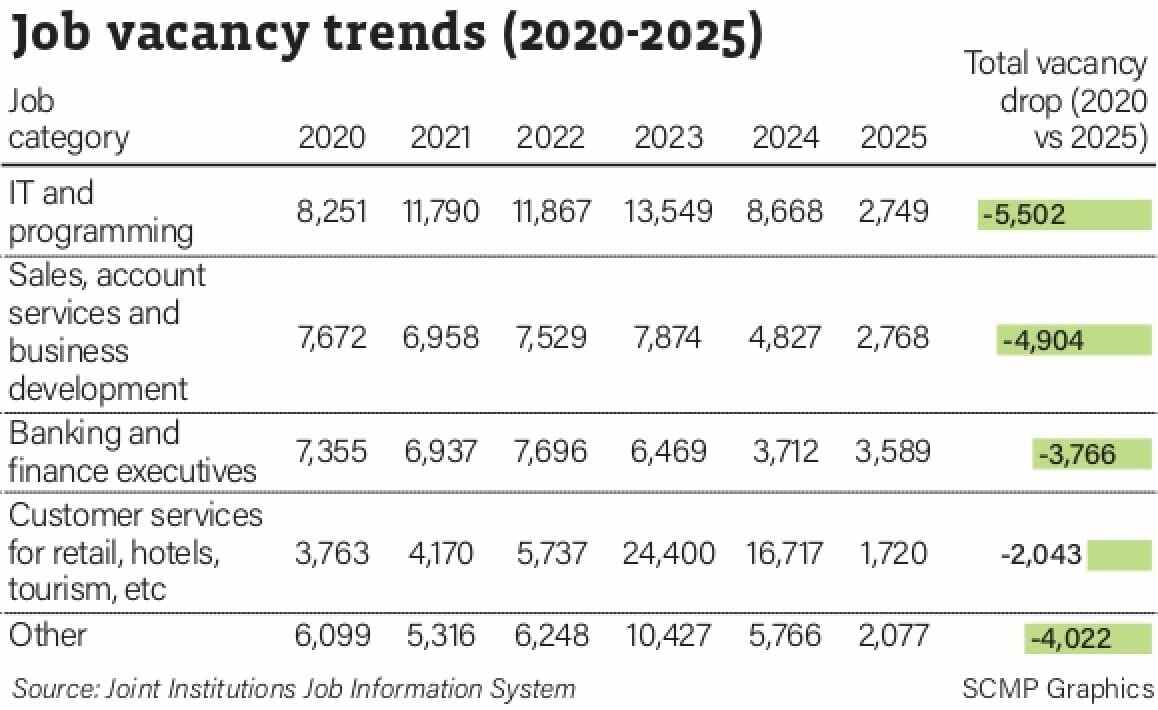
1. Using the chart, note TWO observations about job vacancies in different sectors.
2. Why might different sectors have different job vacancy trends from 2020 to 2025? Explain using News, Glossary and your own knowledge.
Issue: Navigating AI and the job market
-
Rise of AI may create new job positions
-
Experts say to focus on building skills like analysis that AI can’t replicate
Experts note that as artificial intelligence reshapes the labour market, institutions should develop ways to help students learn to navigate a job market that may offer fewer entry-level opportunities. Still, they say AI is unlikely to replace all workers and may even create new careers.
Wilson Wong Wai-ho, an associate professor at the Chinese University of Hong Kong (CUHK), has studied how the technology may impact the future of work.
More firms are turning to AI to fill what were once entry-level jobs, and the technology has upended the traditional ways young people entered the workforce and advanced. This could lead to what Wong described as a “broken talent chain”, leaving businesses without the right mix of young talent to sustain future operations.
But he was confident businesses, universities and the government would have no choice but to fix the issue as they became more aware of it.
This could include bridging courses for university students entering the workforce, more extensive internship programmes or even incentives for companies to hire young people and train them for future jobs, he said.
“Businesses should discuss with the government and universities how to solve this issue. The sooner you talk about it, the sooner you come up with a solution,” Wong said. “We do not want so many young people feeling frustrated before they step foot in the job market. The societal cost of this is very high.”
Despite the challenges, the rise of AI might also create new roles and industries, said Michael Chau, professor in innovation and information management at the University of Hong Kong’s HKU Business School.
He cited positions such as AI developers and repair engineers, model trainers, hardware manufacturers and downstream product manufacturers as new opportunities.
While AI might also influence or change how many jobs operate, the professions were likely to remain, Chau said. He cited the relatively more stable vacancy levels of medical practitioners and teachers reflected in the data.
“E-learning has been going on for ages, but there is still a need for teachers,” he said. “The role of teacher will transform as time passes and more new technology emerges, but it will remain.”
He added that the programming field would continue to exist, with perhaps fewer roles in the future, as people used AI to manage workflows.
To remain competitive, it was crucial to be equipped for jobs that required specialised judgment, which AI struggled to replicate, said Alexa Chow Yee-ping, managing director of ACTS Consulting.
For Chau, the key to staying ahead of the curve is to keep learning to use AI and remaining adaptable.
“As long as you keep learning and stay up to date, you don’t have to be too afraid ... even if you change jobs,” Chau said.
Staff writers
Question prompts
1. How might the wider adoption of AI lead to new career opportunities, according to Issue?
2. In your opinion, will AI replace all human workers in the long term? Explain using Issue, Glossary and your own knowledge.
3. What can universities and the government do to help new workers and graduates transition to the labour market alongside the rise of AI? Explain your answer using News, Issue and your own knowledge.
Illustration
Question prompts
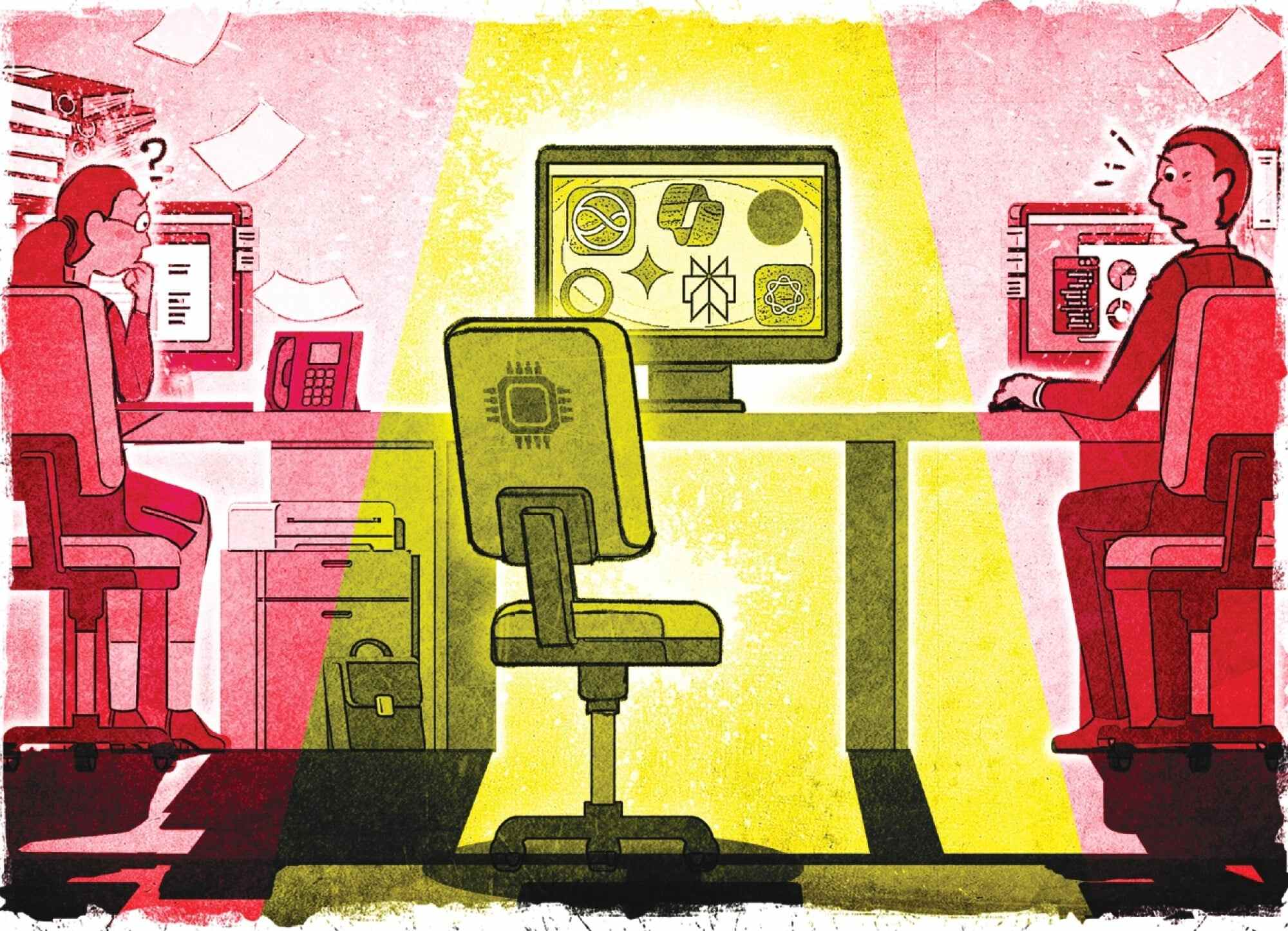
1. What does the empty chair in the cartoon represent? What expressions are the people making, and why might they be making them?
2. What skills can a human worker develop to try to avoid being replaced by AI in the future job market? Explain using Issue, Glossary and your own knowledge.
Glossary
sluggish economy: a period of little to no economic growth, characterised by slow activity, low consumer spending and a lack of momentum
job vacancies: open positions in a business or organisation that people can apply for
clerical work: the routine administrative and operational tasks required to maintain the daily functions of an office or organization
downstream product: the final good or service created at the end of a supply chain, ready for sale to the consumer. Downstream products for AI could include apps and tools that use this technology, such as ChatGPT or DeepSeek.
Sample answers
News
-
B
-
According to Chau, the two reasons for fewer career opportunities for fresh university graduates are AI, which can handle and speed up clerical work that every industry requires and can even generate code quickly; and macroeconomic challenges caused by the pandemic, as the economy worsened during Covid-19.
-
Two jobs affected by AI are data entry and customer service. Firstly, for data entry tasks, AI can handle more work and do it more quickly. For instance, AI can automatically process, organise, and input data using automation tools and machine learning. As data entry is repetitive and rule-based, AI systems can perform these tasks more efficiently and with fewer errors than humans, eventually reducing the number of human workers in this role. Customer-service positions are also affected because AI chatbots and automated customer-support systems can answer questions and resolve issues, putting these positions at risk. According to Kwan, AI resolved up to 60 per cent of customer support tickets for his company, reflecting how AI reduced the need for human staff and lowered demand for entry-level customer service jobs.
Chart
-
The IT and programming sector had the largest decline in job vacancies among all sectors, falling from 8,251 in 2020 to 2,749 in 2025, which resulted in a total drop of 5,502 jobs. Second, the customer service sector fell sharply after peaking in 2023. Vacancies from the sector increased significantly from 5,737 in 2022 to 24,400 in 2023, yet fell dramatically to 1,720 in 2025. (accept all reasonable answers)
-
Different sectors experienced different job-vacancy trends from 2020 to 2025, mainly due to AI development and economic changes following the pandemic. The advancement of AI has replaced some routine jobs across industries. AI tools can perform tasks such as clerical work, programming, data entry, and customer service. Specifically, AI can generate code efficiently for IT and programming, while AI chatbots can handle support tickets for customer service. This can reduce the need for human workers. Yet during and after the pandemic, businesses cut costs and slowed hiring due to the city’s sluggish economy. Industries such as banking, finance, and sales were affected by reduced business activity, and companies became more cautious about expanding their workforces. Therefore, the overall number of job offerings decreased. Technology and automation adoption across sectors also improve efficiency and reduce labour costs; therefore, more routine and repetitive jobs are easily replaced. Overall, sectors involving routine, repetitive, or administrative work underwent larger declines. (accept all reasonable answers)
Issue
-
The wider adoption of AI may create new career opportunities, as there will be demand for workers to develop, maintain, and apply AI technologies. Specifically, Chau suggested AI developers and repair engineers, model trainers, hardware manufacturers and downstream product manufacturers could be new employment opportunities.
-
In my opinion, AI is unlikely to replace all human workers in the long term. Some professions, such as teachers and medical practitioners, remain relatively stable. AI changes how jobs operate, but does not eliminate them completely. Occupations that require specialised judgement, creativity and human interaction, such as positions in the education sector and the creative industry, are harder for AI to replace. Although AI can perform clerical work, data entry, and coding, which mainly affect routine tasks, jobs like those of reporters and lawyers still require decision-making and communication. Furthermore, AI lacks human empathy, creativity, and ethical judgment. For instance, despite the rise of e-learning, teachers are still needed for emotional support and mentorship, and doctors are necessary to make complex medical decisions. Therefore, I believe AI will transform jobs rather than replace all workers, and humans will continue to work alongside AI adaptation. (accept all reasonable answers)
-
Universities and the government can take several measures to help graduates transition into the labour market. Universities can provide bridging courses and AI-related training for students entering the workforce, expand internship programmes and offer incentives for companies to hire young people and train them for future jobs. This will help students learn AI tools, data analysis and digital skills, keeping graduates competitive in a changing job market. Expanded internship and work-experience opportunities can also allow students to gain practical skills and workplace experience, which helps to alleviate the city’s “broken talent chain” where fewer entry-level jobs exist. The government can also provide incentives for companies to hire graduates and fund skills-upgrading schemes. Since Chau said workers must keep learning and remain adaptable, lifelong learning helps graduates adjust to AI-driven changes. Overall, universities, businesses, and the government need to work together to help new workers and graduates transition into an AI-driven job market. (accept all reasonable answers)
Illustration
-
The empty chair represents an AI worker. Human workers are shown with perplexed or concerned expressions as the AI worker occupies a central, highlighted role in the office. The workers’ expressions can reflect a sense of displacement and job insecurity caused by the outstanding performance of the AI worker.
-
Human workers can develop skills that artificial intelligence can hardly replicate, such as critical thinking, creativity, emotional intelligence and adaptability. Chau suggested that workers should focus on jobs requiring specialised judgment, which AI struggles to replicate. He also emphasised the importance of continuous learning and adaptability to stay competitive. Critical thinking and analytical skills are important because AI can process data efficiently through machine learning, but humans are better at solving unfamiliar and niche problems and at evaluating ethical and social consequences with moral and empathetic consideration. Being creative and innovative is also important for a human worker. As AI generates content mostly based on existing training data, humans play a key role in creating new ideas and designing innovative solutions. Professions such as design and research rely heavily on creativity, making them less likely to be replaced. Communication skills are also important because AI cannot fully replicate in-person communication or understand human emotions. Roles that require significant human interaction, such as teachers who provide in-person emotional guidance to students and healthcare workers who offer comfort to patients, are less prone to full AI replication. These occupations depend on personal connection, which AI cannot fully duplicate. (accept all reasonable answers)