Deep Dive delves into hot issues in Hong Kong and mainland China. Our easy-to-read articles provide context to grasp what’s happening, while our questions help you craft informed responses. Check sample answers at the end of the page.
News: Hong Kong universities back proposal for ‘upgraded’ short-term study tours
-
Programmes aimed at non-local secondary students would highlight topics such as AI and medicine
-
Authorities hope the tours could encourage more international students to pursue higher education in the city
At least five Hong Kong universities have backed the government’s proposal to launch study tours aimed at attracting non-local secondary students to pursue higher education in the city, with programmes featuring topics such as artificial intelligence (AI).
The University of Hong Kong (HKU) is the city’s oldest tertiary institution. It said it would offer up to 35 programmes this summer, giving outstanding non-local students a chance to earn full scholarships.
In this year’s government budget, education authorities said they hoped tertiary institutions would organise more short-term study tours. Summer break would be the ideal time for these tours, since campus resources are underused. They say it could encourage non-local students to pursue studies in the city.
A source said universities had already been running study tours. Still, the government wanted them to upgrade their offerings to attract more students from outside the city and encourage them to remain in Hong Kong for higher education.
The source said the tours could focus on themes ranging from technology and innovation to arts, culture and creativity.
Some universities in the United States and the United Kingdom offer similar summer programmes for secondary school students. Although they are pathways to full undergraduate degrees, admission is not guaranteed.
The HKU Academy for the Talented will offer up to 35 short-term pre-university programmes for non-local students from June to August, according to a spokesman. The courses will cover fields such as artificial intelligence, science, arts and humanities, medicine and healthcare, law and the social sciences.
“Secondary school students from around the world will be able to experience authentic Hong Kong university life. Outstanding international students will also have the chance to receive full scholarships to participate,” it said.
HKU has been offering such summer programmes since 2011. Nearly half of past participants have come from mainland China, South Korea, India, Australia, the US and the UK.
A spokesman for the Chinese University of Hong Kong (CUHK) said its summer institute had run a two-week academic enrichment programme for local and non-local secondary school students for nearly two decades.
“[CUHK] will continue to do so in 2026. The institute offers an immersive opportunity for students from Hong Kong and overseas to experience university-level studies and campus life at CUHK,” the spokesman said.
The Hong Kong University of Science and Technology (HKUST) said it launched a preparatory programme this year for both local and non-local secondary school students.
Last year, HKUST held its first large-scale Summer Bootcamp for Polymaths, a nine-day programme that attracted more than 150 secondary school students from over 17 countries.
Staff writers
Question prompts
1. Which of the following statements is false, according to the information in News?
(1) HKU will offer 25 short-term pre-university programmes for local students.
(2) The government wants to use study tours to attract more students from outside the city to stay in Hong Kong for higher education.
(3) Five Hong Kong universities are backing a government initiative to launch high-level study tours designed to recruit non-local secondary students.
(4) Local students are calling for more scholarship opportunities to establish Hong Kong as a global hub for higher education.
A. (1), (3) only
B. (1), (4) only
C. (2), (3) only
D. (3), (4) only
2. What is the primary goal of these “upgraded” study tours, and how do they differ from existing programmes universities have run for years?
3. Based on News, how is HKU hoping to attract “talented” and “outstanding” non-local secondary students? What specific incentives and academic topics is it using?
Photo
Question prompts
1. What is being shown in the photo? How does it relate to the information in News?
2. Will short-term study tours be an effective way to attract more non-local university students? Explain your opinion using News and Glossary.
Issue: Hong Kong sees more non-local university students after quota increase
-
Government doubled non-local student quotas at public universities starting from the 2024-25 academic year
-
Authorities plan to increase the quota to 50 per cent in the 2026-27 academic year
Hong Kong public universities had more than 20,000 non-local undergraduate students in the second academic year since the government doubled quotas, a 17 per cent year-on-year increase.
The Education University of Hong Kong (EdU) saw the sharpest increase in non-local undergraduate students under the policy, jumping by 90 per cent over three academic years, followed by Baptist University.
Starting in the 2024-25 academic year, the government doubled the non-local student admission quotas at public universities to 40 per cent of the number of local students. Authorities plan to raise the threshold to 50 per cent in 2026-27.
Speaking at a “Study in Hong Kong” event last month, Secretary for Education Christine Choi Yuk-lin said that Hong Kong universities have proved popular among mainland Chinese students. The government previously announced plans to increase recruitment in Southeast Asia and countries participating in the Belt and Road Initiative as well.
Choi said that about one in every four university students came from outside Hong Kong, while about 70 per cent of academic staff were from outside the city.
About 5,000 hostel places could be added under a scheme to accommodate more non-local students by allowing private developers or operators to convert commercial buildings into student hostels, Choi added.
Except for those awarded scholarships, non-locals pay full tuition fees for undergraduate programmes, ranging from HK$160,000 to HK$218,000 (US$21,000 to US$28,000) starting from the 2025-26 academic year, depending on which university they attend.
In contrast, local students studying publicly funded bachelor’s degrees are heavily subsidised.
Figures from the University Grants Committee showed that 20,093 non-local students were enrolled in undergraduate programmes in 2025-26, up from 17,161 in the previous academic year.
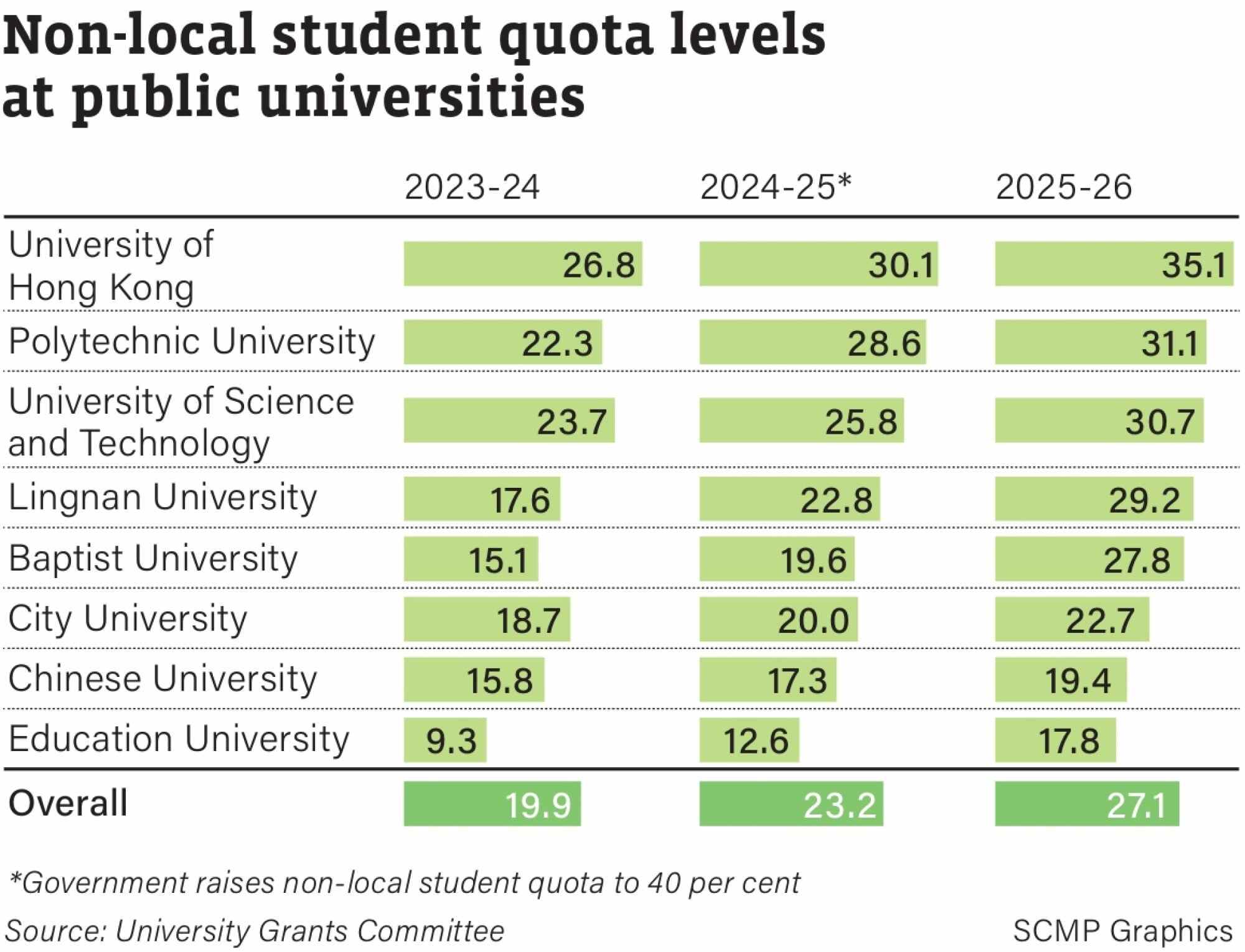
The figure for the current academic year is equivalent to about 27.1 per cent of the total number of local undergraduates, up from last year’s 23.2 per cent, but has not exceeded the current quota of 40 per cent.
A breakdown of the figures showed that the University of Hong Kong had the highest number of non-local undergraduate students in 2025-26, at 4,894, equivalent to 35.1 per cent of the local undergraduate population.
In terms of percentage increase, EdU recorded the highest jump since the quota increase.
The number of non-local undergraduates at the city’s largest teacher-training institution rose from 442 in 2023-24 to 841 in the current academic year – an increase of 90 per cent.
Overall, the number of non-local undergraduates at the eight institutions has risen by 36 per cent since the policy was launched.
Staff writers
Question prompts
1. Using Issue, ONE government initiative aimed at encouraging non-local students to study in Hong Kong.
2. Why might there be a need to review the non-local student admission quotas at Hong Kong’s universities?
3. What factors must Hong Kong consider before increasing the non-local student quota again? Explain using Issue, Glossary and your own knowledge.
Chart
Question prompts
1. Using the chart, note ONE trend about the quota levels of non-local students at the city’s public universities.
2. How do you feel about the government’s push for more non-local students? Explain your opinion using Issue, Glossary and your own knowledge.
Glossary
-
tertiary institution: a school providing education after secondary school, such as a university or vocational college
-
pre-university programmes: short-term academic courses taken before starting a university degree. They serve as a bridge to ensure students meet the academic requirements for university entry.
-
polymaths: individuals with knowledge spanning many different subjects
-
admission quotas: a fixed limit on the number of students allowed into a particular programme. Once this limit is reached, no more students are accepted, regardless of their qualifications.
-
threshold: a level, rate or amount at which something comes into effect
-
student hostels: supervised residential buildings specifically for students. They provide basic lodging and often include shared facilities like kitchens, study halls and common rooms to foster community.
Sample answers
News
1. B
2. The primary goal is to attract more non-local secondary students to Hong Kong and encourage them to stay for higher education by offering enhanced, themed short-term programmes. They differ from existing programmes by being deliberately “upgraded” to be more targeted, higher-profile and marketed as pathways to local university study, with a stronger focus on themes like technology, innovation and arts to increase international appeal.
3. HKU is expanding its summer pre-university offerings, up to 35 programmes run by its Academy for the Talented, targeting non-local secondary students with courses spanning AI, science, arts and humanities, medicine and healthcare, law and the social sciences. To incentivise participation and long-term enrolment, HKU highlights the experience of real campus life and offers full scholarships to outstanding international students selected for the programmes. Building on a history of running similar summer courses since 2011, HKU uses these themed academic tracks and scholarship opportunities to position itself as an attractive pathway for talented students worldwide.
Photo:
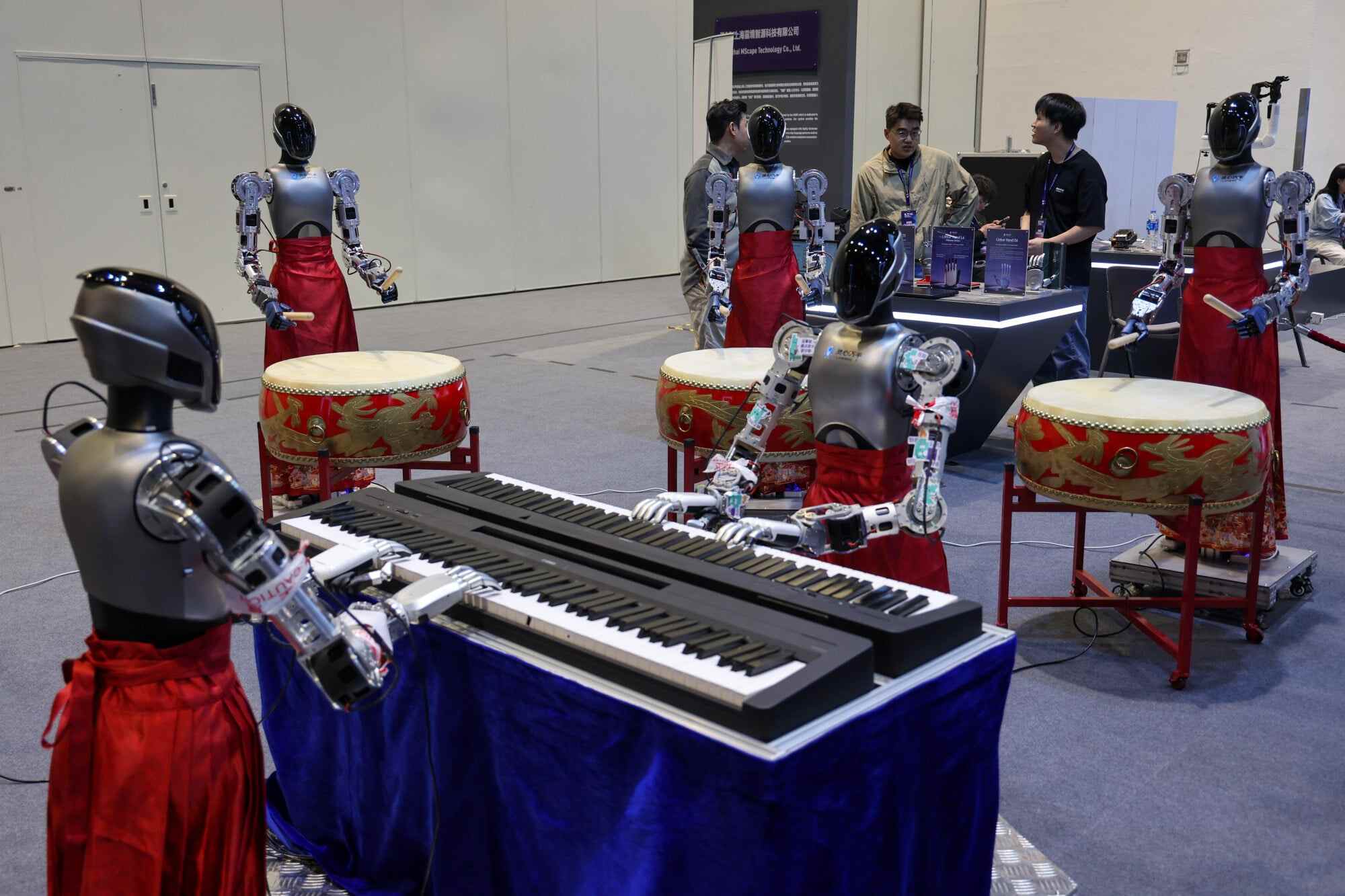
1. Humanoid robots perform on musical instruments at the Hong Kong International AI Art Festival, held at the Hong Kong Convention and Exhibition Centre in Wan Chai. AI is one of the major themes of the new study tours planned to attract non-local students.
2. Short-term, upgraded study tours have strong potential to recruit non-local secondary students because they let participants experience authentic campus life at tertiary institutions and engage with focused pre-university programmes in high-demand fields like artificial intelligence, science, medicine, law and the arts. HKU’s plan to run up to 35 programmes and offer full scholarships to outstanding international participants shows how academic content plus clear incentives can motivate students to consider Hong Kong for higher education. But these tours do not guarantee admission. To convert interest into enrolment universities must provide meaningful academic value, follow-up engagement and transparent pathways to admission. When well designed and resourced, such programmes can become a cost-effective recruitment channel during the underused summer months. (accept all reasonable answers)
Issue:
1. The government doubled the non-local student admission quotas at public universities to 40 per cent of the number of local students starting in 2024-25, with plans to raise the threshold to 50 per cent in 2026-27.
2. There may be a need to review the quotas to assess the policy’s impact on university demographics, local student access and campus resources, and to decide if the planned increase to 50 per cent continues to be feasible. A review allows authorities to check whether the rise in non-local enrolment is sustainable, whether accommodation and services such as student hostels are sufficient, and whether the policy is meeting goals like boosting internationalisation and attracting talent from Southeast Asia and Belt and Road countries. (accept all reasonable answers)
3. Hong Kong authorities must evaluate the availability of student hostels, current enrolment trends and budgetary implications, as most non-locals pay full tuition while local students are heavily subsidised. Policymakers must ensure quotas do not unfairly limit the access that local students have to campus resources. Other considerations include maintaining academic standards, supporting integration and other student services for a more international campus and monitoring labour-market impacts. A careful, evidence-based review that balances the goals of internationalising with the needs of local students will be essential before any further quota increase. (accept all reasonable answers)
Chart:
1. Across 2023-24 to 2025-26, the percentage of non-local undergraduates rose at every public university shown in the chart, with the overall share increasing from about 19.9 per cent to 27.1 per cent. Notably, Baptist University saw the largest rise of about 12.7 percentage points from 2023-24 to 2025-26.
2. I support a measured expansion of non-local enrolment because it brings academic diversity and helps Hong Kong tertiary institutions become more internationally competitive. The government’s doubling of the quota has clearly increased non-local numbers, but authorities should manage admission quotas and student hostel capacity so –campus resources are not strained. Offering full-fee places to most non-locals also helps universities generate revenue while scholarships can target top talent, balancing institutional finances and merit-based access. (accept all reasonable answers)