Deep Dive delves into hot issues in Hong Kong and mainland China. Our easy-to-read articles provide context to grasp what’s happening, while our questions help you craft informed responses. Check sample answers at the end of the page.
News: Hong Kong’s finance secretary outlines new budget
-
City recorded a surplus of HK$2.9 billion last year
-
Nine government departments will receive more money this year; others to see significant cuts
Hong Kong’s financial secretary Paul Chan Mo-po announced in his annual budget address last month that the city’s recurrent spending would be cut by 2 per cent in 2026-27, even after it recorded an estimated HK$2.9 billion consolidated surplus for 2025-26.
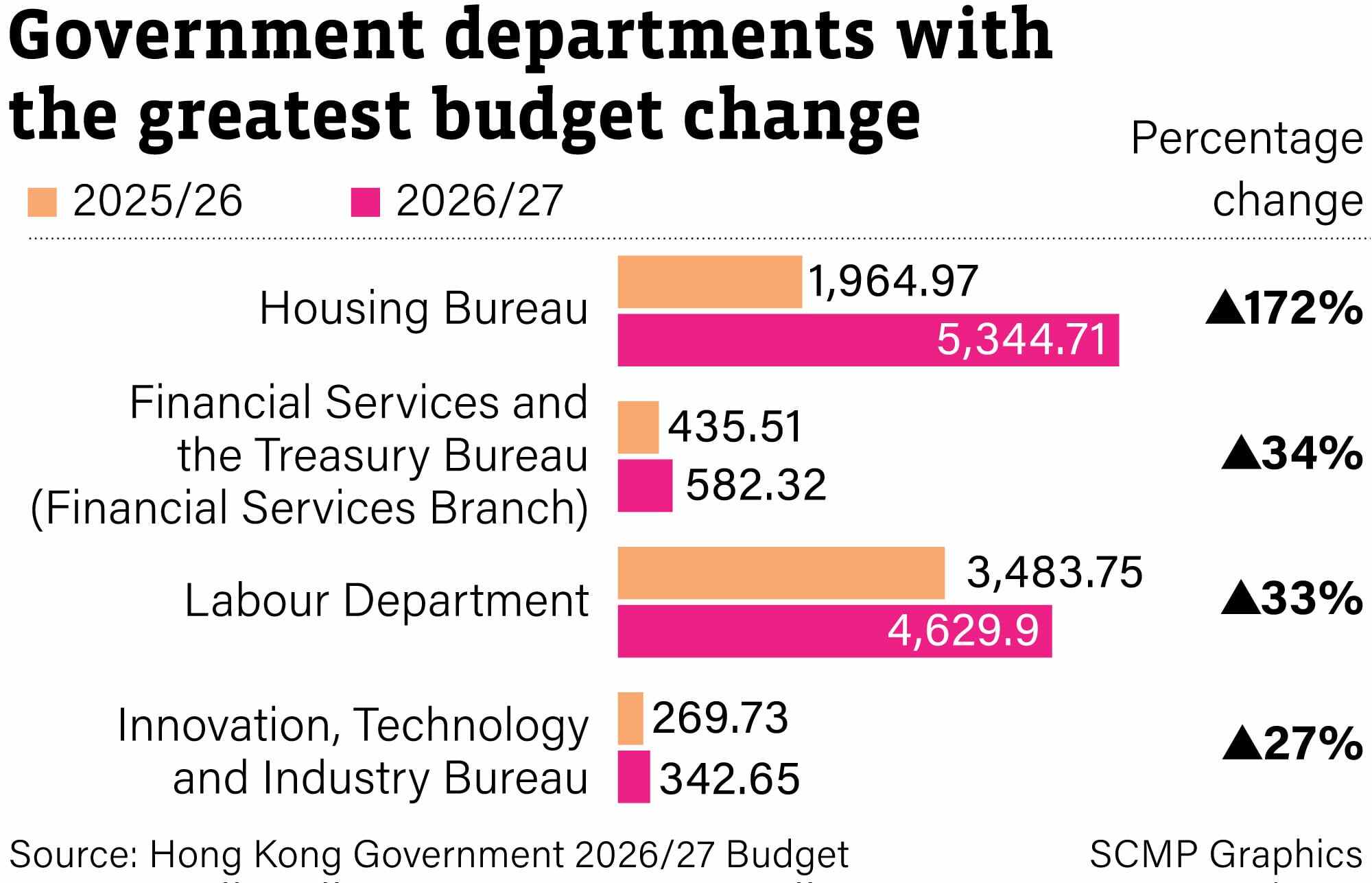
Still, the individual budgets of nine bureaus and departments will rise more than 10 per cent. These include Hong Kong’s innovation and technology (I&T), intellectual property and investment promotion departments, which will see increases ranging from 11 to 27 per cent.
The new spending covers initiatives such as expanding the use of artificial intelligence (AI), launching a pilot programme to help businesses secure patents and financing for their products, and pursuing measures to help mainland Chinese firms “go global”.
This year’s budget focused on I&T development and pledged significant support and investment in key areas such as AI and intellectual property.
The Housing Bureau recorded the largest overall budget increase, rising from HK$1.96 billion in 2025-26 to HK$5.34 billion this financial year.
Of that amount, HK$4 billion was earmarked for the long-term resettlement of Wang Fuk Court residents who lost their homes in the deadly fire in November.
Funding for the Labour Department also rose by 33 per cent, due to higher cash flow needs after the abolition of the Mandatory Provident Fund (MPF) offsetting arrangement.
However, 11 departments significantly tightened their budgets, cutting expenditure by more than 10 per cent.
The Environment and Ecology Bureau had the largest reduction, with its budget slashed by 70 per cent.
This stemmed from reduced cash flow requirements following the government’s extension of the validity of unused relief balances under the electricity charges relief scheme.
RTHK, the city’s public broadcaster, and the Information Services Department will have their budgets cut by 28 per cent and 12 per cent, respectively.
Another of the government’s cost-control measures involved trimming the civil service establishment by 2 per cent in each of the next two financial years. This will bring the number of government posts down from 192,416 to 187,429 by next March, a reduction of 2.6 per cent.
The Home and Youth Affairs Bureau will expand from 194 to 225 posts, a 16 per cent increase.
Its salary expenditure will increase from HK$137 million in 2025-26 to HK$150 million in 2026-27.
A spokesman for the bureau said the larger workforce was mainly due to the creation of time-limited posts to assist in the preparation and coordination of activities and celebration programmes for the 30th anniversary of the city’s handover next year.
The Culture, Sports and Tourism Bureau faces the sharpest reduction, from 401 posts to 310 by next March, representing a 23 per cent decrease.
Staff writers
Question prompts
1. Which of the following statements is false, according to the information in News?
(1) Hong Kong’s innovation and technology and investment promotion departments will have their budgets cut in the coming financial year.
(2) Nine government bureaus and departments will see their budgets increase by more than 10 per cent.
(3) In total, 10 departments tightened their budgets significantly, cutting expenditure by over 11 per cent.
(4) The Home and Youth Affairs Bureau needs a bigger workforce to prepare for the 30th anniversary of the handover.
A. (1), (2) only
B. (1), (3) only
C. (2), (3) only
D. (3), (4) only
2. Why did the Environment and Ecology Bureau have the largest reduction in budget? Explain using News and your own knowledge.
3. To what extent do annual shifts in the budget reflect the government’s development goals? Explain using News, Glossary and your own knowledge.
Chart 1
Question prompts
1. Using the chart, note TWO observations about the budget increases in different departments.
2. Why might different departments be receiving different budget increases? Explain using News, Glossary and your own knowledge.
Issue: Hong Kong cuts early childhood education budget for 2026-27 financial year
-
Subsidies for the sector have fallen by 30 per cent since hitting peak in 2020-21
-
Vice-chairwoman of the Hong Kong Federation of Education Workers said budget cuts could lead to fewer teachers
Hong Kong’s early childhood education sector will receive its lowest level of subsidy in more than a decade as the number of preschools falls to a 13-year low, with the government cancelling two grants for kindergartens in the new school year.
The 2026 budget announced that the early childhood sector will receive only HK$4.5 billion from the government in the 2026-27 financial year, representing a 6.6 per cent drop from the current year.
According to authorities, the new budget cuts kindergarten funding primarily due to the shrinking number of students. The government estimated that there would be just 105,800 toddlers enrolled in kindergartens next school year, 79,000 of whom would attend subsidised institutions – both record lows.
The sector suffered the largest cut in resources among all areas overseen by the Education Bureau.
Overall, subsidies for early childhood education have fallen by 30 per cent compared with their peak in 2020-21. The number of students in subsidised kindergartens has dropped by nearly 40 per cent over the same period.
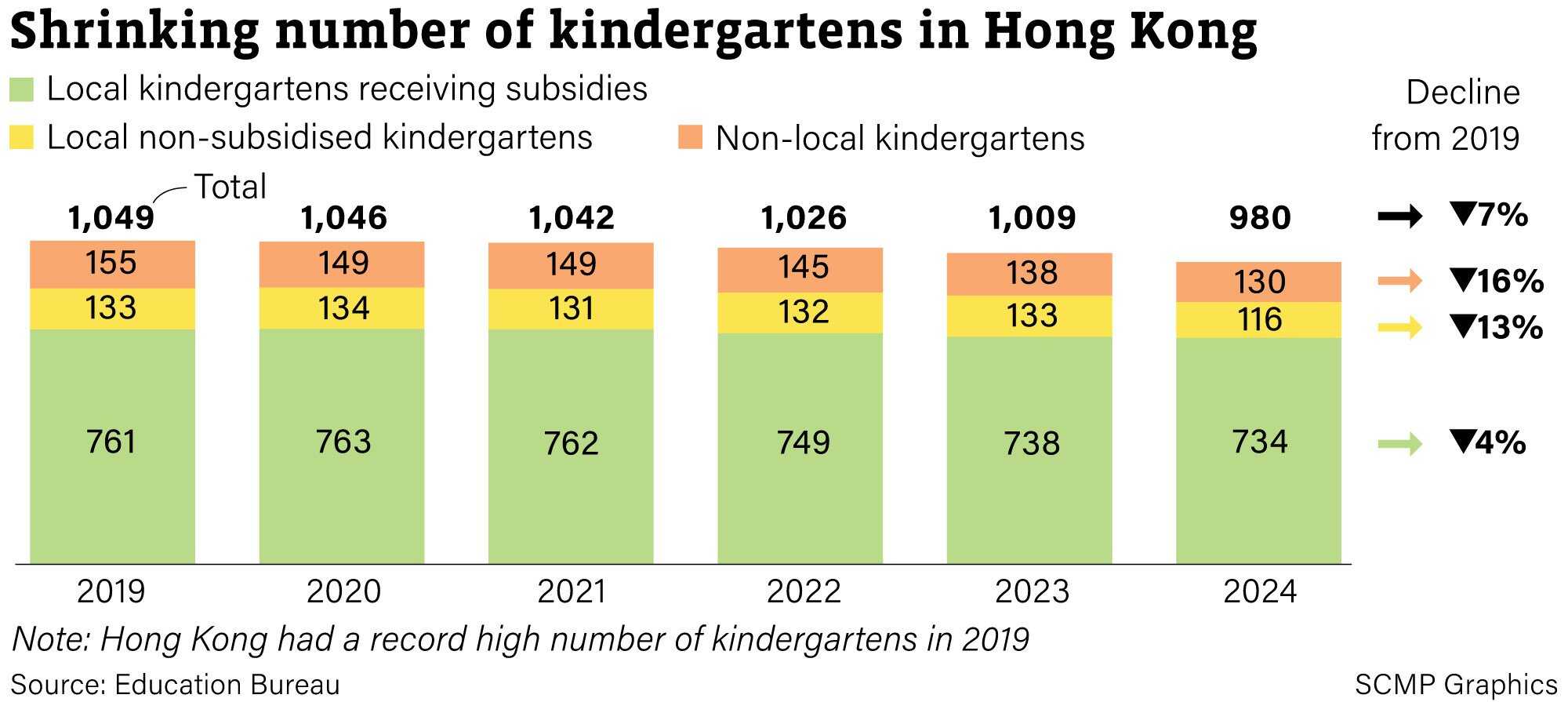
The number of kindergartens in Hong Kong stands at 958 after 22 institutions closed last year, a new low since 2013, according to the budget. This figure is expected to decline further by the end of this school year.
The Education Bureau will scrap two subsidies – one for kindergarten activities and another for hiring substitute teachers – which cost the government HK$15.9 million and HK$24.9 million respectively in the last school year.
According to calculations by the South China Morning Post, each subsidised kindergarten will lose an average of HK$40,000 in funding. However, the bureau will not cut the unit subsidy or per-student subsidy in the new school year. Preschools will be allowed to use their unit subsidies or other existing resources to cover expenses previously funded by the two now-cancelled grants, including off-campus activities and substitute teacher hiring.
Choi Lai-fong, vice-chairwoman of the Hong Kong Federation of Education Workers and a preschool principal, said the scrapping of the two grants would further strain kindergartens’ budgets, which were already under pressure from the low birth rate.
In 2025, only 31,100 babies were born – the lowest number on record.
She said the grim outlook brought by continuous cuts in government support and shrinking student numbers would not only lead to more school closures but also more dismissals of teaching staff.
“We are truly miserable because we are now actually a sunset industry. Kindergarten management has no choice but to keep sacking teachers if the budget is further tightened,” Choi said.
Staff writers
Questions prompt
1. According to Issue, why will Hong Kong’s latest budget cut subsidies for early childhood education?
2. Using Issue and Glossary, explain what it means when Choi describes the education sector as a “sunset industry”.
3. List the two subsidies being cut from the early childhood education budget. How might this affect schools, teachers and students?
Chart 2
Question prompts
1. Describe the trend shown in the chart. Explain why it is happening using information from Issue.
2. Amid kindergarten closures, what could the government do to support teachers working in early childhood education? Give TWO suggestions.
Glossary
-
recurrent spending: the regular annual costs for running public services
-
abolition of the Mandatory Provident Fund (MPF) offsetting arrangement: a change in how employers pay employees who have been dismissed or laid off from their positions. Every month, employers must put money into employees’ MPF accounts, which employees can use for retirement. Now, employers cannot use this money to cover payments to employees that have been dismissed.
-
unused relief balances: the unused money from a government subsidy for electricity bills. Authorities announced at the end of 2025 that the unused funds could be used to pay electricity bills through the end of 2026.
-
unit subsidy or per-student subsidy: money given to schools to cover expenses on salaries for teaching staff and supporting staff as well as other operating costs
-
sunset industry: an old and declining sector of work that has passed its peak
Sample answers
News
-
B
-
The environmental branch under the Environment and Ecology Bureau experienced the largest reduction because the Hong Kong government previously allocated a large sum of money through the Electricity Charges Relief Scheme to help households pay their electricity bills. Yet, many residents hadn’t used up their credits yet, so the government extended the expiry date of those existing balances. With the unused credits and the old allocated money remaining, the government does not need to add as much money with this year’s budget, without actually cutting the benefit to the public.
-
From the new budget plan, it indicates that the Hong Kong government is prioritising innovation and technology (I&T), Artificial Intelligence (AI), and intellectual property. The difference in proportions of money allocation across sectors reflect the focus of the government’s goals in development as well as considering the recurrent spending, which includes the ongoing operating expenses for health services and education. This year, the Hong Kong government’s new spending includes initiatives aimed to improving the use of artificial intelligence (AI), and launching a pilot programme to help businesses securing patents and financing, and measures to help mainland Chinese firms to “go global”, which is to encourage firms across the border to use Hong Kong as a platform for expanding their businesses overseas.
Chart 1
-
First, the Housing Bureau recorded the largest overall budget increase, rising from HK$1.96 billion in 2025-26 to HK$5.34 billion this financial year, with a 172 per cent increase. Second, Hong Kong’s innovation and technology (I&T), intellectual property and investment promotion departments also see increases ranging from 11 to 27 per cent, which in total is approximately $73 million. (any two)
-
The variations in budget increases among different departments can be attributed to the government’s strategic focus on pressing sectors, such as housing and technology. As social problems and issues of the city are different every year, the government allocates funds accordingly to address the prioritised issues as recurrent spending. Consequently, this year the budget of the Housing Bureau reaches the highest as the government is targeting a total production of around 196,000 public housing units over the next five years and also to cover the long-term resettlement of Wang Fuk Court residents who lost their homes in the deadly fire in Tai Po; while more resources for IT, for developing the Northern Metropolis, and aligning with national 15th Five-Year Plan goals. (accept all reasonable answers)
Issue
-
The budget cut is due to the shrinking number of students, specifically the number of toddlers enrolled in kindergartens next school year, the number of them would attend subsidised institutions both record lows.
-
When Choi describes the education sector as a “sunset industry”, she probably refers to the sector as structurally declining. Hong Kong has recorded the lowest fertility rate, resulting in a lower number of students. Eventually, with insufficient numbers of students, primary and secondary schools are facing closure, where the professionals and teachers are laid off or gradually leave the industry as the budget from the government is tightened on unit subsidy and per-student subsidy. (accept all similar answers)
-
The subsidy cut includes a grant for kindergarten activities and a grant for hiring substitute teachers. These cuts aim to reduce government expenditures, given the low birth rate and declining student population. For schools, as they may face insufficient students enrolling and funding from the government, they might not be able to support the education, and the difficulty of managing the school, so they are forced to sack teachers and face closures; while for teachers, especially preschool teachers, they are trained over the years, but now they are facing such unstable job conditions; For students, the reduced subsidies on activities might affect the opportunities of them having experiential learning. (accept all reasonable answers)
Chart 2
-
The trend shows that the number of local kindergartens are decreasing year by year since 2019. This is because the city’s birth rate is dropping, which consequential led to the decrease in the number of students enrolled in kindergarten.
-
Firstly, the government can enhance mental health and wellbeing support for teachers, especially as the reduced budget might result in reduced staff headcounts in the early childhood sector. Increased workload of teachers might heighten their work pressure, so offering resources to address teachers’ burnout, such as hotlines for work-related problems, can be beneficial. Secondly, the government can introduce flexible funding policies that allow schools to reallocate existing resources to maintain staffing levels and support professional development to lower the chance of teachers being laid off. (accept all reasonable answers)