Deep Dive delves into hot issues in Hong Kong and mainland China. Our easy-to-read articles provide context to grasp what’s happening, while our questions help you craft informed responses. Check sample answers at the end of the page.
News: City uses technology to track rats
-
Hong Kong is using AI to detect and map rodents
-
More than 87,000 rodents caught in the first half of 2026
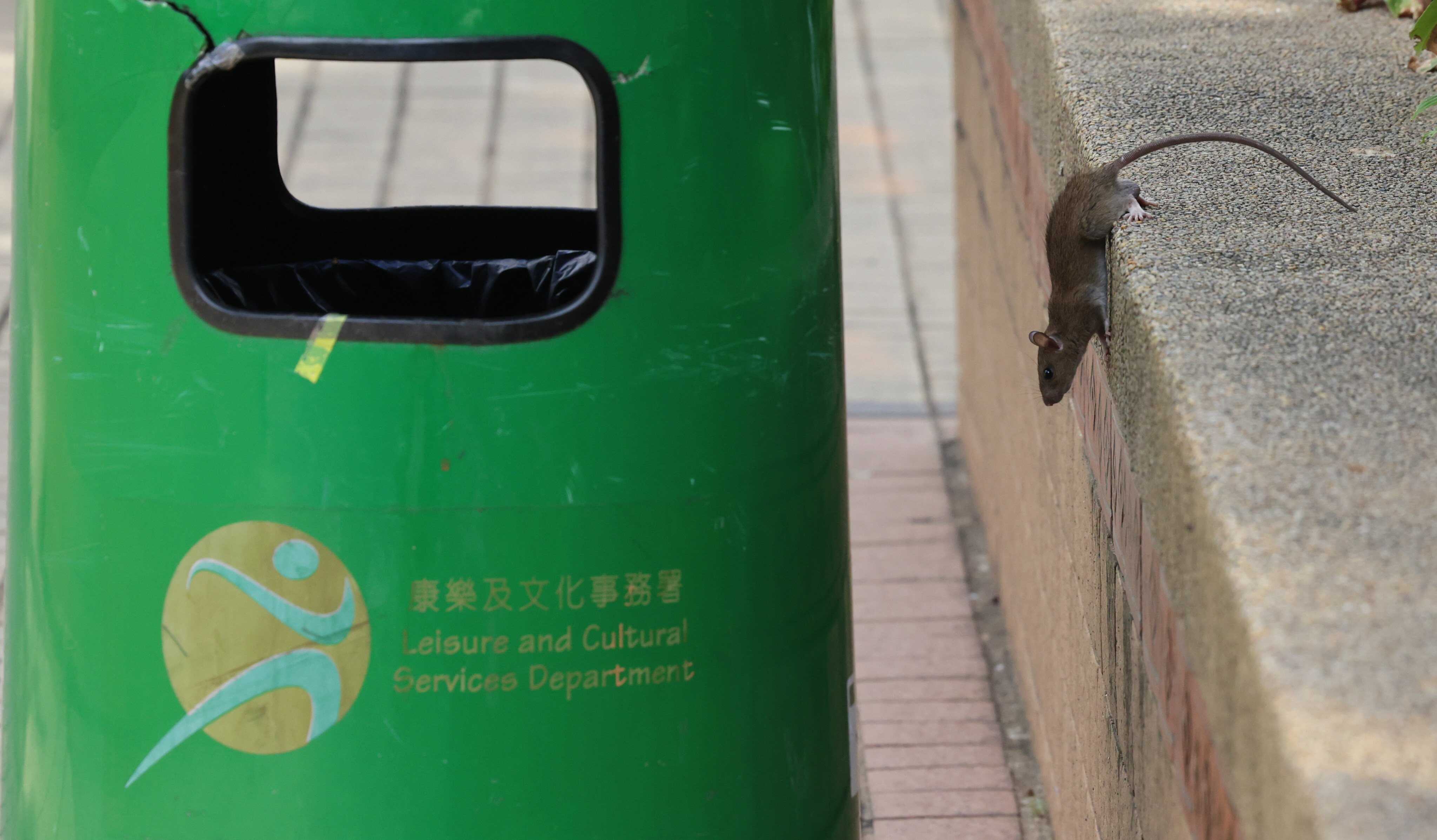
Hong Kong resident Yau Suk-ming was startled when a rat leapt out from her kitchen blender. The rodent scurried away before the 74-year-old retiree could catch it. Still, she was not surprised to see the rat. Earlier, she had noticed rat droppings in her flat in Kowloon City.
Rodents lurking below the city’s wet markets, butcher shops and fresh produce stores have increasingly become a cause for concern about public health and hygiene.
The number of live or dead rodents caught or collected in Hong Kong in the first half of 2026 stood at 87,105. The annual number had risen in the past decade, from 37,169 in 2016 to 157,182 in 2025 – a 323 per cent increase.
Despite this rise, authorities have said their containment strategy is working. The Food and Environmental Hygiene Department (FEHD) said it had deployed the latest artificial intelligence (AI) technology to track and capture rodents.
Thermal imaging cameras installed across Hong Kong take images at two-minute intervals from 7pm to 7am for three consecutive nights, every six months.
The system’s AI algorithm detected and counted rats from their thermal signatures, analysed the frequency of their appearance and peak activity hours and mapped dispersal routes, a spokesman said.
This provided the absence rate. The rate was measured by dividing the number of snapshots in which no rodents were detected by the total number of images taken.
“A high rodent absence rate gives the impression that Hong Kong is almost rodent-free in certain districts, yet some residents have reported that the rat infestation problem is getting worse,” said Brian Wong Shui-hung, a researcher at local think tank Liber Research Community.
According to department statistics, those rates exceeded 90 per cent across all 18 districts in the second half of last year. Eastern, Islands and Tuen Mun districts were more than 98 per cent rat-free, while Sai Kung topped the list at 99.5 per cent.
Wan Chai and Kowloon City were the only two districts with more than 10 locations recording a rat absence rate below 80 per cent.
District councillor Lam Tak-shing attributed the rise in sightings in Kowloon City to 65 active construction sites, where vibrations drive rats into public spaces.
He noted that the Highways Department has repaired broken concrete and sewage pipes off Ma Tau Wai Road to restrict rodent movement, bringing the district’s infestation largely under control.
To ensure dynamic surveillance that responded to new rat hotspots, the placement of the thermal cameras was “continuously calibrated” based on verified complaints, live and dead rodent catch figures, routine inspections and views of local communities, an FEHD spokesman said.
Staff writers
Question prompts
1. According to the information in News, which of the following statements is false?
(1) The total number of rodents caught or collected has increased by 323 per cent over the last nine years.
(2) Thermal imaging cameras record images for 12 hours straight every night throughout the year to calculate the rodent absence rate.
(3) Sai Kung achieved the highest rat absence rate among all 18 districts at 99.5 per cent.
(4) Kowloon City was the only district to report over 10 locations with a rat absence rate under 80 per cent.
A. (1), (2) only
B. (1), (3) only
C. (2), (4) only
D. (3), (4) only
2. Based on your understanding of News, explain ONE reason why a high rat absence rate reported by the FEHD may not accurately reflect the actual rodent situation on the ground.
3. Do you think using AI thermal imaging technology is an effective strategy for managing Hong Kong’s rodent problem? Give TWO reasons for your stance using News and Glossary.
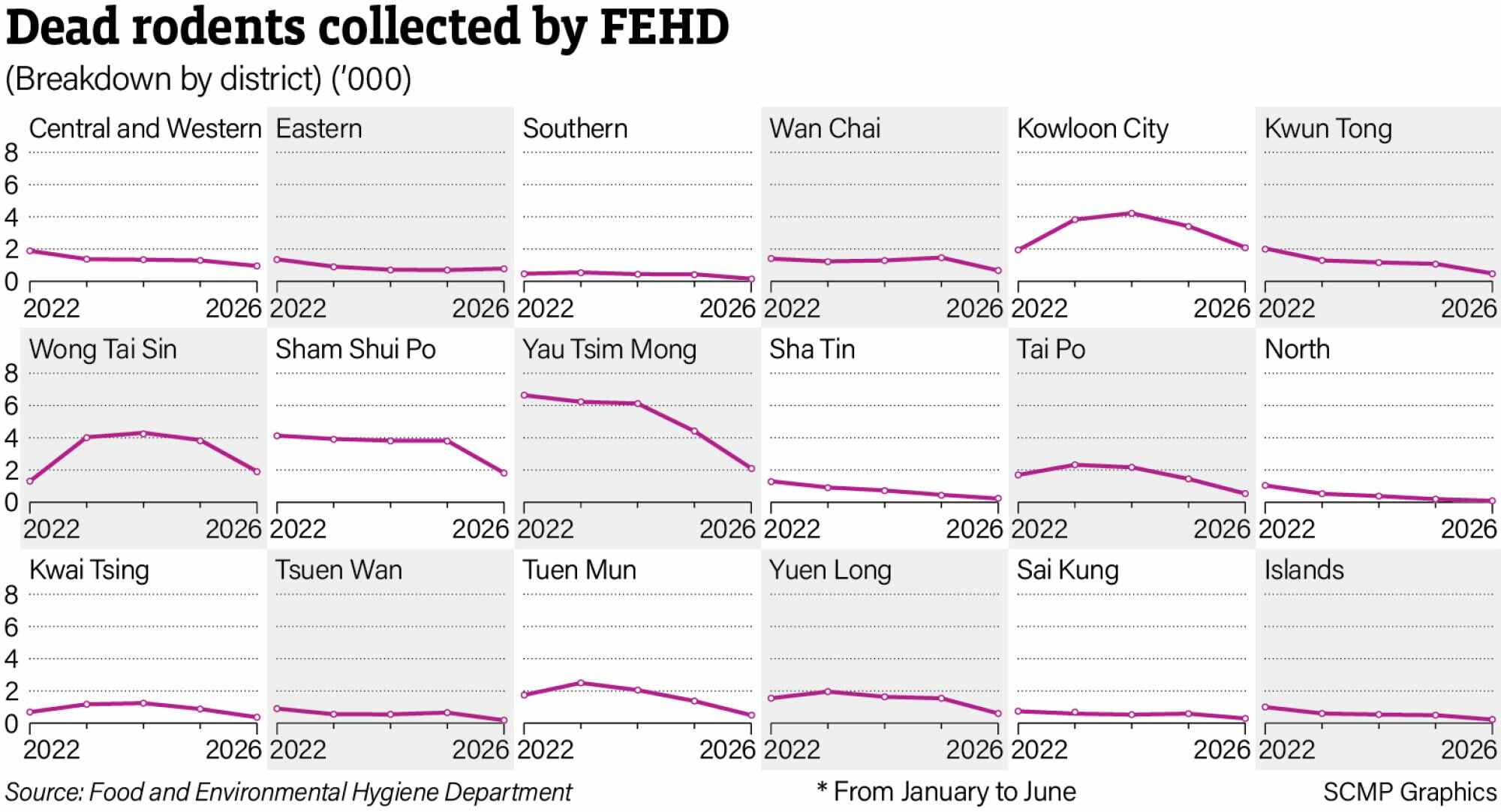
Chart 1
Question prompts
1. Identify ONE district in which the number of dead rodents collected increased significantly between 2022 and 2024. What trend has it been on since 2024?
2. Using the information in News, explain why this area has so many dead rodents.
Issue: Does AI rat tracking work?
-
Underlying issues need to be addressed to solve the city’s worsening rodent problem, experts say
-
Food waste and illegal dumping contribute to rat issue
Although many Hong Kong districts are reporting high rodent absence rates, that does not mean the city is rodent-free, according to Michael H. Parsons, an urban ecologist at the Centre for Urban Ecological Solutions. It could simply mean rodents have shifted to areas that were not under surveillance.
One way to gauge the scale of a rodent problem – regardless of official metrics – was to measure sightings in the daytime over a few days, Parsons added.
Ming Wai-kit, an associate professor at City University’s department of infectious disease and public health, said cities such as London and Paris face rat issues due to high urban density, food waste and ageing drainage systems.
These cities have tackled their infestations by cleaning water sources, sealing off abandoned buildings and drains, and using traps and surveillance. Ming cited Tokyo’s approach to dealing with rats, including strong public hygiene practices and proper food waste recycling.
To control rat levels in Hong Kong, authorities must address illegal dumping and improve food waste handling, Ming explained. While Hong Kong’s problem is less severe overall compared to other cities, infestations remain serious near markets, housing estates and eateries.
He suggested that the government create an online reporting system for residents to report rat sightings, helping authorities measure and contain them.
Local businesses have taken their own actions. For example, Kowloon City grocery store Chan Hing Wong Foods pays HK$700 monthly for professional pest control.
Employee Yan Chan called the service worthwhile, noting that rats could otherwise damage inventory, resulting in greater losses.
Lawrence Iu Chun-yip, executive director of the think tank Civic Exchange, highlighted the government’s integrated rodent control framework.
He urged authorities to focus on sustained outcomes, such as measuring the time required to clear a rat-infested area and observing whether the rodents returned after eradication.
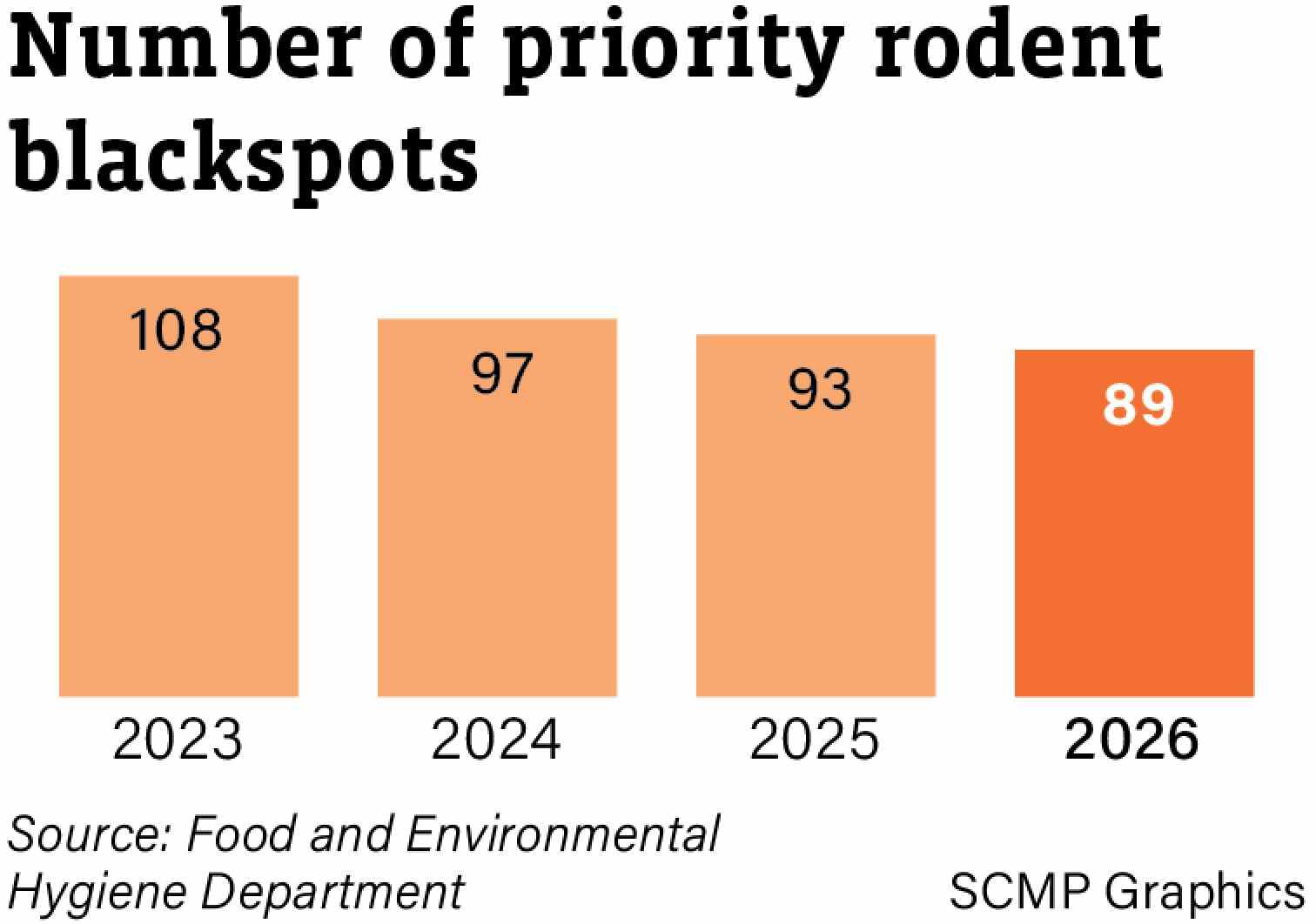
In 2024, the Food and Environmental Hygiene Department (FEHD) launched an anti-rodent charter encouraging private stakeholders to step up inspections. In the same year, the FEHD conducted strategic anti-rodent operations at 97 priority rodent blackspots.
However, enforcement challenges persist. In July, contract workers were caught keeping trapped rats and feeding them apples and sweet potatoes instead of exterminating them, resulting in the contractor’s suspension.
Peter Leung Kwong-yuen, chairman of the Pest Control Personnel Association of Hong Kong, supported the government’s move to establish a charter aimed at rat control in residential buildings. He urged the government to step up contractor training and oversight of how workers handled the pests.
An FEHD spokesman stated that proactive inspections, enforcement, education and public complaints guide resource deployment. They urged property managers, food businesses and residents to all play their part.
Staff writers
Question prompts
1. Why are daytime rat sightings a good indicator of Hong Kong’s rodent problem?
2. Using Issue, identify and explain TWO measures that can help control or prevent rodent infestations in Hong Kong.
3. How do the July contractor incident and Lawrence Iu’s recommendations highlight the gap between policy implementation and long-term effectiveness? Explain using Issue, Glossary and your own knowledge.
Chart 2
Question prompts
1. Describe the overall trend in the number of priority rodent blackspots across the city between 2023 and 2026. What was the total reduction over this period?
2. Do you think the government’s strategy for eliminating priority rodent blackspots has been successful? Explain using News, Issue, Glossary and your own knowledge.
Glossary
-
containment strategy: a planned approach used to limit the spread, impact or reach of a problem
-
thermal signature: the infrared heat pattern emitted by a living organism that allows cameras to identify and track it in the dark
-
rodent absence rate: the percentage of thermal surveillance snapshots in which no rodents are detected relative to the total number of images taken
-
integrated rodent control framework: the Hong Kong government’s unified, cross-departmental strategy that combines multiple methods, such as hygiene enforcement, structural repairs and waste management, to combat pest populations
-
anti-rodent charter: an initiative launched by the government that invites owners of residential buildings and commercial units to commit to anti-rodent efforts on their premises
-
priority rodent blackspots: areas that officials have deemed as needing targeted measures because they have a high concentration of rats
Sample answers
News
1. C
2. Local residents report that the rat infestation problem is actually worsening in their daily lives despite high statistical absence rates. / Thermal cameras only capture snapshots at two-minute intervals during specific time windows (7pm–7am for three consecutive nights every six months), which may miss rat activity outside these locations or time frames. (any one)
3. Effective: Using AI thermal imaging technology is an effective strategy for managing Hong Kong’s rodent problem because the cameras can track rodents, their peak activity hours and dispersal routes using thermal signatures. Data collected also allows authorities to calibrate camera locations continuously based on complaint hotspots, routine inspections and community views.
Not effective: Despite high statistical absence rates (over 90 per cent across many districts), overall rodent capture numbers have skyrocketed by 323 per cent over the past decade, showing the underlying problem persists. Relying on absence rates creates a false impression that districts are almost rat-free, potentially delaying necessary public action and hygiene measures.
(accept all reasonable answers)
Chart 1
1. Kowloon City saw a big increase between 2022 and 2024. After 2024, the number of dead rodents collected decreased steadily from 2024 to 2026. (accept all reasonable answers)
2. A district councillor blamed the rise in rat sightings in Kowloon City on construction sites that would drive rats into public spaces.
Issue
1. The thermal imaging only works at night, but rats also move around in the day, which is also when they would cause disruptions to people’s lives. (accept all reasonable answers)
2. Cut off the primary food source that attracts and sustains rodent populations near markets and eateries / Allow residents to register rat sightings, helping authorities measure prevalence and deploy targeted resources / Repair broken concrete and sewage pipes to restrict rodent movement and prevent them from entering public spaces / Encourage private stakeholders and shopping centres to step up regular inspections, traps and other preventive measures (any two)
3. Policy charters and outsourcing rely heavily on frontline execution, but poor oversight can lead to failures in enforcement, such as contractors keeping and feeding trapped rats instead of exterminating them. To bridge this gap, the government must move beyond simply launching frameworks and instead focus on sustained outcomes by tracking concrete metrics like systematic drives to clear rats from certain districts and recording the success or failure of these drives. (accept all similar answers)
Chart 2
1. The number of priority rodent blackspots consistently decreased year after year. The total reduction was 19 blackspots from 108 in 2023 to 89 in 2026.
2. While the government’s strategy for eliminating priority rodent blackspots has achieved measurable progress, its long-term success remains limited due to gaps in enforcement and surveillance. On one hand, official data shows a clear reduction in citywide blackspots from 108 in 2023 to 89 in 2026, supported by AI thermal imaging and an integrated rodent control framework that drove annual rodent captures to a 323 per cent increase over the past decade. Initiatives like the anti-rodent charter have also engaged private stakeholders to step up building inspections. On the other hand, a high statistical rat absence rate does not guarantee a rodent-free environment, as thermal cameras can miss rats that shift outside surveillance zones or activity windows. Furthermore, serious implementation issues, such as contract workers feeding trapped rats instead of exterminating them, demonstrate that policy targets do not always translate to effective pest control on the ground. True success will depend on sustained oversight, managing food waste density and tracking rat recurrence rather than relying solely on blackspot counts. (accept all reasonable answers)