Content provided by British Council
Read the following text and answer the quiz below.
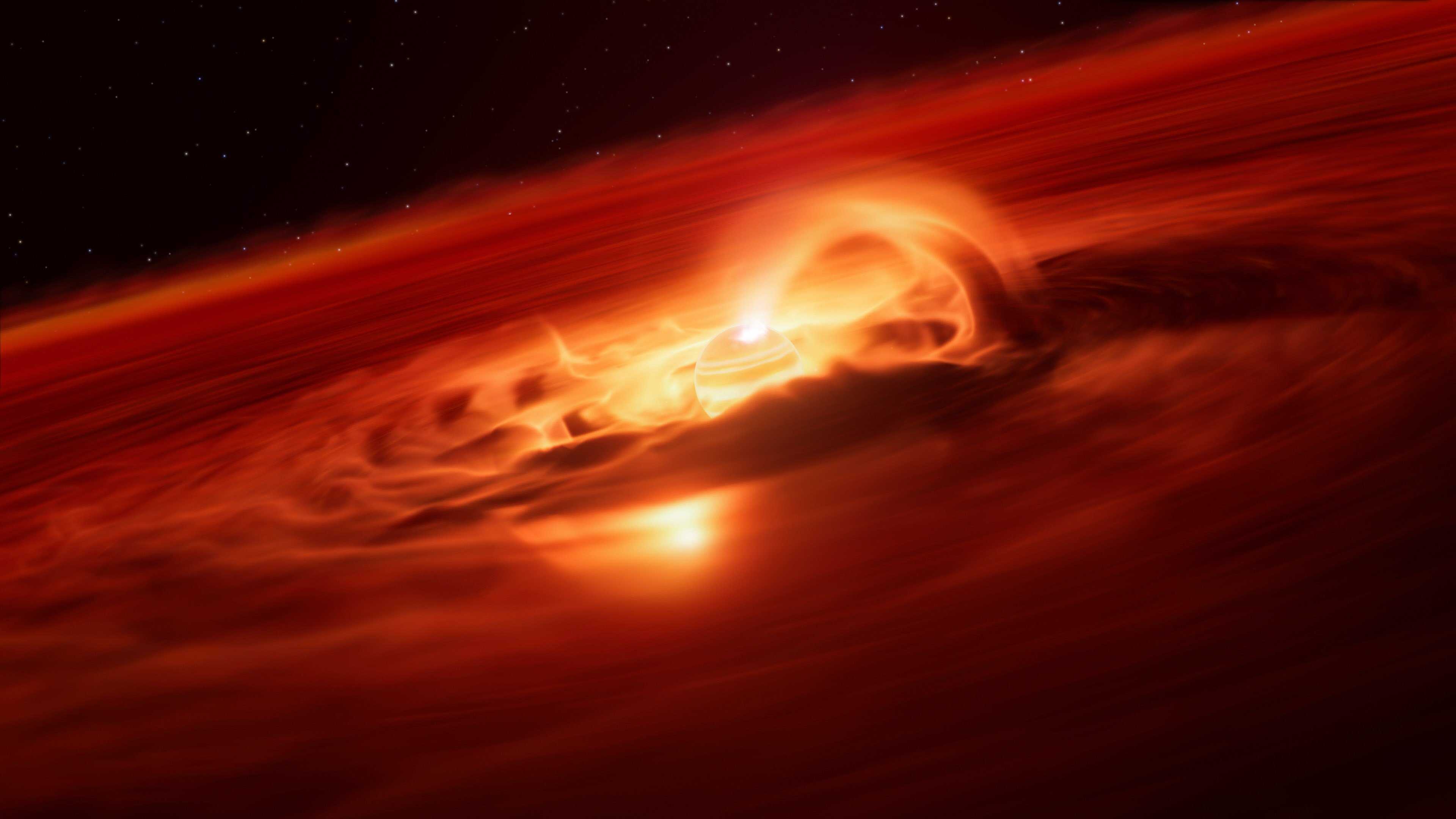
[1] A “rogue” planet was seen gobbling 6 billion tonnes of gas and dust a second – an unprecedented rate that blurred the line between planets and stars, astronomers said earlier this month. Unlike planets in our solar system, which orbit the sun, rogue planets float freely through the universe untethered to a star.
[2] Scientists estimate our galaxy could have trillions of rogue planets, but they are difficult to spot since most drift quietly in perpetual night. These objects intrigue astronomers because they are “neither a star nor a proper planet”, said Alexander Scholz, an astronomer at the University of St Andrews and co-author of a new study. “Their origin remains an open question: are they the lowest-mass objects formed like stars or giant planets ejected from their birth systems?”
[3] The team behind the study were stunned to observe an astonishing growth spurt in a rogue planet around 620 light-years from Earth in the constellation Chamaeleon. The planet, officially called Cha 1107-7626, has a mass five to 10 times bigger than Jupiter. Scholz explained that the object is “still in its infancy”, being roughly 1 or 2 million years old. The object grows by sucking in matter from a disc that surrounds it – a process called accretion.
[4] But what the astronomers saw happen to Cha 1107-7626 “blurs the line between stars and planets”, study co-author Belinda Damian said in a statement. In August, the planet suddenly started devouring matter from its disc at a record-breaking 6 billion tonnes per second – eight times faster than a few months earlier. “This is the strongest accretion episode ever recorded for a planetary-mass object,” said lead study author Victor Almendros-Abad of Palermo Astronomical Observatory.
[5] By comparing light emitted before and during this binge-eating session, the scientists discovered that magnetic activity played a role in driving matter towards the object. This phenomenon had previously only been observed in stars. The chemistry in the disc also changed. Water vapour was detected in the disc during the accretion episode but not beforehand. This is also something that has previously been observed in stars – but never for a forming planet.
[6] Lead study author Ray Jayawardhana of Johns Hopkins University said the discovery implied “that some objects comparable to giant planets form the way stars do, from contracting clouds of gas and dust accompanied by discs of their own, and they go through growth episodes just like newborn stars”. No matter how weird, Cha 1107-7626 is still expected to have similar characteristics to huge planets because it is of similar size. Scholz said that unlike stars, this object was “not massive enough to ever have fusion reactions in the core”. So, like other planets, “it will cool inevitably as it gets older”, he added.
[7] Amelia Bayo, another co-author of the study in The Astrophysical Journal Letters, said, “The idea that a planetary object can behave like a star is awe-inspiring ... [It] invites us to wonder what worlds beyond our own could be like during their nascent stages.” The observations were made with the European Southern Observatory’s Very Large Telescope in Chile and included data from the James Webb Space Telescope.
Source: Agence France-Presse, October 2