Read the following text and answer the quiz below.
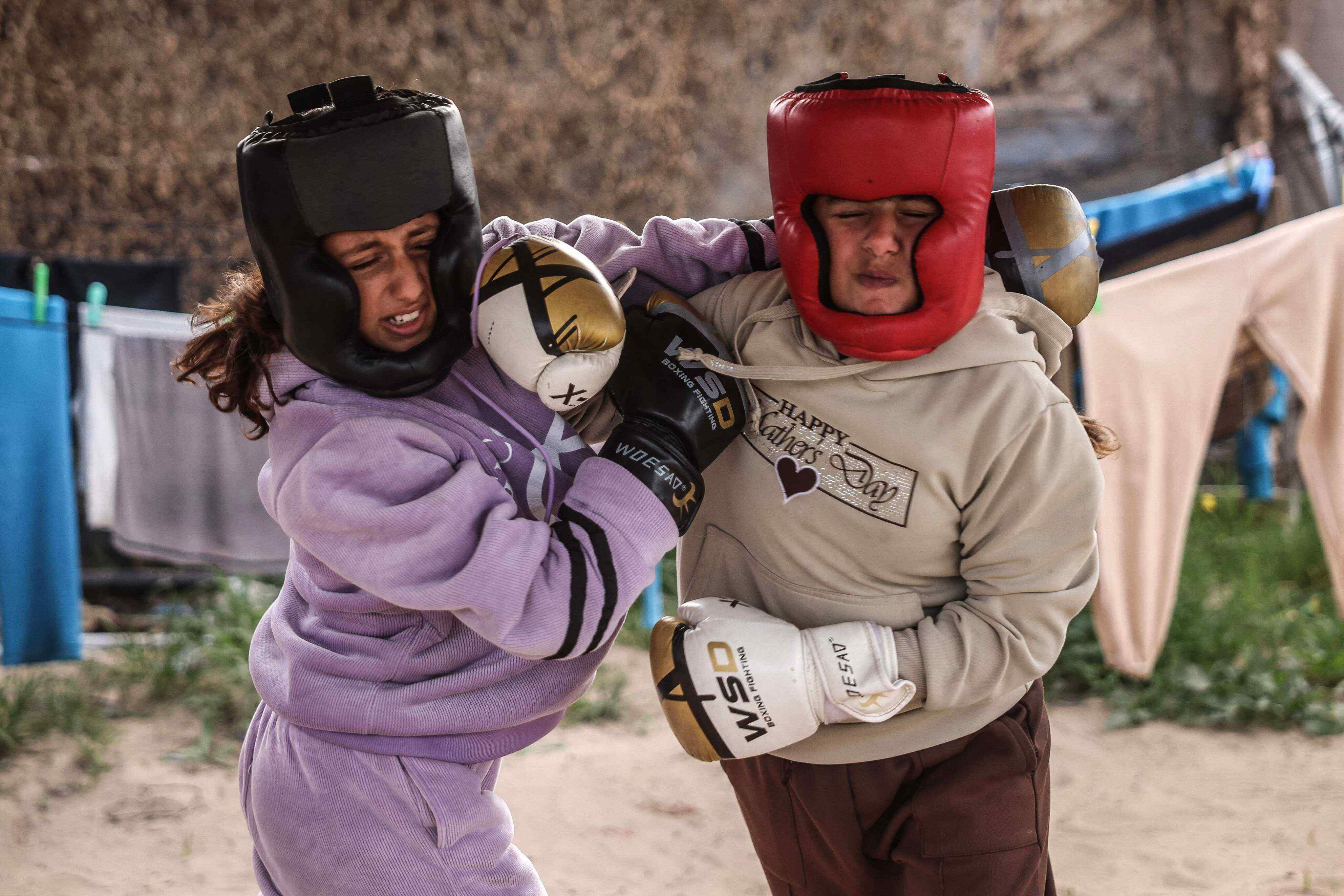
[1] In a makeshift boxing ring carved into the sand among the tents of displaced Palestinians in southern Gaza, a dozen young girls warmed up, preparing to deliver powerful punches at their coach’s command. Osama Ayub, who once operated a boxing club in Gaza City in the northern part of the Palestinian territory, lost both his club and his home during a strike amid the ongoing conflict between Israel and Hamas.
[2] After finding shelter in the southern city of Khan Younis, he opted to put his sporting skills to work for displaced Gazans. They were crammed into tents and makeshift shelters by the tens of thousands. “We decided to work inside the camp to offer the girls some psychological relief from the war,” Ayub said.
[3] Behind him, some of the young athletes faced each other in the ring, surrounded by cheering gymmates, while others trained on a punching bag. “The girls have been affected by the war and the bombardments; some have lost their families or loved ones. They feel pain and want to release it, so they have found in boxing a way to express their emotions,” Ayub said. Ayub now runs free training sessions for 45 boxers aged between eight and 19, three times a week. He has received positive feedback from both his students and the community.
[4] One of the youngsters, Ghazal Radwan, aged 14, hopes to become a champion and represent her country. “I practise boxing to develop my character, release pent-up energy and to become a champion in the future, compete against world champions in other countries and raise the Palestinian flag around the world,” she said.
[5] One after the other, the girls trained with Ayub, shifting from right to left jabs, hooks and uppercuts at his command. In war-devastated Gaza, where construction materials are scarce, Ayub had to improvise to build his small training facility. “We brought wood and built a square boxing ring, but there are no mats or safety measures,” he said.
[6] He called on the international community to support the boxers and help them travel abroad to train, “to strengthen their confidence and offer them psychological support”. The strict blockade that Israel imposed on the Gaza Strip makes the reconstruction of sports facilities particularly complicated, as building materials are routinely rejected by Israeli officials.
[7] In January, the official Palestinian news agency Wafa reported that a shipment of artificial turf, donated by China to Gaza’s youth and sports council, was not permitted entry into the region by Israel. With medicine, food and fuel in short supply, sports equipment ranks much lower on the list of items allowed into Palestinian territory.
[8] Rimas, a 16-year-old boxer, said she and her friends continued “to practise boxing despite the war, the bombardments and the destruction”. “We, the girls who box, hope for your support, that you will bring us gloves and shoes. We train on sand and need mats and punching bags,” she said.
Source: Agence France-Presse, February 10
Content provided by British Council