Hong Kong students as young as seven are being referred for addiction counselling for online gaming, with requests for help involving increasingly younger children, a digital habits workshop has heard.
Crystal Leung Chui-yee, officer-in-charge of the Sunshine Lutheran Centre, a counselling and treatment centre for problem gamblers, revealed the alarming frontline trend at the workshop organised by Young Post and the South China Morning Post’s student business, SCMP Learn, which about 70 parents attended on Sunday.
Leung, a counselling psychologist, cited the case of a seven-year-old Primary Two pupil who was referred to her centre with a severe addiction to virtual subcultures and pay-to-win games.
“By the time he came to us, we discovered that he had taken nearly HK$8,000 (US$1,020) in cash from his mother and used her credit card,” Leung said at the workshop, titled “AI responsibilities, digital habits and hidden pitfalls”.
“Eight thousand dollars is a massive sum for a seven-year-old. It signals an incredibly dangerous boundary cross.”

Leung said randomised gaming “loot boxes” could act as early conditioning for adult gambling addictions.
“When they can get whatever they want with just one click, it creates a cognitive short cut,” she said.
“The human brain is very smart; it remembers the instant gratification and dopamine it gets from taking that short cut.”
Modern online games entice players with limited-time discounts to draw for rare weapons or characters, she added.
“What is the ‘short cut’ here? It is spending,” Leung said. “Once a child pays up and lands a rare item, the sense of triumph is immense. Constantly feeding a developing mind these quick dopamine hits easily breeds a gambling mindset.”
Whether children bought virtual skins, played mobile games or used physical pinball machines, the underlying psychology was identical, she said.
“The system is engineered to condition them to a speculative mindset from an early age,” Leung said.
She advised parents to unlink their credit cards from devices, while urging them to step into their children’s digital subcultures as curious learners rather than wardens.
“Deciphering their inner emotional needs is far more powerful than hard containment,” she said.
Parents, meanwhile, voiced concerns over the hidden pitfalls of artificial intelligence (AI) and modern screen time.
Despite the Education Bureau’s recent release of its “Blueprint for Digital Education Development in Primary and Secondary Schools”, a pre-workshop poll of more than 100 parents found that 65 per cent lacked the confidence to explain AI to their children.
The survey also found that 80 per cent were worried about misleading online information, while 36 per cent recognised the risk of their children being exposed to illegal gambling sites.
Many expressed fears that their children could fall prey to predatory online risks, ranging from algorithmic rabbit holes and in-game purchases to illegal gambling traps.
The session highlighted how mainstream AI platforms and recommendation algorithms could compound these risks, and that chatbots might be inadvertently prompted by curious teenagers to generate workaround links to black-market streaming sites and offshore betting syndicates.
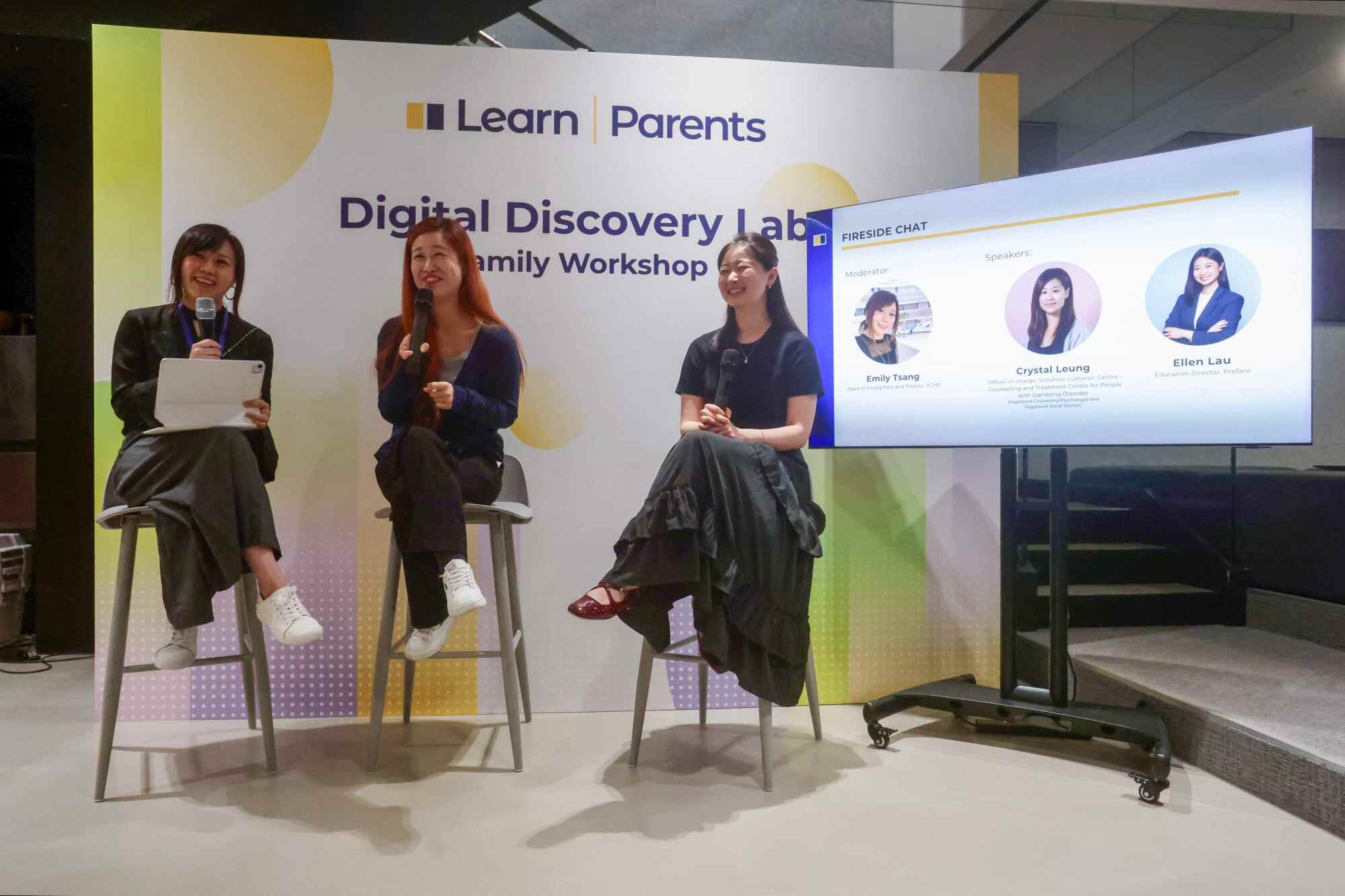
For parent Annie Wong, the workshop dismantled a false sense of security.
“I thought I had nothing to worry about because I don’t let my daughter use a phone independently,” Wong said.
Wong recalled a recent incident where her daughter played a mobile game on her mother-in-law’s smartphone and accidentally authorised a recurring monthly subscription via an ambiguous pop-up ad.
The scare prompted Wong to abandon passive restrictions and instead actively play along with her daughter while introducing compelling offline hobbies.
“It is about making sure she finds the real world attractive, so she doesn’t have to rely on the internet for her sense of achievement or recognition,” Wong said.
Attendee Keith Cheung, 40, the father of a teenage son and daughter, said the session offered a constructive road map.
“My biggest takeaway was learning how to better utilise the positive side of AI to support my children’s learning and development,” Cheung said. “Also, to pay attention to ethical aspects I might have overlooked, so I can be better prepared.”
To steer his children away from online risks, Cheung advocated active co-viewing.
“At the very beginning, we should watch with them and guide them towards useful, interesting websites or YouTube content,” he said. “That way, they’ll have far less exposure to the bad stuff.”