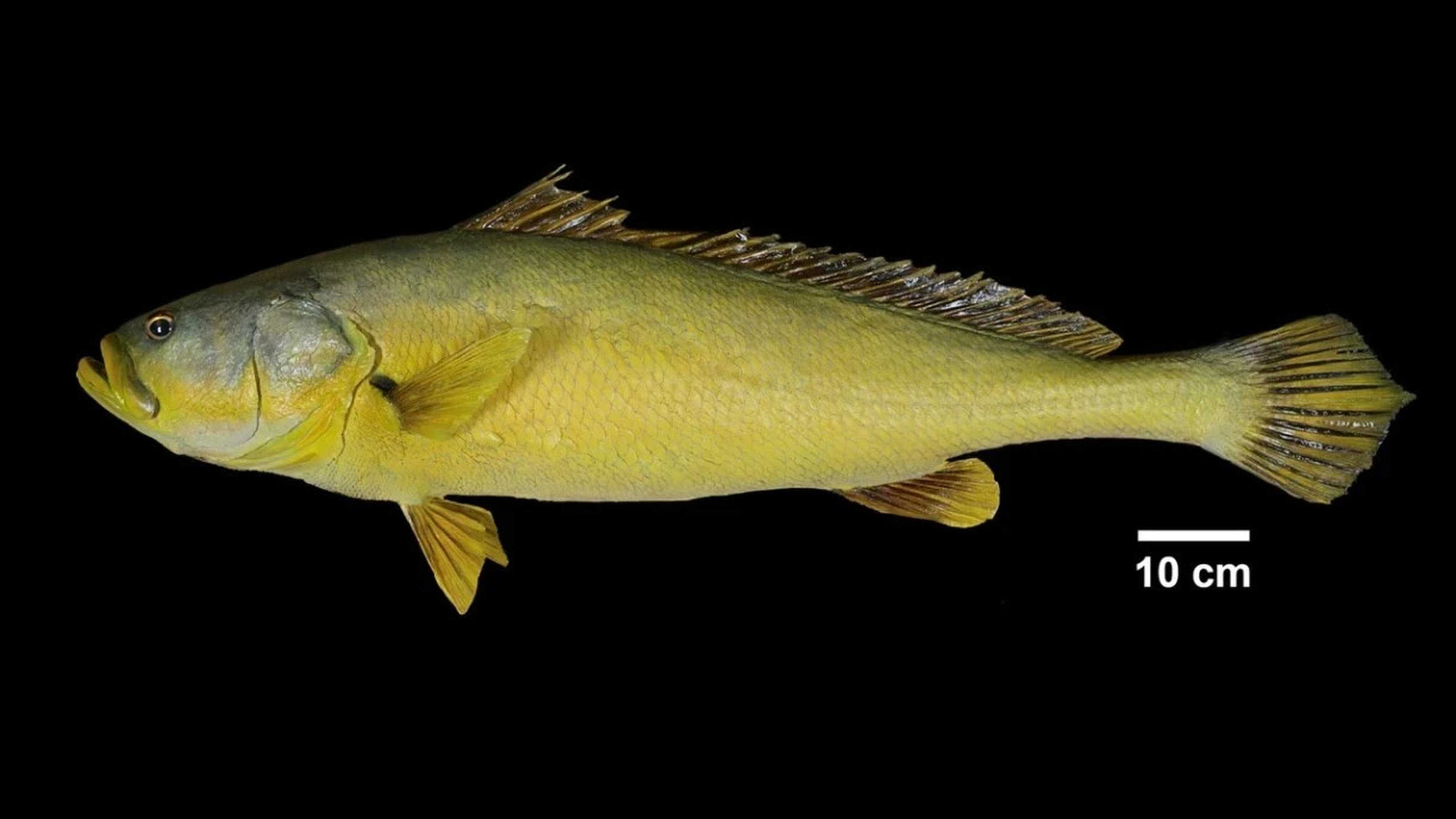
A researcher from Hong Kong has successfully employed environmental DNA (eDNA) technology to locate the critically endangered Chinese bahaba, also known as the “Tai O fish,” in local waters for the first time in over 10 years.
Jack Ip Chi-ho, an assistant professor in the division of science at Lingnan University, collaborated with Wang Junjie, a professor at South China Normal University in mainland China, to conduct this study. They created a genetic identification technique that allows for the detection of DNA remnants of the Chinese bahaba present in the marine environment.
The rare species’ DNA was identified in Hong Kong’s western waters in September last year, one month after about 1,300 hatchery-reared juvenile Chinese bahaba were released into the Pearl River Estuary from the mainland.
Lingnan University said the finding – the first in more than 10 years – suggested some of the released fish might have entered Hong Kong waters.
“The new detection technology developed by our research team is highly sensitive, and if a fish has passed through an area and left behind even a tiny amount of eDNA, its presence can be accurately determined,” Ip said.
Environmental DNA, or eDNA, refers to genetic material shed by organisms into their surroundings, including cells, tissues, fluids and waste.
Known as the “Tai O fish”, the Chinese bahaba is the largest croaker species found in the South China Sea, growing up to two metres (6.5 feet) in length.

Once abundant near Tai O, it has been driven to the brink of extinction by overfishing, particularly for its swimming bladder, which has high medicinal value.
Ip said the technology was developed to address the difficulty of monitoring a species that had not been sighted locally for more than a decade.
“Given the species’ extreme rarity, the chance of encountering it through conventional survey methods is exceptionally low, making it difficult to understand its distribution,” Ip said.
Ip and his team analysed the fish’s mitochondrial genome sequence to develop the technology that could detect its eDNA, including traces from mucus and faeces left in seawater.
The academic added that unlike conventional surveys, which often relied on trawling or capture methods, genetic identification technology did not require fish to be caught or disturbed, reducing harm to seabed habitats and non-target species.
“Researchers simply need to collect seawater samples to conduct large-scale marine surveys within a short period of time, significantly reducing sampling efforts,” Ip said.
Besides computational analysis and laboratory tests, the team also deployed the new technology at 23 sites covering the city’s western waters between January and September last year, collecting 414 seawater samples.
The fish’s eDNA was detected at four locations in September: Tai O; Sha Chau and Lung Kwu Chau Marine Park; Southwest Lantau Marine Park; and Sunny Bay.
Tai O recorded the highest frequency and concentration of DNA among the sites.
“The technology also provides conservation organisations with an effective tool to evaluate the outcomes of juvenile fish release programmes,” Ip said.