Difficulty: Summiteer (Level 3)
When you think of Saturn, you probably picture its dazzling rings. But on March 23, 2025, those rings seemed to vanish for those of us looking from Earth. This was actually an illusion caused by how our planet lined up with Saturn and the sun.
Saturn at a glance
Saturn is the sixth planet from our sun and the second largest in our solar system. This giant, gaseous planet is about 1.4 billion km from the sun.
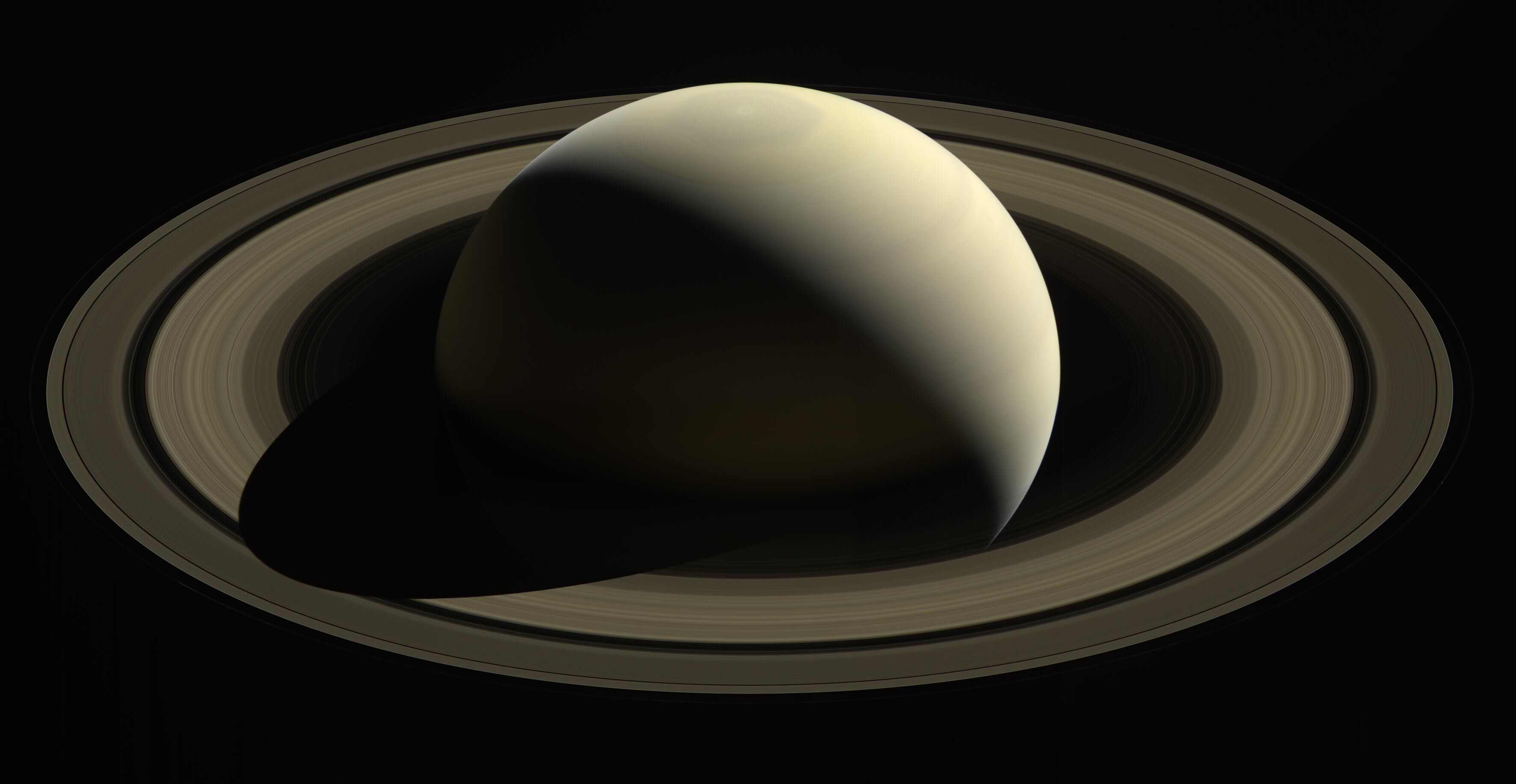
The planet’s rings consist mainly of ice chunks, rock fragments and dust particles ranging from tiny grains to house-sized boulders. These materials likely came from shattered comets, asteroids or moons destroyed by Saturn’s powerful gravity. The debris formed an extensive ring system.
The main rings that are visible from Earth stretch about 280,000km across – that is nearly three-quarters of the distance from Earth to the moon.
Despite their enormous width, the rings are incredibly thin, averaging only 10 metres in height. To put this in perspective, if Saturn were the size of a basketball, its rings would be thinner than a sheet of paper. This thinness is why the rings can seem to disappear.
Why does it look like the rings vanish?
The “disappearing” rings result from an event astronomers call a ring-plane crossing.
Saturn takes 29.5 Earth years to orbit the sun and is tilted on its axis by about 26.7 degrees. This tilt means that as Saturn travels around the sun, we see the rings from different angles: sometimes from above, sometimes from below and occasionally directly at its edge.
When we see the rings from their edges, they are so thin that they almost become invisible, even through powerful telescopes. From our view on Earth, the ring system simply vanishes from our sight.
This phenomenon happens roughly every 13 to 16 years, about twice during each Saturn year.
Saturn’s rings will be edge-on to us three times in total during 2038 and 2039. Of these, the one predicted to occur on October 15, 2038, will be easiest to spot because Saturn will be farther from the sun in our sky that day.
Why this matters
Ring-plane crossings are valuable scientific opportunities. When the rings appear edge-on, astronomers can better study Saturn’s moons, which are usually outshone by the bright rings. These events also help scientists measure the rings’ thickness more precisely and discover faint rings or moons that might otherwise remain hidden.
For astronomy enthusiasts, these rare events remind us that our view of space is always changing and that these changes hold many more surprises for us.