Content provided by British Council
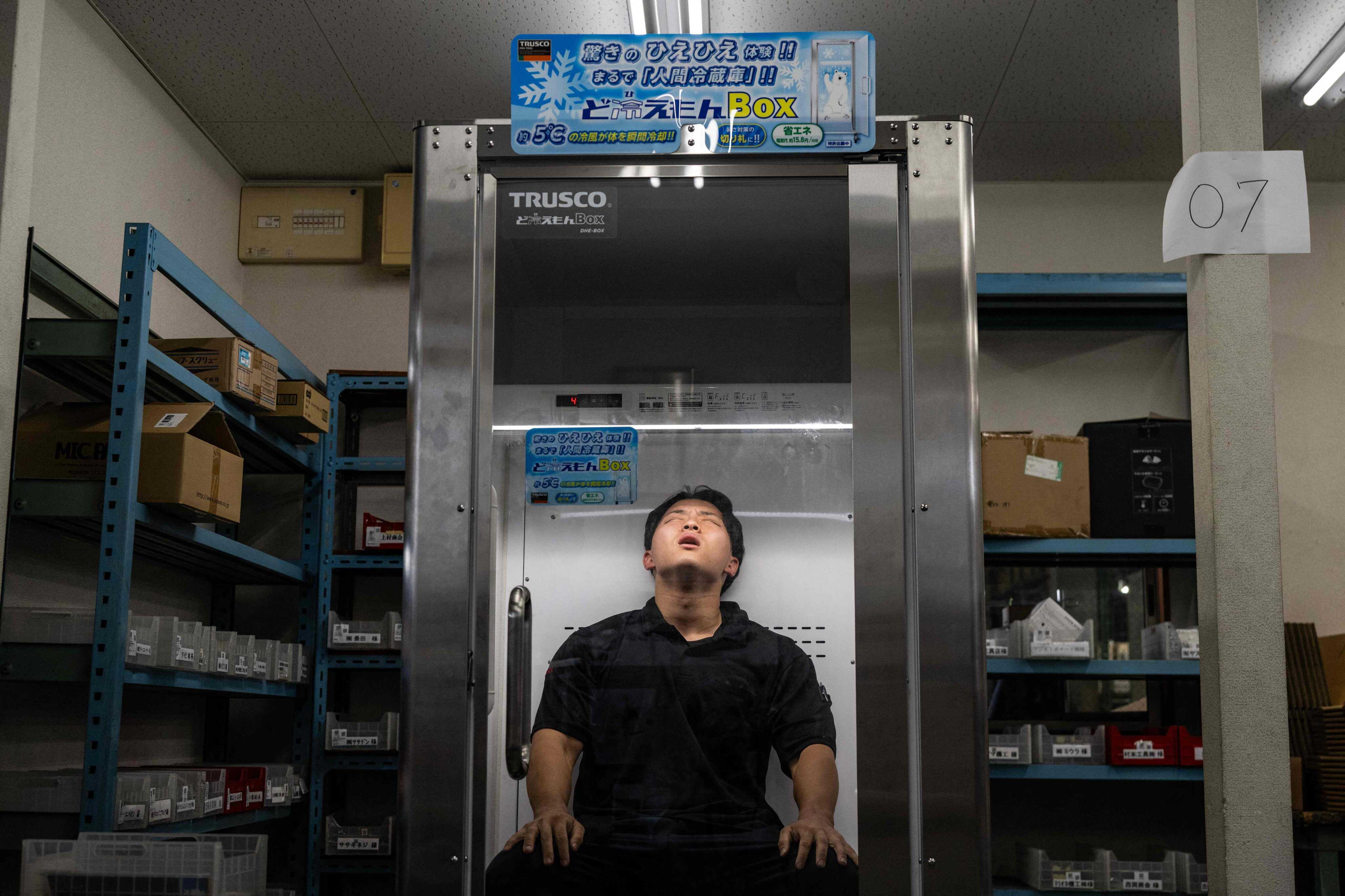
[1] Warehouse worker Isao Tabuchi felt dizzy and unwell after cycling to work. It was a hot summer day in Japan. When he got to work, he headed for his company’s newest purchase: a refrigerator for humans.
[2] The phone booth-sized machine uses jets of chilled air to ensure ice-cold comfort. The machine was launched only this year, but has proved popular in a country that seems to be getting warmer. “I was really able to recover thanks to that. Once you use it, it’s very, very cool,” said Tabuchi, 51. He lives in the western industrial city of Higashiosaka.
[3] Trusco Nakayama is an industrial equipment distributor based in Tokyo. It said it has sold more than 300 units of the Do Hiemon Box since April. They cost 1.5 million yen (HK$74,600) each. Customers include construction sites, factories and warehouses. The company will expand in the future to include golf courses, said company sales agent China Yamamoto. Baseball stadiums may also be interested.
[4] Scientists say climate change is increasing the frequency and intensity of extreme heat events around the world. Japan saw its hottest summer on record in 2025. The weather office began using a new word – kokushobi, or “cruelly hot day” – when temperatures hit 40 degrees Celsius. They urged the public to treat extreme heat as a natural disaster.
[5] Tokyo alone recorded almost 120 heat-related deaths in the month to mid-August. This summer, close to 63,000 people nationwide needed emergency care. The Do Hiemon Box can provide one line of defence. It operates from a standard power socket. It can also be wheeled around, and uses little power, according to its maker. It automatically shuts off after 20 minutes to prevent overuse.
[6] It is essential to invest in heat-countering measures, said Yutaka Kono from Konoe. He works at the same company as Tabuchi. It helps maintain the existing workforce and attracts new recruits. Kono said that conventional air conditioners and spot coolers offer some relief. However, his firm has many open areas where trucks and heavy equipment can operate.
[7] “I was really surprised by this new concept of putting people into a kind of refrigerator. I found it very appealing that by going inside that refrigerator, a person’s body can be cooled in an instant to a safe temperature,” Kono said. “That made me think, ‘We definitely want to install one of these’,” he said.
Source: Agence France-Presse, August 25