Deep Dive delves into hot issues in Hong Kong and mainland China. Our easy-to-read articles provide context to grasp what’s happening, while our questions help you craft informed responses. Check sample answers at the end of the page.
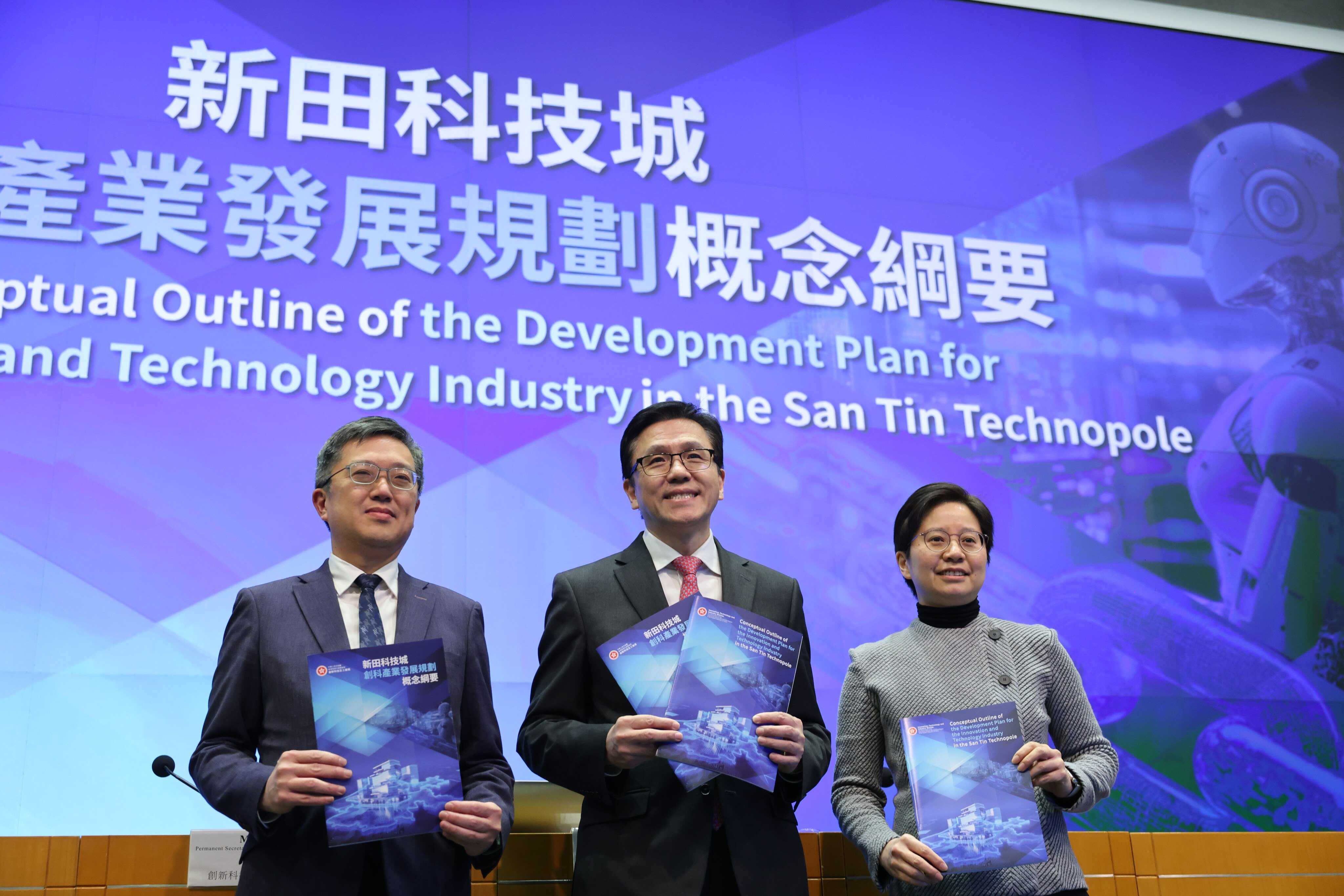
News: Hong Kong to build tech hub in San Tin
-
San Tin Technopole is expected to generate HK$250 billion and create more than 300,000 full-time jobs
-
Project forms part of the Northern Metropolis scheme and has a five-phase development plan
Hong Kong will build a new 300-hectare innovation and technology (I&T) hub near the city’s border with mainland China. This will place the technopole within the Northern Metropolis mega-development, a scheme that will transform 30,000 hectares of land into an economic hub housing at least 2.5 million people.
The San Tin Technopole will be developed in five phases and take at least 10 years to complete, according to Sun Dong, the Secretary for Innovation, Technology and Industry. Sun added that the tech hub is expected to generate HK$250 billion or more for Hong Kong’s economy and create around 300,000 full-time jobs.
The project also aligns with China’s 14th five-year plan to build Hong Kong into a regional innovation hub.
According to a conceptual plan shared by authorities last month, the technopole will be a base for advanced manufacturing and I&T industries.
The government said it hoped the hub would attract global resources and talent.
“Given our unique advantages and determination in developing the I&T industry, the San Tin Technopole will offer land that the city has been lacking. It serves as an ideal condition in luring the leading enterprises for our next step,” Sun said.
The government has earmarked 627 hectares of land for the technopole, with around 300 hectares specifically designated for innovation and technology (I&T) purposes.
Authorities have said the technopole will be divided into “three hubs and three corridors”.
The three “development” hubs are Hetao, Chau Tau and Ki Lun, organised geographically from north to south. These will be integrated with three corresponding “industry development” corridors – life and health technology, artificial intelligence and robotics, and microelectronics and advanced industry.
New enterprises are expected to operate from 2031 or earlier. The Northern Link, which will provide railway services to San Tin, is scheduled to be completed by 2034.
Sun said the San Tin Technopole could take up the transformation and industrialisation of research outcomes from the Hong Kong-Shenzhen Innovation and Technology Park in the Lok Ma Chau Loop.
It could also integrate with industry supply chains in mainland cities in Guangdong.
The concept of the Northern Metropolis featuring an I&T hub was first raised in 2021, when Hong Kong’s then Chief Executive Carrie Lam Cheng Yuet-ngor announced it in her policy address.
Staff writers
Question prompts
1. Which of the following is true, according to the information in News?
(1) The San Tin Technopole’s primary focus will be innovation and technology.
(2) The technopole is expected to take 20 years to become fully operational.
(3) The technopole was first mentioned by a former chief executive.
(4) The technopole is not part of the Northern Metropolis mega-development.
A. (1), (2) only
B. (1), (3) only
C. (2), (4) only
D. (3), (4) only
2. List TWO possible benefits of the San Tin Technopole.
3. Why is the San Tin Technopole being built near the border with mainland China? Explain using News, Glossary and your own knowledge.
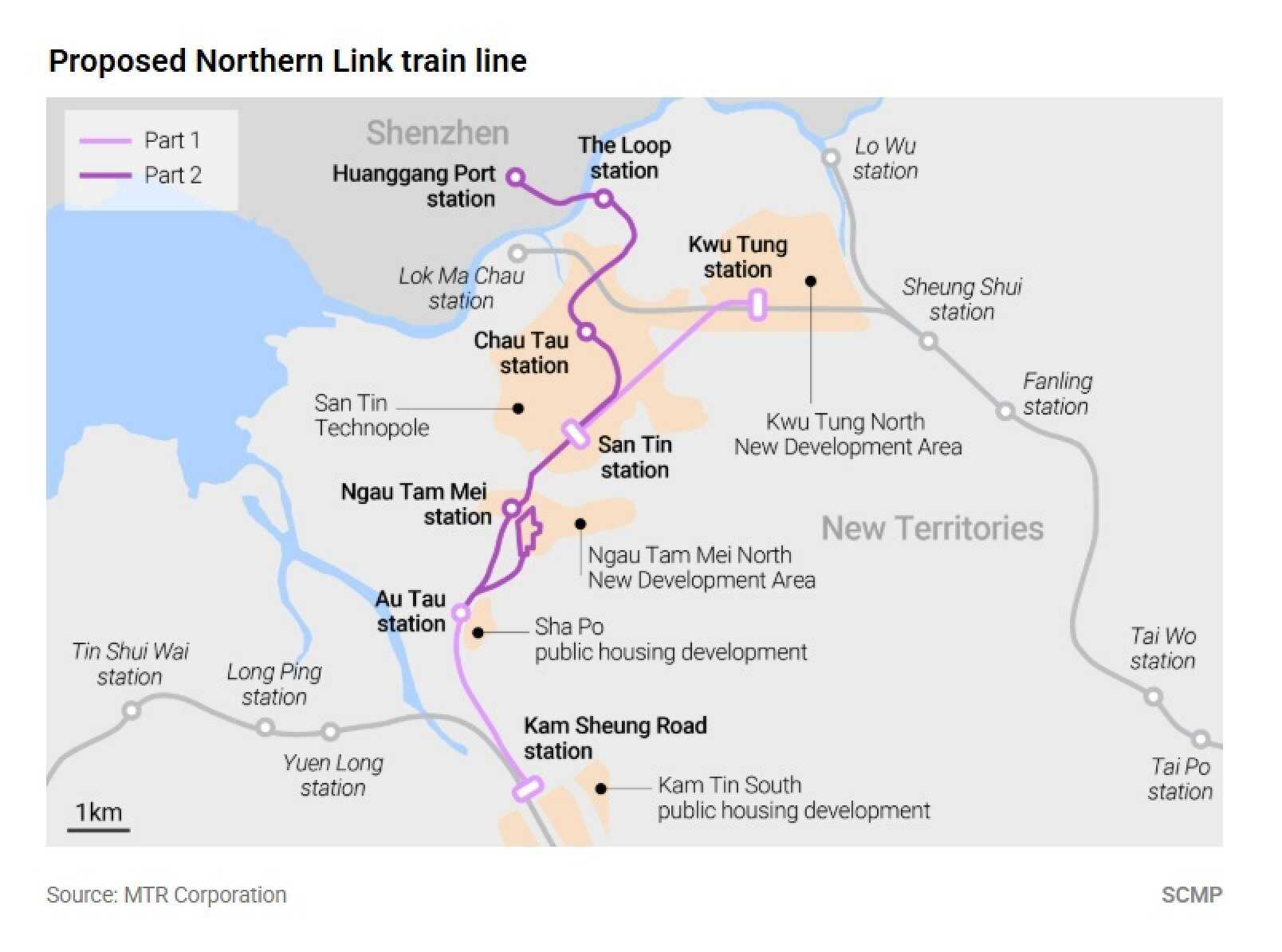
Map
Question prompts
1. Based on this map, explain how the proposed Northern Link train line could benefit residents living in the Sha Po area.
2. How will the new train line connect Hong Kong with mainland China, and how could this be helpful? Explain using News, Glossary and your own knowledge.
Issue: Is 10 years too long for technopole?
-
Experts urge authorities to reconsider San Tin Technopole’s 10-year timeline
-
Hub could help Hong Kong diversify its economy and rely less on its finance sector, they argue
Hong Kong envisions building an international innovation and technology (I&T) hub in the Northern Metropolis megaproject. Dubbed the San Tin Technopole, it would work alongside the traditional international financial centre in Central on Hong Kong Island.
China’s 14th five-year plan, covering 2021-25, tasked Hong Kong with developing eight fields and industries.
This included enhancing its international hub status in finance, shipping, trade and aviation, as well as taking on new roles in I&T, legal and dispute resolution, intellectual property trading and cultural exchange.
While finance and other service industries have been key economic pillars since the 1990s, Hong Kong took only baby steps in technology development at the time.
A dedicated bureau was eventually set up in 2015.
Authorities have said the 10-year timeline accounted for the pace of I&T industry development as well as the time needed for land resumption and site formation works. The government aims to have the first batch of 20 hectares of I&T sites formed for development by 2026.
Professor Christopher Chao, the senior vice-president for research and innovation at Polytechnic University, urged the authorities to speed up the development.
“A 10-year development is still too long. China envisions itself as a nation with strong science and technology in 2035. It may no longer require our contribution by then,” he said.
Chao added that the government should streamline interdepartmental collaboration and roll out preferential policy packages to attract leading companies.
But Kevin Choi Kit-ming, permanent secretary for innovation, technology and industry, said the government needed the 10 years to turn some “primitive land” parcels into “spade-ready sites”.
Why is I&T development important for the city?
Analysts say the San Tin Technopole could help diversify the city’s economy and reduce its reliance on the finance sector. As of June this year, the government has injected more than HK$53.8 billion into various schemes under its I&T Fund, which provides funding for start-ups, attracting talent and other initiatives.
Professor Tang Heiwai, an associate dean at the University of Hong Kong’s business school, warned that attracting companies solely seeking capital would not help diversify the city’s economy.
The professor explained that diversification could only be achieved when the government committed to promoting I&T and attracting mainland and overseas companies to help grow the local industry using research and development (R&D).
“Whenever Hong Kong faces some pressure to transform its economy, a prosperous financial cycle pulls the city’s focus back to finance,” he said. “The city will continue to live off its past glory.”
Staff writers
Question prompts
1. Name ONE reason why the San Tin Technopole’s 10-year completion time frame could be considered reasonable and ONE reason it could be too slow.
2. According to Professor Tang Heiwai, how can Hong Kong diversify its economy?
3. To what extent do you agree that Hong Kong should not only rely on its finance and property sectors to boost the economy? Explain using Issue, Glossary and your own knowledge.
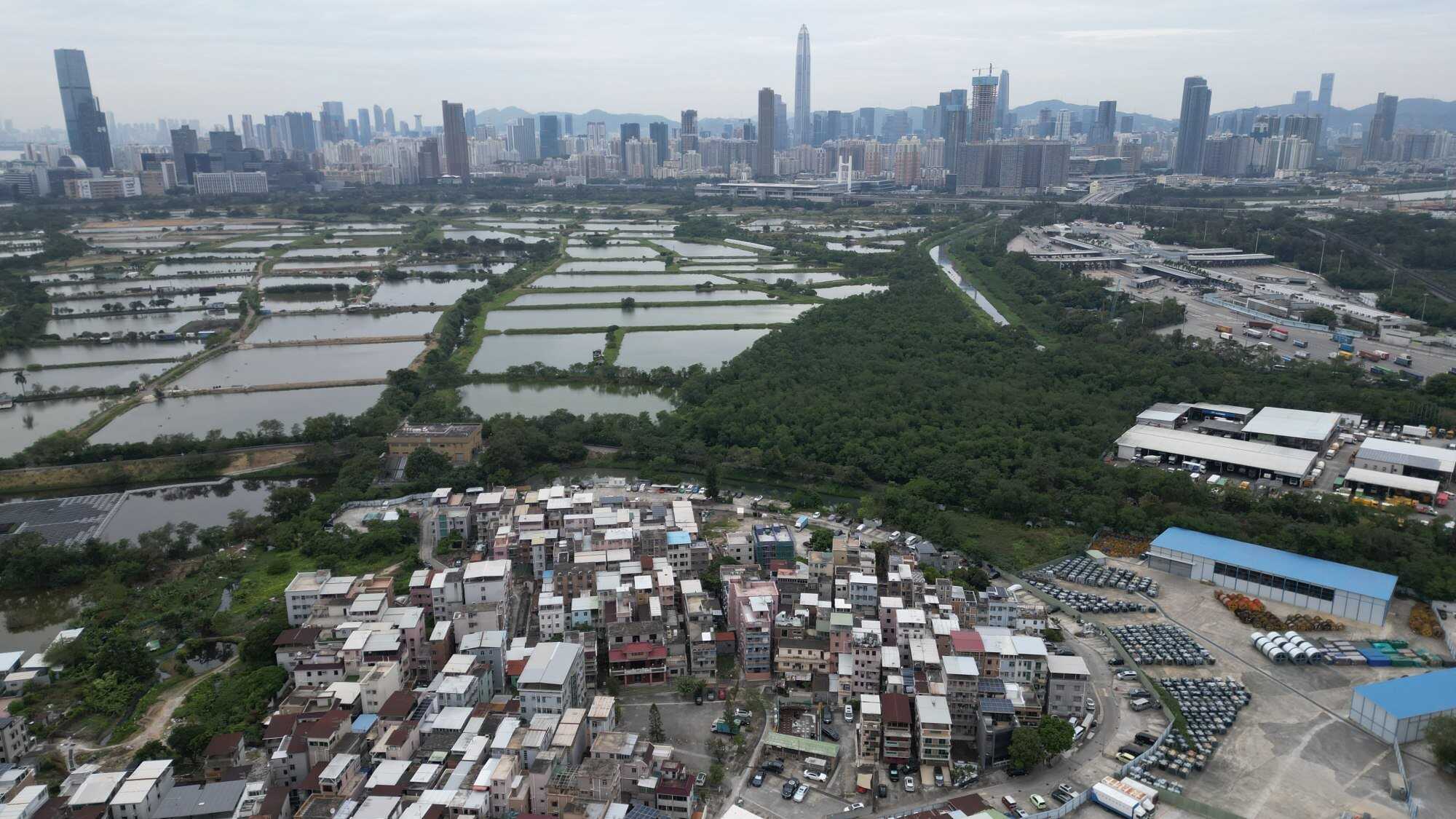
Photo
Question prompts
1. This photo was taken on November 20, 2025. What does it suggest about the extent and scope of work needed to develop the San Tin Technopole?
2. Is a 10-year timeline too long for the project? Explain your opinion using News, Issue, Glossary and your own knowledge.
Glossary
enterprises: projects or undertakings; businesses or companies
Northern Link: a proposed Hong Kong MTR line which would connect the Tuen Ma line and the Lok Ma Chau Spur Line of the East Rail Line. It would complement the Northern Metropolis mega-development.
Hong Kong-Shenzhen Innovation and Technology Park: a new innovation and technology hub co-developed by Hong Kong and Shenzhen, located in northern Hong Kong in the Lok Ma Chau Loop
capital: wealth in the form of money or other assets owned by a person or organisation

Sample answers
News
-
B
-
It is expected to generate HK$250 billion or more for Hong Kong’s economy and create around 300,000 full-time jobs, boosting economic growth and employment. The hub will help attract global talent and advanced enterprises to Hong Kong, strengthening the city’s innovation and technology (I&T) industries (accept all reasonable answers).
-
The San Tin Technopole is being built near the border with mainland China to enable closer collaboration with mainland cities such as Shenzhen, which are major technology and manufacturing centres. It will help transform and commercialise research from the Hong Kong-Shenzhen Innovation and Technology Park and integrate supply chains from nearby Guangdong, enabling stronger regional cooperation and resource sharing. This location supports the goals of China’s 14th five-year plan, which promotes cross-border innovation and aims to develop Hong Kong as a regional innovation hub within the Greater Bay Area. Being near the border facilitates talent exchange, logistics and industrial collaboration between Hong Kong and mainland China. (accept all reasonable answers)
Map
-
The proposed Northern Link train line will reduce travel times to places such as the San Tin Technopole and the Kwu Tong North development area, which are set to become job-creating areas. It will also strengthen internal transport links within Hong Kong and effortlessly connect to border control points such as Lok Ma Chau and Huanggang Port. (accept all similar answers)
-
The new train line will support the Northern Metropolis and the San Tin Technopole, both located near the Hong Kong-Shenzhen border, making travel between Hong Kong’s innovation hub and mainland cities like Shenzhen and other parts of Guangdong smoother. It will link to The Loop station and Lok Ma Chau station, which are cross-border gateways to Shenzhen, enhancing cooperation in innovation, trade and talent exchange. This will make it much easier for residents, workers and enterprises to move between Hong Kong and Shenzhen, supporting the development goals of the Greater Bay Area and China’s 14th five-year plan. (accept all reasonable answers)
Issue
-
Reasonable: The government has said that 10 years are needed to transform “primitive land” into “spade-ready” sites, with the time frame accounting for the time-consuming processes of land resumption and site formation. Developing such a large, complex innovation hub responsibly requires careful planning and infrastructure building. / Too slow: Professor Christopher Chao argued that a 10-year time frame is too long, as China aims to become a strong technological nation by 2035, and Hong Kong might miss its opportunity to contribute meaningfully if development drags on.
-
Professor Tang Heiwai said Hong Kong could only diversify its economy by actively promoting innovation and technology and attracting mainland and overseas companies involved in research and development. He warned that simply attracting firms seeking financial capital would not achieve genuine diversification.
-
I agree that Hong Kong should not rely solely on its finance and property sectors to boost its economy. While these sectors have been strong pillars for decades, they make the economy vulnerable to global market fluctuations and property cycles. Overdependence on them limits opportunities for innovation and job creation in emerging industries. Developing innovation and technology (I&T), as planned through projects like the San Tin Technopole, can help diversify the economy and strengthen Hong Kong’s global competitiveness. By promoting research and development and attracting both mainland and overseas tech companies, Hong Kong can establish new sources of growth and reduce its reliance on traditional economic sectors. (accept all reasonable answers)
Photo
-
The photo, an aerial view of the area marked for the San Tin Technopole development, shows a large area of rural land with scattered low-rise buildings, fish ponds and greenery near the border with Shenzhen. This suggests that extensive land clearance, infrastructure and site formation will be required before construction of the San Tin Technopole can begin.
-
In my opinion, the 10-year timeline is reasonable, given the extensive preparation required to transform such undeveloped land into a modern innovation and technology hub. It will take time to relocate residents, protect the environment and build proper transport links such as the Northern Link railway. However, the government should still streamline procedures and maintain momentum so that Hong Kong does not lose its competitive edge in innovation and technology development, given the fast-changing landscape of artificial intelligence. (accept all reasonable answers)