
Deep Dive delves into hot issues in Hong Kong and mainland China. Our easy-to-read articles provide context to grasp what’s happening, while our questions help you craft informed responses. Check sample answers at the end of the page.
News: Hong Kong teens lured by triads into illegal activities
-
Authorities warn of covert gang recruitment via messaging apps and games
-
Police shift focus to financial investigations and cybercrime prevention
Hong Kong authorities are warning teenagers about covert triad recruitment tactics. Local gang syndicates are increasingly using messaging apps and online gaming chat rooms to promote illicit part-time jobs as easy ways to make quick cash.
Michael Leung Siu-kei is a supervisor at the Hong Kong Federation of Youth Groups’ youth crime prevention centre. He said in the past, triads would recruit youths loitering in public spaces, but that practice had faded.
Nowadays, triads are more like “employment agencies”, with syndicates using Telegram, Signal or even in-game chat rooms to lure teenagers into working for them, he added.
“They list how much [they pay] for splashing red paint, how much for distributing illicit cigarettes [or] how much for criminal damage,” Leung said. He added that he had to constantly warn youths of the risks of these jobs.
Once a person accepted a job, it meant they had pledged loyalty to a triad boss, but these ties were often loose, he said.
“When we ask some youths about their gang ties, they’ll say: ‘I’ve never even met my boss,’” he added. “Sometimes they claim to belong to one triad faction,
but after a while, we find them working on another job under a different faction.”
Superintendent Joe Au Yeung Tak of the police’s organised crime and triad bureau agreed that triads’ tactics for recruiting young people were no longer as obvious as in the past.
“The triads use a much softer entry point these days: ‘Want to make some quick cash? Come out and meet some new friends. There’s free beer,’” he said.
Police deploy undercover officers to catch recruiters. They also work with schools to prevent triads from infiltrating campuses and conduct cyber patrols to combat online recruitment.
Low-level triad members still rely on traditional crimes such as vice, gambling, extortion and illicit fuel.
But other businesses – for instance, selling pirated videodiscs, controlling red minibus routes and managing nightclubs – have grown obsolete.
Au Yeung said: “The violent clashes and bloody scenes are gone. Instead, there are less conspicuous crimes, involving underground banking networks, cross-border money laundering and cybercrime. They do not require a physical presence and are much more low profile.”
In the past, police relied on mass arrests to target gangs. Now, they have shifted towards targeting deception and financial investigations to cut off the triads’ sources of income.
Triads would often use cryptocurrency in money laundering, Au Yeung said.
“Our focus has shifted to tracing the illicit funds, specifically the channels they use to launder the money, and figuring out how we can freeze those assets and confiscate them,” he said.
Staff writers
Question prompts
1. Which of the following statements are false, according to News?
(1) Triads are reaching out to young people through messaging apps to tempt them into taking part in illegal activities.
(2) Usually, after teenagers agree to work for a triad boss, they maintain loyalty to that leader.
(3) Triad activities are leaning towards more low profile activities, such as cybercrimes and illegal online money transactions.
(4) Triads rely on activities like the management of underground nightclubs to keep a low profile while generating regular income.
A. (1), (2) only
B. (1), (3) only
C. (2), (4) only
D. (3), (4) only
2. Which parties does the Hong Kong Police Force collaborate with to tackle triad crime?
3. Based on the News, explain how young people are lured by triads into committing illegal activities.
Chart
Question prompts
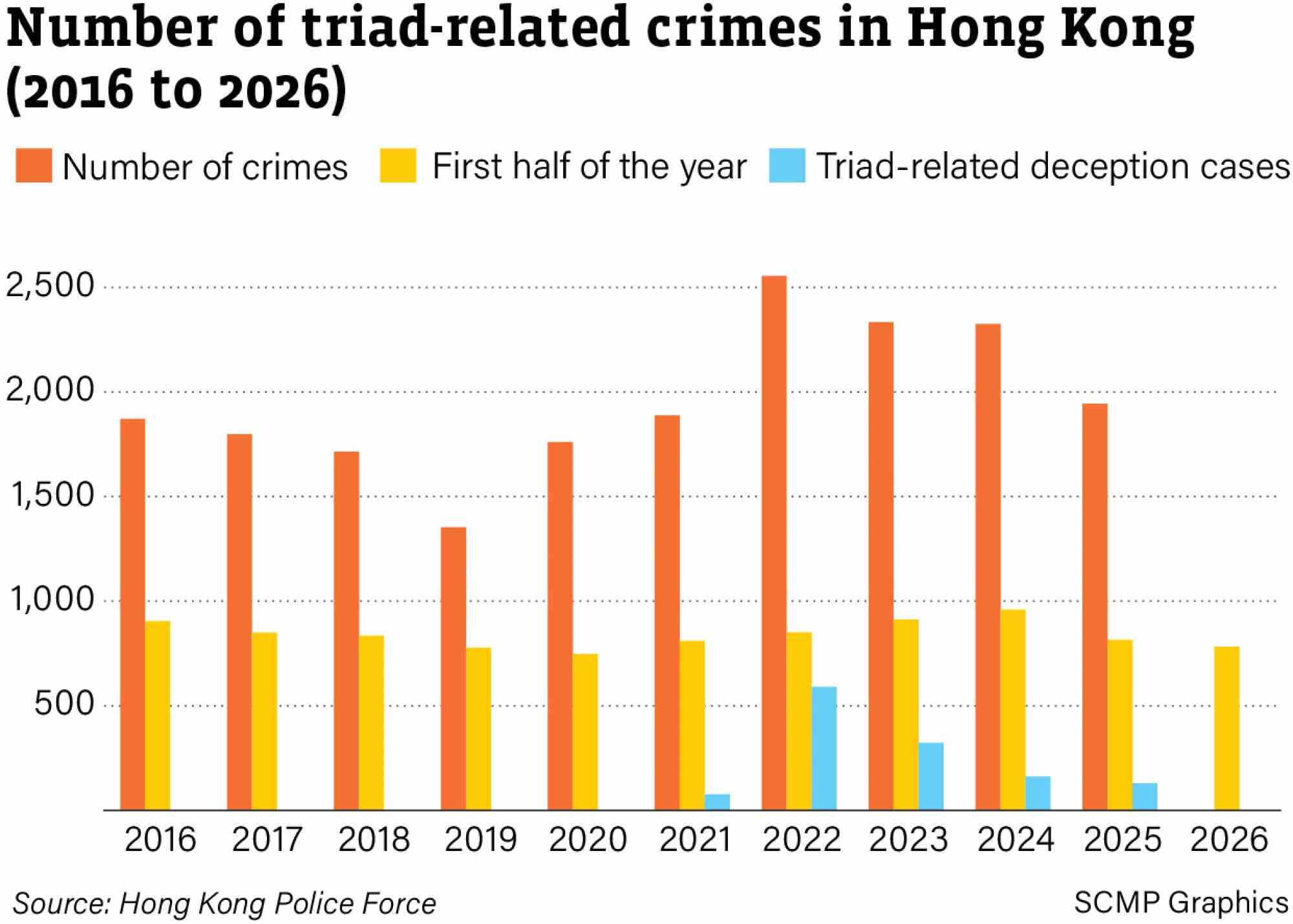
1. Note TWO observations about the trend of triad-related crimes in Hong Kong.
2. How do the trends in this chart relate to the information in News? What are potential limits that these numbers cannot show?
Issue: Waning triad traditions amid tightening legal restrictions
-
Gangs are adapting to evolving legal constraints and modern challenges
-
Some old rituals for new recruits in triads no longer exist
Experts say Hong Kong triad groups have evolved over the past decade, simplifying traditional rituals and adapting to changes in the law.
The Prisons Ordinance was amended last year to tighten restrictions on inmate visits, including a prohibition on receiving outside food. The changes were made after the enactment of the national security law.
Gregory Lau Tat-keung, a former superintendent who retired from the police force in 2013, has written a book about triads.
Lau said he believed the amendment was effective in deterring minor offenders from taking the fall for syndicate bosses because they were subject to stricter prison rules while in prison waiting for trial.
“Before, it was relatively easy [for bosses] to convince them to break the law for the mastermind, because they mistakenly believed that as long as they could receive outside food, their boss still controlled everything,” he said.
“It wasn’t until they were convicted in court that they realised they were in trouble. They suddenly realised they were subject to strict prison regulations, no outside food, no special perks and fewer visitation rights.”
The stricter rules also made it more difficult for visitors to bring inmates cigarettes, which served as a kind of “underground currency” in prisons, Lau said.
According to Lau, triads are also forgoing rituals to avoid arrest or struggling to maintain them in the face of modern limitations.
Some old rituals for new recruits in triads, including shredded paper lotuses and chopping off a chicken’s head to seal a blood oath, no longer exist, Lau said.
“Take chopping off a chicken’s head [as an example]. Where do you even get a chicken’s head nowadays? Ever since the avian flu outbreaks, there are no chicken heads any more. So it turned into chopping an egg,” Lau said.
“And taking a blood oath? What about cross-contamination? We might as well just drink red wine.”
He added that some triads held ceremonies in the mountains, on barges or in mainland China to avoid attention from law enforcement.
Lau said: “A lot of people have been misled into thinking that the triads are all about loyalty and brotherhood.”
Lau recalled that many of the gangsters he had arrested had lined up to be prosecution witnesses.
“Let me be a tainted witness. I’m ratting out my boss. Otherwise, how can I get my sentence reduced?” he said, describing the detainees’ thinking.
“We shouldn’t believe in loyalty. Actual substantial interests are what matter most, including [having] fewer sentences and getting more money for informants.”
Staff writers
Question prompts
1. According to Gregory Lau, why are local triad groups simplifying traditional rituals?
2. List ONE example of the tightened restrictions in prison. Explain how it deters triad members from taking the fall for their triad bosses.
3. Why does Lau think triad members line up to be prosecution witnesses? Suggest ONE way that the police force can use this to deter triad groups from crime.
Illustration

Question prompts
1. What is being shown in the illustration, and how does it relate to the information in News and Issue?
2. Based on how triad crime has evolved, how might it be more difficult for schools and the police force today to protect young people from being lured into gangs? Suggest ONE way that schools can help cope with the situation.
Glossary
-
syndicates: temporary associations of individuals, companies or entities formed to carry out a specific business or perform a specific duty, sharing both the risks and the resources required. In Hong Kong, it often refers to organised crime networks, specifically triad groups that operate in the city.
-
money laundering: the criminal process of disguising the origin, ownership or destination of illicitly obtained funds to make them appear legitimate
-
cybercrime: a criminal activity carried out using computers, digital networks or electronic devices. It encompasses offences that can only exist in a digital world, such as hacking, and cyber-enabled crime, such as fraud facilitated on digital platforms.
-
deception: a type of crime that includes online shopping fraud, telephone fraud, investment fraud and romance scams. It usually involves tricking victims into losing money.
-
illicit funds: money that has been generated, transferred or utilised through illegal activities, including both money derived directly from crime like fraud and legal money that is used for illegal purposes, such as bribery
-
prosecution witnesses: a person who provides testimony or evidence in court to help the lawyers who are trying to prove that a person is guilty of a crime
-
informants: someone who gives confidential information to the police

Sample answers
News
-
C
-
The Hong Kong Police Force works with schools, other jurisdictions and organisations such as banks and telecommunications providers to combat triad crime.
-
Young people are being drawn to triads through covert tactics that leverage messaging apps like Telegram and Signal, as well as chat rooms in online gaming. The triads advertise illicit part-time jobs as easy ways to earn quick cash. These advertisements often target the desire for financial gain, presenting these “jobs” as simple tasks, such as painting graffiti or distributing illegal goods. They also include social incentives, like the opportunity to meet new friends and enjoy free beer.
Chart
-
The total number of triad-related crimes remained relatively stable from 2016 to 2021, but it peaked in 2022 with over 2,500 cases. By 2025, the number had decreased to under 2,000. Triad-related deception cases are shown on the chart, initially appearing in 2021, spiking in 2022, and then declining, although they do not entirely disappear.
-
The trends shown in the chart indicate an increase in cases of cybercrime and deception, which aligns with news reports about the changing types of crimes that triad groups are recruiting youth for. Interestingly, there has been a decrease in triad-related deception cases, suggesting that law enforcement is effectively tackling these issues. However, this decline may also indicate that triads are successfully concealing their cybercriminal activities, preventing them from being reported.
Issue
-
Gregory Lau stated that local triad groups are either simplifying or abandoning traditional rituals to avoid arrest or because of difficulties maintaining them in modern times.
-
One example of a tightened restriction in prisons is the prohibition on receiving outside food. This restriction may discourage minor offenders from taking the blame for syndicate bosses, as they are subjected to stricter prison rules while on remand. Previously, these offenders believed that receiving food from outside meant their bosses were still in control.
-
Lau said that many gangsters he arrested were willing to become prosecution witnesses because they had strong personal interests, such as receiving shorter sentences and earning more money as informants. The police department could deter triads from engaging in criminal activities by establishing formal agreements with the prosecution. These agreements would clearly outline which charges would be dropped or reduced, as well as the protections granted in exchange for full and truthful testimony. Triad members are likely to weigh their own protection against these potential benefits. Additionally, the police can help connect former triad members or at-risk teens with job opportunities, reducing their temptation to pursue easy money and thus deterring them from committing crimes in the future.
Illustration
-
The illustration depicts a red Chinese dragon emerging from a glowing smartphone screen, set against a dark background filled with binary code and silhouetted figures. The dragon may symbolise triad gangs, while the shadowy faces represent triad members involved in cybercrime and digital recruitment.
-
As triad crime has evolved, it has become increasingly challenging for schools and law enforcement to protect young people. Triads are now shifting their activities to cybercrimes, particularly through online games, making it difficult to identify and stop them from targeting youth. To address this issue, schools can implement programmes, including workshops and informational talks, that educate students about the dangers of “easy money jobs” and help them recognise common red flags associated with recruitment scams. These programmes can also connect teenagers with legitimate part-time job opportunities, allowing them to earn money and reducing the likelihood that gang offers will tempt them.