Deep Dive delves into hot issues in Hong Kong and mainland China. Our easy-to-read articles provide context to grasp what’s happening, while our questions help you craft informed responses. Check sample answers at the end of the page.
News: Hong Kong’s sustainable aviation fuel goal
-
China’s gutter oil has evolved from a waste product to a key ingredient for clean energy production
-
Financial uncertainties surround the production of sustainable aviation fuel in Hong Kong
China’s once-notorious “gutter oil”, recycled from kitchen and drainage waste, now carries the nickname liquid gold.
The substance has become a highly sought-after feedstock for producing clean energy, especially sustainable aviation fuel (SAF). Biofuel producers such as Hong Kong-based EcoCeres are sourcing gutter oil across the Greater Bay Area.
Gutter oil is among a range of feedstocks, such as animal fat and agricultural waste, that can be used to produce renewable jet fuel, an alternative that reduces life-cycle carbon emissions by up to 80 per cent compared with conventional jet fuel. SAF can be safely blended with jet fuel and used in aircraft engines without modification, but the challenge is the price.
EcoCeres’ co-chairman, Alan Chan Ying-lung, explained how the value of gutter oil has changed in the past decade: “I can recall that the gutter oil we collected was basically free 10 years ago, and authorities even offered subsidies [to collectors], but now the unit cost is even more expensive than fuel,” he said.
The Hong Kong government initially set a goal for SAF to account for between 1 and 2 per cent of all fuel consumed by flights departing from Hong Kong International Airport by 2030.
But in the city’s first five-year plan released in September, Chief Executive John Lee Ka-chiu revised the target to 1 to 3 per cent. He also said the city would aim to develop an internationally competitive SAF value chain in the Greater Bay Area.
Despite setting a 2030 target for SAF use, the government has yet to clarify who will pay for it.
“Producers need confidence that demand will be there. Airlines need fuel that is available and affordable. Investors need clarity on the direction of policy. A well-designed policy can connect these needs,” said Ronald Lam Siu-por, the CEO of Hong Kong’s flagship carrier Cathay Pacific Airways, at a clean jet fuel conference in September.
Niki Wang Yangwen, the Asia-Pacific associate director of biofuels at S&P Global Energy, said some industry players expected the city to be a trial site for mainland China to gauge market reactions. If things worked out in Hong Kong, they might gradually roll out similar measures.
Hong Kong is not alone in setting green fuel targets. Elsewhere, demand for SAF is being driven more by mandates than pledges by airlines.
The International Civil Aviation Organisation has adopted a collective goal to cut global aviation emissions by 5 per cent by 2030, with a path to net zero by 2050.
Staff writers
Question prompts
1. Which of the following statements are false, according to News?
(1) Sustainable aviation fuel (SAF) is a substitute for conventional jet fuel that can be blended with it and used in aircraft engines without modification.
(2) The Hong Kong government recently lowered its yearly overall baseline for the use of SAF on all flights leaving Hong Kong International Airport.
(3) John Lee aims to make Hong Kong part of an internationally competitive SAF value chain in the Greater Bay Area.
(4) All governments have decided to mandate cutting their national aviation emissions to net zero by 2050.
A. (1), (2) only
B. (1), (3) only
C. (2), (4) only
D. (3), (4) only
2. According to Ronald Lam, why must the Hong Kong government clarify how the additional cost of SAF will be shared among stakeholders?
3. What role might Hong Kong play in mainland China’s overall SAF adoption? How could this work? Explain using News and your own knowledge
Illustration
Question prompts
1. What is being shown in the illustration, and how does it relate to the information in News?
2. Do you think adopting SAF in aviation does enough to reduce carbon emissions in the industry? Explain using News and your own knowledge.
Issue: How can Hong Kong meet its SAF goal?
-
Hong Kong will invest in local production and blending facilities for sustainable aviation fuel (SAF)
-
Policies and incentives to foster industry cooperation and consumer acceptance are key, experts say
In the chief executive’s 2026 policy address, the Hong Kong government committed to reaching its sustainable aviation fuel (SAF) targets by studying a mandatory consumption mechanism and launching targeted publicity and educational campaigns by 2028.
It will also develop a local blending facility to mix neat SAF with conventional jet fuel into a ready-to-use supply to support uptake. The Transport and Logistics Bureau and the Environment and Ecology Bureau said the facility was expected to begin operations by 2030.
The government has also spearheaded the establishment of an SAF production base in Dongguan for biofuel producer EcoCeres. It will begin production by 2030, producing 450,000 tonnes of SAF and renewable diesel per year at full capacity.
EcoCeres, a clean energy unicorn, is the world’s second-biggest producer of SAF.
Alan Chan Ying-lung, the company’s co-chairman, said its current production of about 770,000 to 800,000 tonnes – well above the 3 per cent requirement of around 200,000 tonnes – was manageable.
Chan said the supply chain was end-to-end, with Dongguan as its starting point. Used cooking oil is collected from nearby cities in the Greater Bay Area and pre-processed locally, while Hong Kong handles blending, research and development, and financing.
Chan said the government should have a longer-term plan beyond 2030 and provide details of its mandatory mechanism, noting that the European Union (EU) had set goals for 2050. Singapore introduced the world’s first green levy, with passengers bearing the cost, while the EU holds fuel suppliers responsible through penalties.
Merlin Lao Man-chi, the head of policy and research at the Business Environment Council, said Hong Kong should offer short-term subsidies. However, it would also need to determine how to allocate costs in the longer run.
He said the levy mechanism in Singapore helped encourage consumer acceptance, but such a move would be “a long shot” in Hong Kong, and the government would need to garner broad public support.
Lawmaker Chan Siu-hung said he was not worried that the aviation industry would lose customers.
He argued that the government should not offer subsidies because Hong Kong relied on both local and international airlines.
Subsidising local airlines could be regarded as unfair competition, while taxpayers’ money should not be used to fund foreign airlines, he said.
“Protecting the environment comes at a cost. If we do not pay it today, our children and grandchildren will have to pay it in the future,” he said.
Staff writers
Question prompts
1. What measures is the Hong Kong government taking to achieve its SAF target, according to the information in Issue?
2. According to Issue, how is an end-to-end supply chain for SAF being established in the Greater Bay Area?
3. To what extent do you think that a green levy would encourage Hong Kong to adopt SAF? Explain using News, Issue and your own knowledge.
Chart
Question prompts
1. Which places have the highest SAF targets among the markets in the chart? Where will SAF demand be highest?
2. How are different places working to reach their SAF goals? Provide TWO examples from Issue. Why do you think these differences exist?
Glossary
-
gutter oil: oil that has already been used for cooking. Safety codes do not permit the reuse of this oil because it is not fit for human consumption. In the past, some restaurants were illegally reusing this oil, and some people even tried to sell it.
-
feedstock: the raw, unprocessed organic material, such as waste cooking oil, animal fats or agricultural residues, used as the primary input for refining sustainable aviation fuel (SAF). Hong Kong uses cooking oil collected locally and across the Greater Bay Area as the primary feedstock for producing SAF.
-
mandates: official, legally enforceable requirements issued by a governing authority that compel certain parties to comply with specific standards, quotas or rules
-
unicorn: a privately held start-up company that is valued at more than US$1 billion (HK$7.84 billion)
-
end-to-end: a complete, fully integrated process that manages every stage of a system, from initial raw material sourcing to final delivery and consumption. By developing an end-to-end sustainable aviation fuel supply chain, Hong Kong aims to establish a reliable, cost-effective green aviation fuel network.
-
levy: an official tax, surcharge or fee imposed by a government or regulatory authority to raise funds for a specific public purpose
Sample answers
News
-
C
-
According to Ronald Lam, the Hong Kong government must clarify how the additional cost of SAF will be shared among stakeholders to ensure transparency and fairness while implementing the new fuel requirements. This clarification is essential for all parties involved, including airlines, fuel suppliers and consumers, as it will help manage expectations and foster cooperation during the transition to more sustainable aviation practices. (accept all reasonable answers)
-
According to Niki Wang, Hong Kong may serve as a trial site for mainland China’s adoption of SAF, allowing stakeholders to gauge market reactions and test the feasibility of SAF initiatives. If successful, the insights gained could inform broader implementation strategies across mainland China. This aligns with global trends, in which regulatory mandates are increasingly driving the aviation industry’s shift towards greener fuels, positioning Hong Kong as a critical testing ground for future developments in the region. (accept all reasonable answers)
Illustration
-
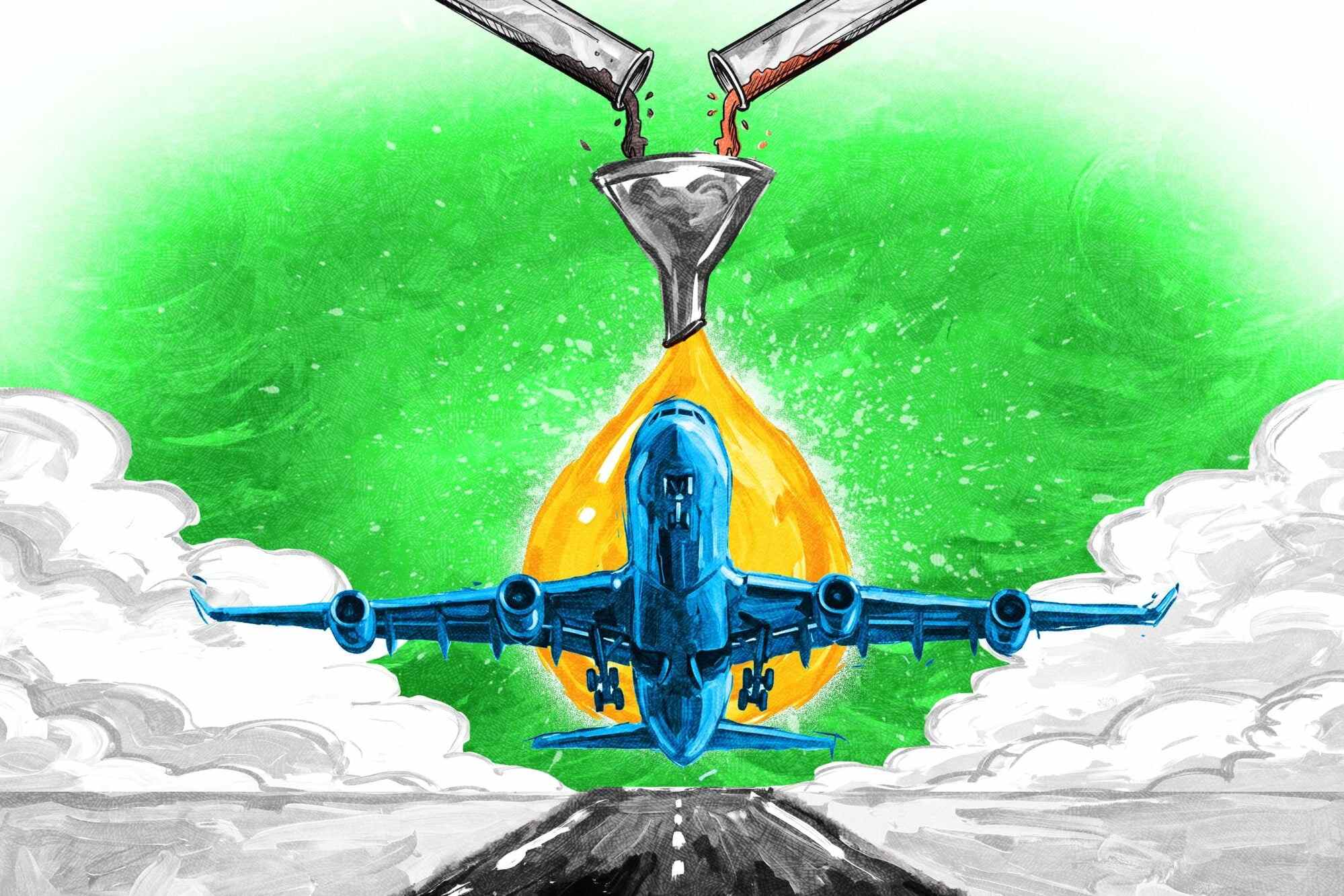
The illustration depicts liquid being poured from two tubes into a jet through a funnel. This visually represents how SAF can be blended with traditional jet fuel. The transformation of feedstock into SAF is symbolised by a golden liquid droplet, emphasising SAF’s highly refined, clean nature as a viable substitute for conventional fuels. The green background further underscores the eco-friendliness of this initiative, reflecting the aviation industry’s commitment to reducing carbon emissions. (accept all reasonable answers)
-
While adopting SAF can help reduce carbon emissions, it does not eliminate them entirely. Since SAF is often blended with fossil jet fuel, flights are still burning a certain amount of fossil fuel, which continues to generate carbon emissions. (accept all reasonable answers)
Issue
-
The Hong Kong government is taking several measures to achieve the SAF target, including studying a mandatory SAF consumption mechanism, launching targeted publicity and educational campaigns, and developing a local blending facility, which is expected to start operations by 2030. Additionally, the government is facilitating the establishment of EcoCeres’ SAF production base in Dongguan, which will produce 450,000 tonnes of SAF annually from 2030. (accept all reasonable answers)
-
An end-to-end regional supply chain for SAF in the Greater Bay Area is being established through several initiatives. The process will start in Dongguan, where EcoCeres collects used cooking oil from nearby cities and pre-processes it. This facility will produce SAF and renewable diesel by 2030. In Hong Kong, the blending of neat SAF with conventional jet fuel will take place, alongside research and development activities. This integrated approach ensures a streamlined supply chain, from production to final consumption. (accept all reasonable answers)
-
The green levy mechanism distributes financial responsibility among international travellers rather than burdening domestic carriers alone. This broader approach ensures that everyone contributes to the costs associated with green initiatives. Additionally, mandating the levy guarantees price transparency, enabling clear calculations of how the funds will be allocated to green fuel projects. A notable example of this successful implementation is Singapore, which demonstrates the positive impact of such a mechanism. (accept all reasonable answers)
Chart
-
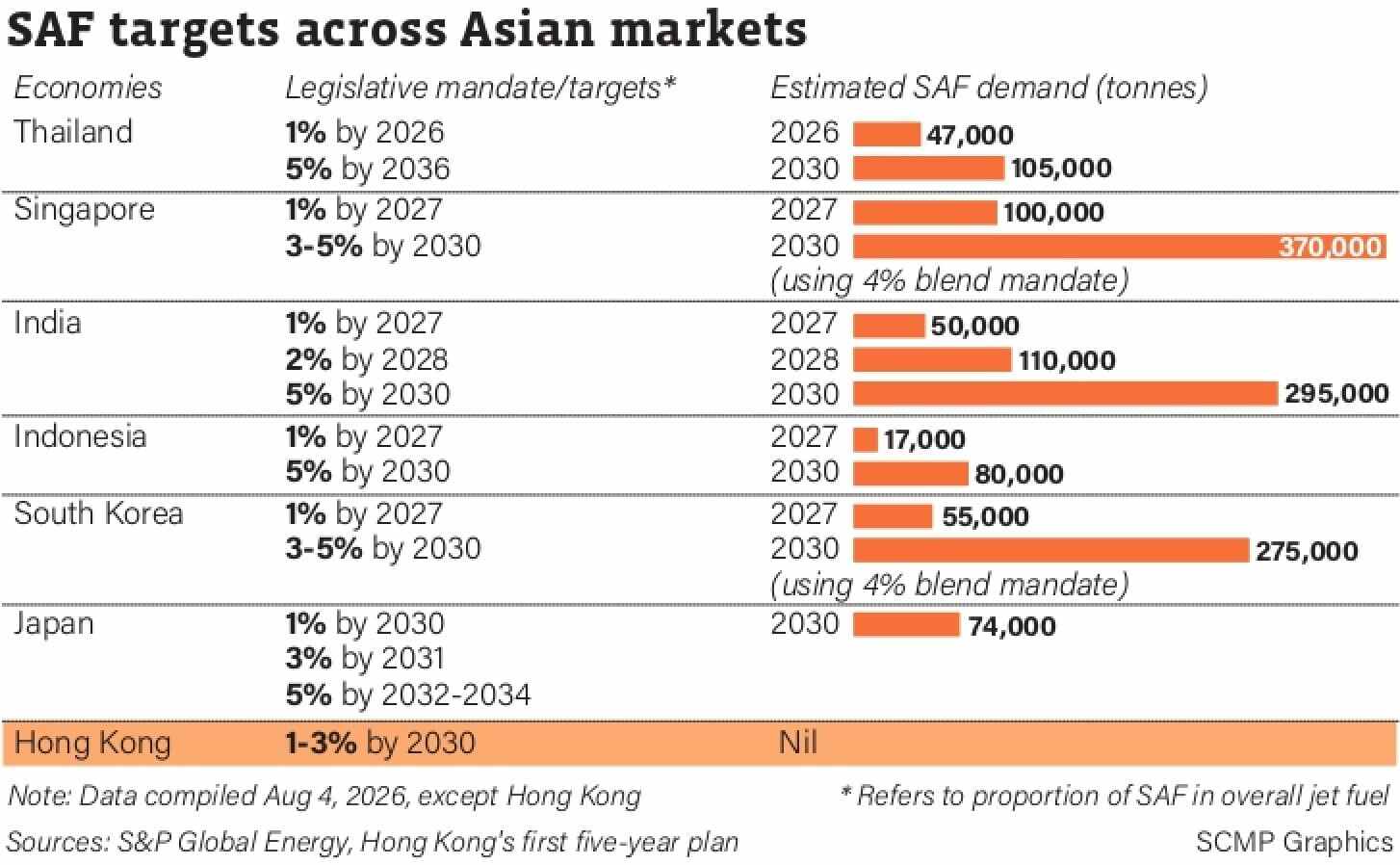
Singapore and South Korea have set ambitious targets, aiming for up to 5 per cent by 2030. In contrast, Hong Kong has a more modest goal of 1 to 3 per cent by that same year. According to projections, Singapore and India will have the highest demands for SAF by 2030, with estimates of 370,000 tonnes and 295,000 tonnes respectively.
-
Different places have varying timelines and percentages for their green fuel goals, as their economic situations and attitudes towards sustainable energy differ. In the European Union, penalties are imposed on fuel suppliers, while in Singapore, consumers are responsible for paying these costs. Each local government needs to determine whether the financial burden should fall on consumers or corporations based on their specific needs.