Content provided by British Council
[1] A sample – obtained by Nasa’s Perseverance rover – of rock formed billions of years ago contains potential signs of ancient microbial life on Mars, according to scientists. But the minerals spotted in the sample also can form through nonbiological processes. The discovery, detailed in research published last month, represents strong evidence about the possibility that Earth’s planetary neighbour once harboured life.
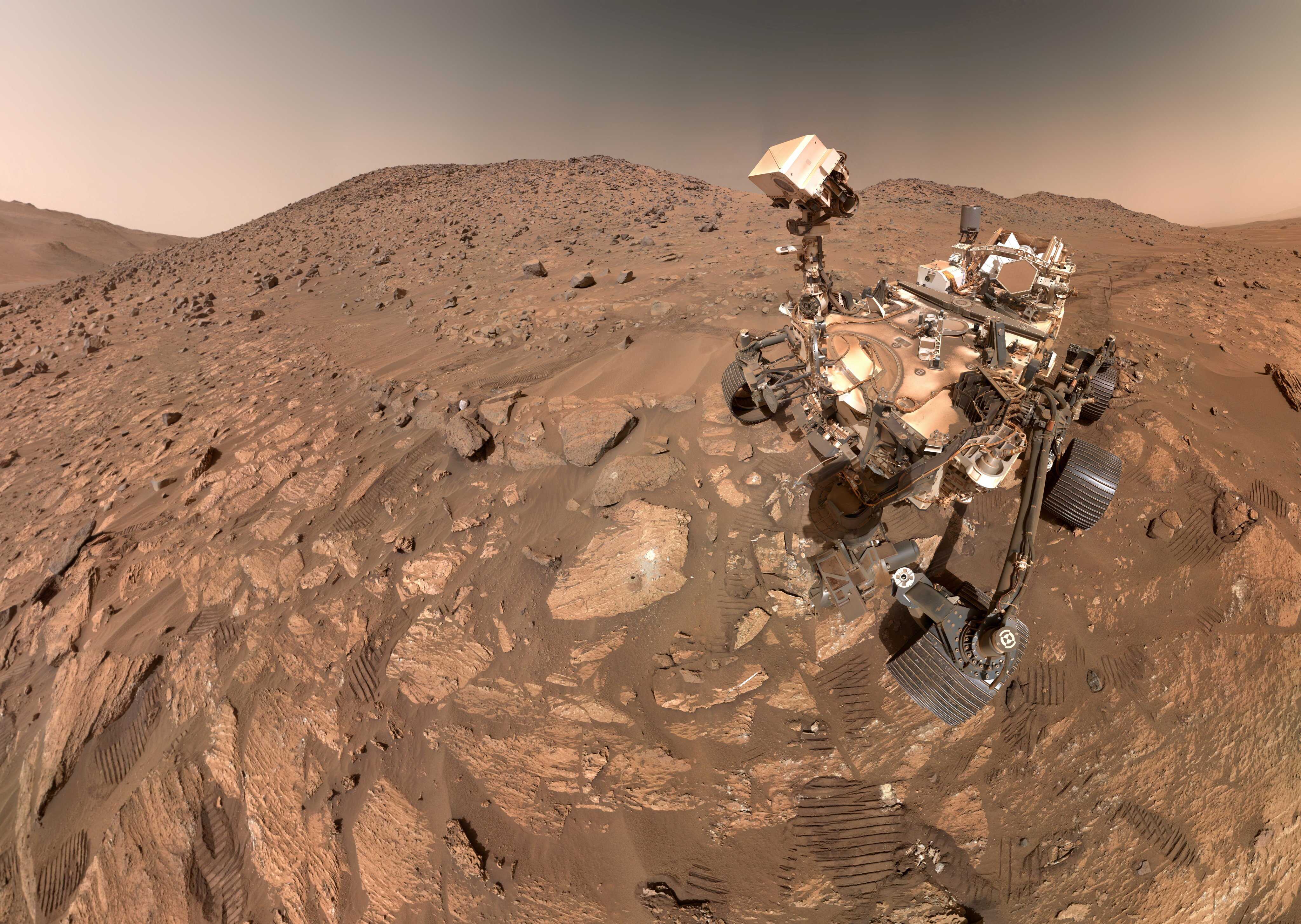
[2] Since landing on the Martian surface in 2021, the six-wheeled rover has been seeking signs of ancient life as it explores Jezero Crater, an area in the planet’s northern hemisphere that once was home to an ancient lake basin. Perseverance has been collecting samples of rock and loose material called regolith and analysing them with its various on-board instruments.
[3] The rover obtained the newly described sample, called the Sapphire Canyon sample, in a place called the Bright Angel rock formation. This formation consists of fine-grained mudstones and coarse-grained conglomerates, a kind of sedimentary rock composed of gravel-sized particles cemented together by finer-grained sediments. Stony Brook University planetary scientist Joel Hurowitz, who led the study published in the journal Nature, said that a “potential biosignature” was detected in these multi-billion-year-old sedimentary rocks.
[4] This came in the form of two minerals that appeared to have formed as a result of chemical reactions between the mud of the Bright Angel formation and organic matter also present in that mud, Hurowitz said. They are: vivianite – an iron phosphate mineral – and greigite, an iron sulphide mineral. “These reactions appear to have taken place shortly after the mud was deposited on the lake bottom. On Earth, reactions like these, which combine organic matter and chemical compounds in mud to form new minerals like vivianite and greigite, are often driven by the activity of microbes,” Hurowitz said. “The microbes are consuming the organic matter in these settings and producing these new minerals as a by-product of their metabolism.”
[5] But Hurowitz offered some words of caution. “The reason, however, that we cannot claim this is more than a potential biosignature is that there are chemical processes that can cause similar reactions in the absence of biology, and we cannot rule those processes out completely on the basis of rover data alone,” he said.
[6] Mars has not always been the inhospitable place it is today; its surface had liquid water in the distant past. Scientists have suspected that microbial life once could have lived in Jezero Crater. They believe river channels spilled over the crater wall and created a lake more than 3.5 billion years ago. The Sapphire Canyon sample was collected in July 2024 from a set of rocky outcrops on the edges of Neretva Vallis, an ancient river valley carved by water rushing into Jezero Crater.
[7] The sample collected by Perseverance provides a new example of a type of potential biosignature that the research community can explore to try to understand if these features were formed by life, Hurowitz said, “or alternatively, whether nature has conspired to present features that mimic the activity of life.”
Source: Reuters, September 10