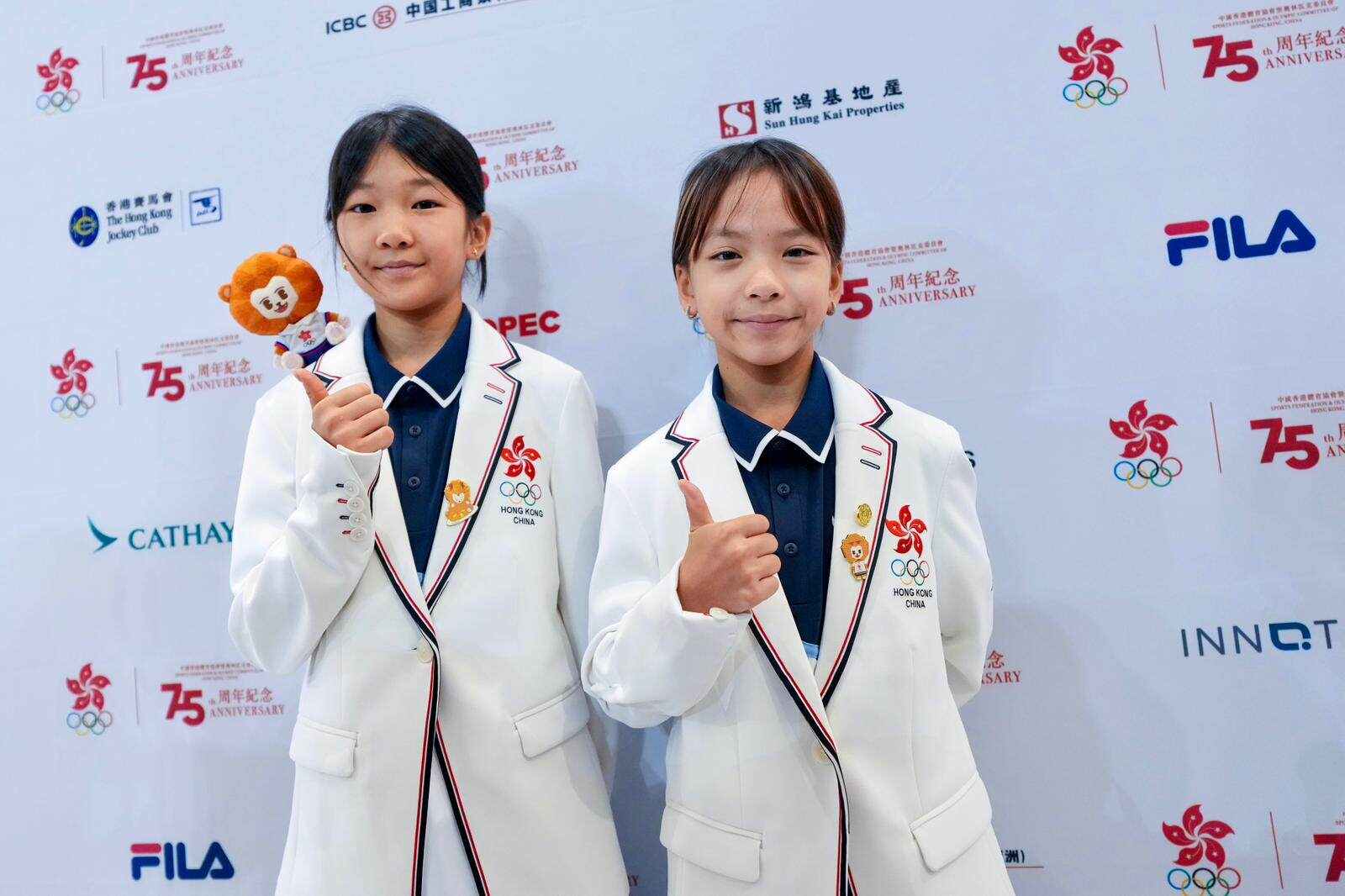
In a skateboard team where the oldest member is merely 16, Katniss Wong Yi-huen and Kamus Wong Yeuk-ching stand out as the youngest competitors in the city’s Asian Games delegation, which consists of 580 athletes participating in 38 different sports.
And while Kamus Wong is already 12 years old, her teammate could end up celebrating her 12th birthday at the Games’ opening ceremony at Paloma Mizuho Stadium in Nagoya on September 19.
“I started skateboarding about two years ago after I came across it while watching those reels on Instagram, and then a friend of mine introduced me to the sport,” Katniss Wong said.
“Participating in the Asian Games feels like a huge matter for me. I am quite nervous but excited at the same time; I’ll keep working hard.
“Of course, I’d like to win a gold medal in some tournaments going forward, but for now, it’s just about doing the best I can, and performing the tricks and techniques I’ve learned.”
A pupil at the ESF South Island School, Katniss Wong finished seventh in the Asian Championship final in April and also took part in the World Skateboarding Tour World Cup in Rome in June.
The youngster wants to follow in the footsteps of skateboarding idols, Olympic medallists Sky Brown and Arisa Trew, and also compete at the Olympics, with her first opportunity coming in Los Angeles in two years.
“I wish to train and compete in different places to learn as much and try as hard as I can, and compete in more tournaments worldwide,” the 11-year-old said.
“I think the happiest thing about skateboarding was when you mastered some new tricks; it could be difficult when you couldn’t do something, and you would be unhappy. But it’s about keeping trying and keeping going, and you’ll get better eventually, just like me!”
Kamus Wong, meanwhile, who finished a place below her teammate in the regional championship, is not the first skateboarder in her family.
“We used to ski as a family, but the global pandemic locked down everything,” Dio Wong, her father, said. “So my wife and I started skateboarding, and before we knew it, our daughter also started.
“She started around six years ago, but has been practising more seriously over the past two years.”
A student at Baptist University Affiliated School Wong Kam Fai Secondary and Primary School, Kamus Wong said skiing and skateboarding “felt alike”, and the most difficult part of her practice was to “link all my moves together”.
Her father added his daughter’s school has been “very supportive” and she had been granted some extra off days to practise and compete at the Games.
“She will practise at some state-level facility in Nanjing before the Asian Games, and will only start her new school year afterwards,” he said.
Apart from the two youngest delegation members, Yuna Wan Hiu-yin, Li Pak-lam and Gu Jiahuan, who are between 13 and 16 years old, will make their Asian Games debuts, and coach Cheung Hang-tat said the newest generation of athletes could be the future of the sport in the city.
“Our athletes are really young; some of them – Wan, Li and Gu – will head to Paraguay for the WSG Park Skateboarding World Championship immediately after the Games,” he said. “I believe we’re developing in a positive direction.
“A golden age for skateboarding would be 14 to 20 years old. We have a lot of moves coming off the stairs, the bowl or the half-pipe, so athletes are prone to falling and we need to have a strong physique. Also, when we’re younger, our centre of gravity is lower, making it easier for us to absorb the force.”
For the first time, Hong Kong is also sending teams to the Games in modern pentathlon, wrestling, rhythmic gymnastics and padel.
Pentathletes Shum Chun-hei and Liu Hei-yu said they grew up swimming and started devoting time thinking the sport was “new and interesting”.
Shum, 16, said modern pentathlon had “taught me a lot” since he started about two years ago.
“It’s quite fun and enjoyable as it contains some different sports,” he said. “Most importantly, it taught me to look at different things with a calm and open mind.
“For example, even if you didn’t perform well in one event, you still have a chance to catch up, so you won’t be so negative.”
Diocesan Girls’ School pupil Liu said practising for the five events – fencing, an obstacle discipline, swimming and the combined laser-run – was a “great test” for her both physically and mentally.
As for wrestler Isaac Wong Ching-shing, he believed his sport, which featured at the first modern Olympics in 1896 and the second Asian Games in 1954, was “definitely the toughest one” of all.
“I was really interested in combat sports to start with, and then I decided to take one sport seriously; it’s been four years since I’ve been doing this,” said the 18-year-old, who will compete in the men’s freestyle 57kg category on the penultimate day of the Nagoya Games.
“I think wrestling is the toughest sport of all. It’s really challenging because it’s a six-minute sprint compared to other sports.”
A participant at the recent under-20 World Championships in Slovakia and the under-23 Asian Championships in Vietnam, Wong said wrestling was still developing in Hong Kong.
“It’s our first Games, and we might not be that strong compared to other countries, but we’re growing,” he said. “I’m more focused on my performance, knowing that if I can do that, I can get good results.”